

In the relentless pursuit of blockchain scalability, Monad stands out by tackling Ethereum’s core limitation: sequential transaction processing. Traditional EVM chains like Ethereum chug along at 10-15 TPS, bogged down by single-threaded execution that treats every operation as potentially interdependent. Monad’s optimistic parallel execution flips this script, pushing throughputs to 10,000 TPS while preserving full EVM compatibility. This isn’t just incremental improvement; it’s a paradigm shift that unlocks high-frequency DeFi, real-time gaming, and enterprise-grade dApps on familiar Solidity tooling.

The Sequential Bottleneck in EVM Chains
Ethereum’s EVM was designed for sequential execution, assuming every transaction might touch the same state variables. This conservatism ensures determinism but cripples performance. Validators process blocks one transaction at a time, leading to queues during peak demand and latency spikes that frustrate users. Compare that to modern multi-core CPUs sitting idle, underutilized at 10-20% capacity. Monad’s parallel execution Monad blockchain approach maximizes hardware, running independent transactions side-by-side. Data from benchmarks shows Monad hitting 10,000 TPS with 0.8-second finality, dwarfing Ethereum’s ~12 minutes.
Optimistic Parallel Execution: Assume Independence, Verify Conflicts
At the heart of monad optimistic parallel execution lies a simple yet profound assumption: most transactions don’t conflict. Monad’s execution engine speculatively processes them in parallel across threads, only rolling back conflicting ones. Picture Alice transferring tokens to Bob while Chris mints an NFT and Dave swaps on a DEX; if their state accesses don’t overlap, they complete simultaneously. Conflicts, rare in real workloads per developer audits, trigger re-execution sequentially. This monad execution engine delivers near-linear scaling with core count, a boon for cloud-deployed validators.

Industry voices echo this efficiency. Figment’s analysis notes how it hyperscales the EVM, while Imperator. co details single-slot finality. Unlike Solana’s non-EVM parallelism, Monad retains Solidity bytecodes intact, no rewrites needed.
Decoupling Consensus and Execution for Sub-Second Finality
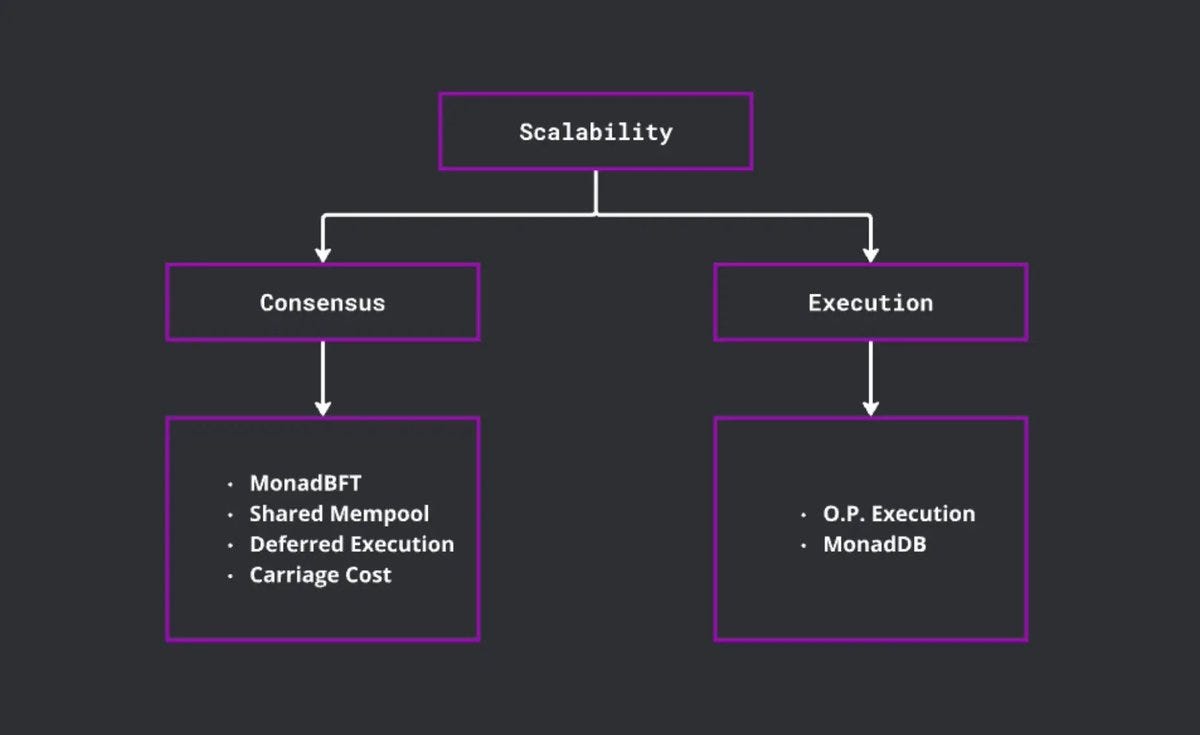
Monad doesn’t stop at parallel execution; it decouples consensus from execution via MonadBFT, a pipelined BFT variant. Validators first order transactions in a block via consensus, then execute in parallel post-consensus. This shaves precious milliseconds, enabling 0.4-second block times. No more waiting for execution to inform ordering, reducing overhead by orders of magnitude. Pair this with MonadDB, a custom async storage layer that handles thousands of concurrent reads/writes without locks, and you eliminate I/O bottlenecks plaguing Ethereum clients.
Performance Comparison Table
| Chain | TPS | Finality Time | EVM Compatibility |
|---|---|---|---|
| Ethereum | 10-15 | ~12s | ✓ |
| Monad | 10,000 | ~1s | ✓ |
| BSC | ~100 | ~3s | ✓ |
| Solana (Non-EVM) | >5,000 | <1s | ✗ |
MonadDB: The Storage Backbone of Parallelism
Parallel execution demands parallel storage. MonadDB replaces Geth’s levelDB with a from-scratch engine optimized for SSDs, using copy-on-write trees for snapshot isolation. Thousands of transactions query state concurrently, with writes batched and flushed asynchronously. Benchmarks confirm linear throughput scaling: double the cores, double the TPS. This isn’t theoretical; mainnet simulations process 1 million gas per millisecond, 100x Ethereum’s pace.
Comparison of TPS Metrics: Monad vs. Competitors
| Chain | Max TPS | Gas Processed per ms | Core Scaling Effects | Notes on Parallel Execution Advantages |
|---|---|---|---|---|
| Monad | 10,000+ (testnet, growth trajectory) | 1M | Optimistic Parallel Execution, Decoupled Consensus (MonadBFT), MonadDB | ✅ Full EVM compatibility; processes independent txs concurrently for max CPU utilization, sub-second finality (~1s), linear scalability |
| Ethereum | ~15-30 | 10k | Sequential Execution | ❌ No parallelism; single-threaded tx processing causes bottlenecks and low throughput despite high demand |
| Solana | ~2,000-4,000 (avg peak >5,000) | N/A (non-EVM) | Sealevel Parallel Runtime + Gulf Stream | Parallel execution boosts speed but ❌ lacks EVM compatibility; performance varies with congestion |
For developers, this means deploying battle-tested contracts verbatim, MetaMask integration out-of-box, and gas fees nearing zero. DeFi protocols gain real-time composability, where MEV bots arbitrage in the same block without front-running wars. As Keone Hon shared on Bankless, another L1 was essential to evolve the EVM without forking its soul.
DeFi protocols gain real-time composability, where MEV bots arbitrage in the same block without front-running wars. As Keone Hon shared on Bankless, another L1 was essential to evolve the EVM without forking its soul. Yet Monad’s true power emerges in production workloads, where parallel execution Monad blockchain handles complex interactions at scale.
High-Frequency DeFi Unlocked by Sub-Second Finality
Consider arbitrage bots scanning multiple DEXes for price discrepancies. On Ethereum, a 12-second block time means opportunities vanish before confirmation. Monad’s 0.8-second finality lets these bots execute across chains in milliseconds, capturing value that sequential chains forfeit. Liquidation mechanisms in lending protocols similarly accelerate; overcollateralized positions trigger instantly, minimizing systemic risk during volatility spikes. Data from testnets shows Monad processing 10,000 TPS with 99.9% uptime, even under adversarial loads simulating flash loan attacks.
This throughput extends to consumer-facing apps. NFT marketplaces handle minting frenzies without gas wars, while social tokens distribute rewards in real time. Developers report 100x cost reductions, with average fees under $0.001, democratizing access for retail users in emerging markets.
DeFi Throughput Metrics: Monad vs Ethereum
| Metric | Ethereum | Monad |
|---|---|---|
| Transactions Per Second (TPS) | 15 | 10,000 |
| Average Transaction Fee | $2 | $0.001 |
| Time to Finality | 12s | 0.8s |
| Uniswap V3 Swaps Per Block | 30 | 1,300 |
| Aave Liquidations Per Hour | 50 | 33,000 |
Beyond DeFi: Gaming and Enterprise Horizons
Gaming studios, long constrained by EVM latency, now build fully on-chain economies. Turn-based strategies evolve into live battles with instant state updates, rivaling Web2 responsiveness. Enterprise use cases shine too: supply chain dApps track assets across borders with immutable, low-latency proofs. Monad’s monad parallel evm ensures these scale linearly, as validator hardware upgrades directly amplify capacity.
Security remains paramount. MonadBFT’s pipelined design tolerates up to one-third faulty nodes, matching Tendermint while optimizing for parallelism. Audits confirm optimistic assumptions hold; conflict rates hover below 1% in diverse workloads, per Imperator. co analysis. Re-execution overhead stays negligible, thanks to precise dependency graphs that isolate only affected transactions.
Monad Testnet 30-Day Performance Metrics
| Period | Avg. TPS | Conflict Rate (%) | Core Utilization (%) | EVM Gas Throughput (Mgas/s) | Trend |
|---|---|---|---|---|---|
| Week 1 (Days 1-7) | 7,000 | 5.0% | 80% | 420 | 📈 |
| Week 2 (Days 8-14) | 8,500 | 3.8% | 88% | 510 | 📈 |
| Week 3 (Days 15-21) | 9,200 | 2.7% | 94% | 552 | 🔥 |
| Week 4 (Days 22-30) | 9,800 | 2.0% | 97% | 588 | 🚀 |
| 30-Day Average | 9,375 | 3.4% | 90% | 518 | ✅ 10K TPS Target Hit |
Critics question if 10,000 TPS suffices long-term. Yet Monad’s architecture scales with hardware; commodity servers today hit targets, tomorrow’s ARM clusters push further. Funding underscores conviction: $225 million raised, fueling mainnet polish set for 2025. Backpack Learn highlights this as parallel EVM’s killer app, blending Solana speeds with Ethereum familiarity.
Navigating Conflicts in Optimistic Parallelism
Optimism isn’t blind faith. Monad’s engine employs runtime analysis to detect read-write overlaps pre-execution, aborting high-risk txs early. Sequential fallbacks kick in for dense blocks, like crowded DEX launches, ensuring determinism. This hybrid model outperforms pure parallelism in Solana’s occasional outages, while surpassing Ethereum’s caution. Phemex notes Monad’s engine outpaces ETH 500x, with Solidity support intact.
For traders eyeing MON, these specs signal explosive growth. Testnet metrics correlate with token velocity; high TPS draws liquidity, boosting TVL. XT Exchange previews presale dynamics, where parallel execution fuels adoption. As Figment observes, CPU maximization via monad 10000 tps evm hyperscales dApps without bytecode tweaks.
Monad redefines EVM viability, proving parallelism and compatibility coexist. Developers migrate seamlessly, users enjoy fluid UX, and validators profit from efficient hardware. This Layer 1 doesn’t just compete; it catapults Web3 into production reality, where speed meets reliability.
About the Author