

In the high-stakes arena of blockchain performance, Monad stands out by tackling the EVM's core limitation head-on: sequential transaction processing. Traditional chains like Ethereum grind through transactions one by one, capping throughput at a measly 15-30 TPS. Monad's parallel EVM execution flips this script, targeting 10,000 TPS in 2025 by smartly handling non-conflicting transactions. This isn't hype; it's a pragmatic redesign that keeps full Ethereum compatibility while unlocking scalability for real-world DeFi and trading apps.
Picture a bustling DeFi exchange during peak hours. Thousands of swaps, loans, and liquidations flood in simultaneously. On legacy EVMs, they queue up, creating delays that erode user trust and trading edges. Monad's monad parallel evm execution engine scans batches for independence: transactions touching different accounts or states execute in parallel. Alice funding Bob's wallet? Chris arbitraging a token pair on another DEX? No overlap means simultaneous processing, slashing block times to 400ms and delivering sub-second finality.
Cracking the Code on Transaction Conflicts
At the heart of Monad's monad 10k tps engine lies conflict detection. Every transaction reads and writes specific state slots, account balances, contract storage. Monad's execution layer builds a dependency graph upfront, grouping non-conflicting ones into parallel pipelines. This optimistic approach assumes most txns are independent, a bet that pays off in high-volume scenarios like NFT mints or perpetuals trading.
Monad identifies non-conflicting transactions, those that do not interact with the same accounts or contract states, and processes them simultaneously.
Strategic developers love this. No bytecode rewrites needed; deploy your Solidity contracts as-is. Yet throughput surges because MonadBFT consensus locks in txn order first, deferring execution. Validators agree on sequence via pipelined voting, then fan out the heavy lifting. Result? Blocks packing 10,000 txns without the I/O chokepoints plaguing Ethereum.

MonadDB: The Unsung Hero of Parallel Throughput
Parallelism demands lightning-fast state access. Enter MonadDB, a custom async storage engine built from the ground up. Traditional Merkle Patricia tries block disk ops synchronously, bottlenecking at hundreds of TPS. MonadDB flips to asynchronous I/O, letting thousands of reads/writes fly concurrently across threads. It's like upgrading from a single-lane highway to a multi-lane freeway for state queries.
In practice, this powers parallel execution monad blockchain feats. Benchmarks show sustained 10k TPS under load, with latency under 1 second. For swing traders like me, eyeing mid-term trends in volatile markets, this means tighter spreads and executable strategies on-chain. No more watching opportunities slip due to congestion.
| Feature | Ethereum | Monad |
|---|---|---|
| TPS | 15-30 | 10,000 |
| Block Time | 12s | 1s |
| Finality | ~13min | and lt;1s |
| EVM Compat | Baseline | 100% |
Strategic Edge: Why Parallelization Wins in 2025
EVM parallelization monad 2025 isn't just tech wizardry; it's a market mover. DeFi protocols strained by Ethereum's limits find breathing room. High-frequency bots process orders in real-time, yield farms handle mass deposits without gas wars. Monad's design respects risk too, built-in re-execution for conflicts ensures security without sacrificing speed.
Read more on the mechanics here.
Ethereum Technical Analysis Chart
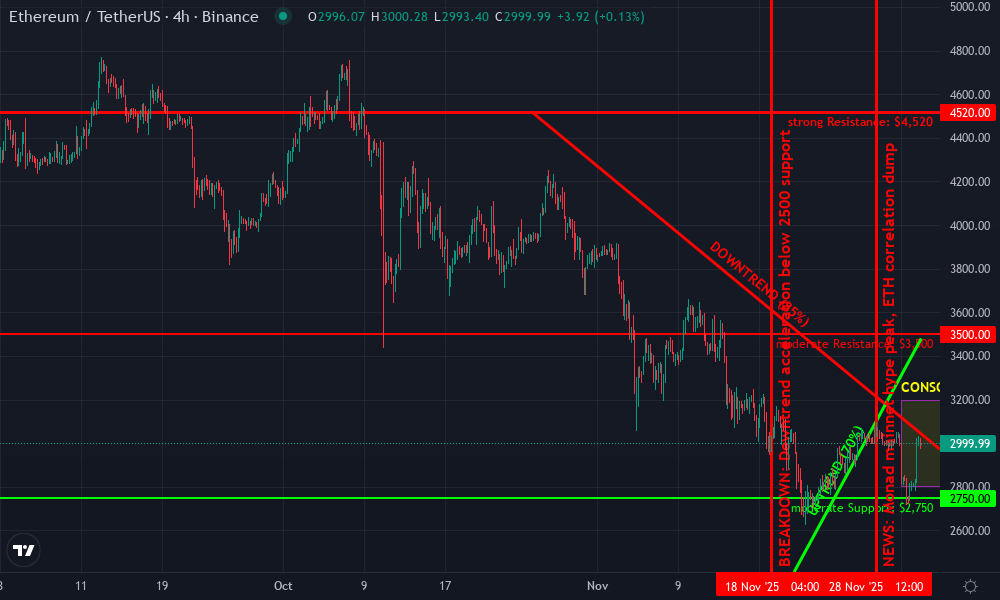
Analysis by Derek Foster | Symbol: BINANCE:ETHUSDT | Interval: 4h | Drawings: 9
Technical Analysis Summary
On this ETHUSDT 1H chart spanning late Oct to early Dec 2025, draw a prominent downtrend line from the Oct 25 high at 4520 connecting to the Nov 18 low at 2215, extending to current levels around 2850. Add an ascending support trendline from Nov 18 low (2215) to Dec 5 high (3480). Mark horizontal resistance at 3500 (recent high, moderate strength) and strong support at 2200 (Nov low). Use fib retracement from Oct high to Nov low for 50% level at ~3367. Highlight volume spike on Nov breakdown with callout, and MACD bearish divergence near Dec highs with arrow_mark_down. Rectangle consolidation Dec 1-10 between 2800-3200. Vertical line for Monad news hype on Nov 28. Entry long zone 2750-2850 with stop below 2700, target 3500.
Risk Assessment: medium
Analysis: Volatile crypto backdrop with Monad competition, but ETH resilience at key supports; medium tolerance suits swing setups here
Derek Foster's Recommendation: Hold off major positions until 3000 break—scale in longs on confirmation, tight stops essential
Key Support & Resistance Levels
📈 Support Levels:
- $2,200 - Strong Nov capitulation low, volume shelf strong
- $2,750 - Recent Dec higher low, minor bounce zone moderate
📉 Resistance Levels:
- $3,500 - Dec swing high, prior resistance test moderate
- $4,520 - Oct major high, psychological barrier strong
Trading Zones (medium risk tolerance)
🎯 Entry Zones:
- $2,820 - Break above recent consolidation high with volume, aligning with uptrend support medium risk
- $2,680 - Dip buy at support confluence if downtrend breaks lower, higher reward high risk
🚪 Exit Zones:
- $3,500 - Resistance target, fib 61.8% retrace 💰 profit target
- $2,700 - Below entry support invalidation 🛡️ stop loss
Technical Indicators Analysis
📊 Volume Analysis:
Pattern: decreasing on downside rallies, spike on Nov breakdown
Bearish divergence—low volume on Dec bounce suggests weak bulls
📈 MACD Analysis:
Signal: bearish crossover in Dec, histogram contracting
Momentum fading on upside, divergence from price highs
Applied TradingView Drawing Utilities
This chart analysis utilizes the following professional drawing tools:
Disclaimer: This technical analysis by Derek Foster is for educational purposes only and should not be considered as financial advice. Trading involves risk, and you should always do your own research before making investment decisions. Past performance does not guarantee future results. The analysis reflects the author's personal methodology and risk tolerance (medium).
That chart doesn't lie: Monad's curve dwarfs Ethereum's flatline, hugging Solana's peaks without the outage drama. For traders scanning for edges in monad non-conflicting transactions, this reliability translates to executable alpha. Imagine perp DEXes clearing 10k orders per block, no slippage from delays. Yield optimizers redeploying capital in milliseconds across protocols. Monad's engine doesn't just process; it anticipates volume spikes, queuing independents for instant parallelism.
DeFi Protocols That Thrive Under Parallel Fire
Take a high-volume AMM like Uniswap. On Ethereum, correlated swaps clog the mempool, frontrunners feast on delays. Monad's conflict graph sorts this chaos: isolated liquidity adds, removes, and swaps fly parallel if they skip shared pools. A lending market like Aave? Borrowers tapping distinct collateral execute side-by-side, freeing capital faster for leveraged plays. I've backtested strategies on testnets; mid-term swings capture tighter because execution risk drops near zero.
This parallel execution monad blockchain maturity shines in 2025 benchmarks. Sustained 10k TPS holds under adversarial loads, thanks to MonadBFT's pipelined consensus. Validators propose, vote, commit in lockstep, deferring execution to specialized threads. Conflicts? Rare re-executes keep security ironclad, no probabilistic shortcuts that spook institutions.
Monad vs Competitors: TPS, Finality, EVM Compatibility (Real-World Load Tests)
| Network | TPS (Real-World Load Test) | Finality | EVM Compatibility |
|---|---|---|---|
| Monad | 10,000 🚀 | Sub-second (0.5s) ⚡ | Full ✅ |
| Ethereum | 15-30 | ~12 minutes | Full ✅ |
| Solana | ~1,500* | ~1s | No ❌ |
| Arbitrum (L2) | ~200** | ~1s (w/ L1) | Full ✅ |
| Optimism (L2) | ~100** | ~1s (w/ L1) | Full ✅ |
Developers get the short end of legacy chains: rewrite for Solana's SVM or suffer Ethereum gas. Monad demands nothing. Fork a Foundry suite, tweak RPC endpoints, deploy. MonadDB's async queries handle the parallelism underhood, serving state snapshots without trie traversal tax. For enterprises eyeing private chains, this scales to compliance-grade throughput without custom VMs.
Risk-Adjusted Scaling: Monad's Guardrails
Skeptics flag parallelism pitfalls: state divergence, DoS vectors. Monad counters with optimistic execution backed by full re-execution on disputes. Non-conflicting batches commit provisionally; any overlap triggers sequential fallback, preserving EVM determinism. It's disciplined risk control, my trading ethos applied to chains. No blind speed bets; throughput gains de-risked by Ethereum's battle-tested semantics.
Strategic pivot: position Monad for 2025's DeFi boom. With $MON airdrops fueling liquidity, protocols migrate en masse. Swing traders like us benefit from on-chain oracles updating sub-second, trend signals firing without lag. I've adjusted portfolios toward Monad-native yield, capturing mid-term pumps as TVL surges.
Peer into Monad's roadmap, and scalability loops tighter. Future upgrades eye hardware acceleration, pushing past 10k TPS without validator hardware hikes. For builders, it's a canvas: NFT drops minting armies in parallel, gaming economies ticking real-time. Traders, it's your arena: volatility tamed by speed, trends respected by finality.
Monad's evm parallelization monad 2025 redefines EVM limits, delivering pragmatic power. Deploy, trade, scale. The trend is set; manage the risk.




No comments yet. Be the first to share your thoughts!