
In the relentless pursuit of blockchain scalability, Monad stands out by reimagining how we execute transactions on an EVM-compatible chain. Traditional networks grind through transactions one by one, creating bottlenecks that cap throughput at mere dozens of transactions per second. Enter Monad's custom parallel execution engine: a engineering marvel that propels this high-performance EVM chain to a staggering 10,000 TPS while preserving every ounce of Ethereum compatibility. This isn't just incremental improvement; it's a paradigm shift for developers building the next wave of DeFi, gaming, and social apps on Web3.
Shattering Sequential Limits with Smart Transaction Grouping
Picture this: on Ethereum mainnet, every transaction waits in line, sequentially reading and writing to the same global state. Conflicts arise frequently, stalling progress and inflating latency. Monad's parallel execution flips the script. The engine scans incoming transactions in a block, astutely identifying those that don't touch the same state keys - think non-overlapping DeFi swaps or NFT mints. These independents race ahead in parallel across multiple cores, dramatically slashing execution time.
This Monad EVM parallelization relies on optimistic execution: process in parallel first, then verify for conflicts deterministically. If clashes emerge, only those transactions rewind and retry, minimizing wasted compute. In benchmarks, this delivers 10,000 TPS Monad reality, with 400ms block times and 0.8s finality. Developers get Ethereum tools, auditors, and libraries intact - no bytecode rewrites needed.
Ethereum Technical Analysis Chart
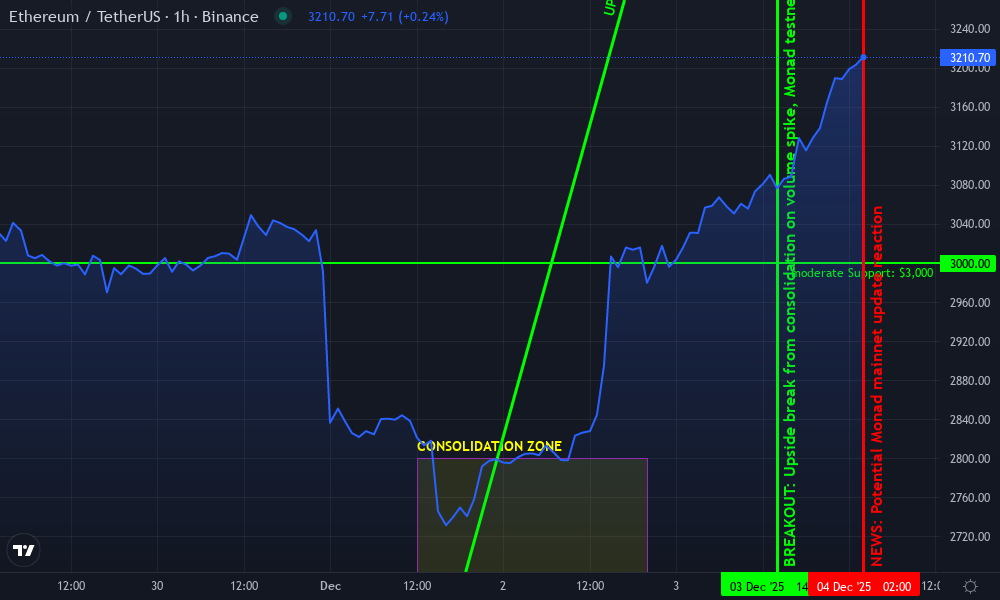
Analysis by Amelia Knox | Symbol: BINANCE:ETHUSDT | Interval: 1h | Drawings: 8
Technical Analysis Summary
To annotate this ETHUSDT 1H chart in my balanced hybrid style, start with a strong uptrend line from the Dec 1 low at 2450 connecting to the Dec 4 high near 4150 using 'trend_line' (blue, thick). Draw horizontal lines at key support 3000 (green) and broken resistance 3800 now support (orange), plus next resistance 4300 (red). Add fib retracement from recent swing low 2950 to high 4150. Mark long entry zone 4000-4050 with 'long_position' icon. Place arrow_mark_up at MACD bullish crossover around Dec 3 14:00. Use callout for volume surge on breakout with 'Increasing volume confirms uptrend strength'. Rectangle for early Dec consolidation 2500-2800. Vertical line at Dec 4 02:00 for potential Monad news catalyst. Text box for risk note: 'Medium risk long, watch 3800 hold'.
Risk Assessment: medium
Analysis: Strong TA setup with fundamental tailwind from Monad EVM scalability, but crypto volatility and overbought potential cap conviction. Medium tolerance fits pullback entry.
Amelia Knox's Recommendation: Long bias with defined risk; scale in on dips to 4000, target 4400. Monitor Monad devnet for confirmation.
Key Support & Resistance Levels
📈 Support Levels:
- $3,000 - Mid-consolidation base, volume shelf moderate
- $3,800 - Broken resistance flip, key hold level strong
- $2,800 - Swing low from Dec 2 weak
📉 Resistance Levels:
- $4,300 - Psych round number + fib 127.2% extension moderate
- $4,500 - Prior ATH projection strong
Trading Zones (medium risk tolerance)
🎯 Entry Zones:
- $4,025 - Pullback to uptrend line + 50% fib retrace in bullish volume medium risk
- $3,850 - Strong support test post-breakout low risk
🚪 Exit Zones:
- $4,400 - Fib 161.8% extension + resistance confluence 💰 profit target
- $3,750 - Below flipped support invalidates setup 🛡️ stop loss
- $4,300 - First resistance take partial profits 💰 profit target
Technical Indicators Analysis
📊 Volume Analysis:
Pattern: bullish surge on breakout
Volume climaxes with price advance from Dec 3, confirming institutional buying amid Monad EVM news
📈 MACD Analysis:
Signal: bullish crossover
MACD line crosses signal from below Dec 3 14:00, histogram expanding positively
Applied TradingView Drawing Utilities
This chart analysis utilizes the following professional drawing tools:
Disclaimer: This technical analysis by Amelia Knox is for educational purposes only and should not be considered as financial advice. Trading involves risk, and you should always do your own research before making investment decisions. Past performance does not guarantee future results. The analysis reflects the author's personal methodology and risk tolerance (medium).
MonadBFT and MonadDB: The Unsung Heroes of the Execution Engine
Parallel execution alone doesn't win the race; Monad layers on specialized infrastructure. MonadBFT, their pipelined BFT consensus, orchestrates validators with hotstuff-inspired efficiency, achieving single-slot finality in under a second. Validators gossip blocks swiftly, ensuring liveness even under network hiccups.
Then there's MonadDB, a from-scratch database tuned for SSDs. It ditches Ethereum's Merkle Patricia tries for a multi-versioned key-value store with asynchronous I/O. State access, the EVM's Achilles heel, now flies at warp speed - reads and writes parallelized, caching hot data in RAM. Combine this with JIT compilation of EVM bytecode to machine code, and you've got a Monad execution engine that's ruthlessly optimized.
Check out this comparison to see why Monad's stack crushes competitors. While Solana sacrifices EVM for speed and Avalanche offers partial compatibility, Monad delivers full Ethereum fidelity at high performance EVM Monad levels.
| Blockchain | TPS (Target) | Finality | EVM Compatibility |
|---|---|---|---|
| Ethereum | 15, 30 | 1, 3 min | Yes |
| Solana | 1,000 and | 12, 15s | No |
| Avalanche | 4,500 | 1, 2s | Partial |
| Monad | 10,000 | 0.8s | Yes |

Real-World Implications for Developers and DeFi Builders
I've audited enough smart contracts to know: scalability without compatibility is a non-starter. Monad's engine lets you port Uniswap or Aave verbatim, then watch gas fees plummet and UX soar. Gaming dApps with real-time interactions? Feasible at last. Enterprise pilots needing Ethereum audits but Solana speeds? Monad bridges that gap.
The public testnet, live since February 2025, proves it: developers are stress-testing Monad parallel execution daily. Internal tests hit 10k TPS cleanly, and with mainnet looming, expect a flood of EVM apps hyperscaled overnight. This isn't hype; it's engineered excellence grounded in research from Keone Hon and team.
Optimistic parallel execution forms the backbone here, allowing the engine to speculate on non-conflicting paths before committing changes. This Monad EVM parallelization technique, combined with precise conflict detection, ensures every block finalizes correctly without sacrificing the EVM's sacred determinism. I've seen lesser attempts falter on edge cases like reentrancy or shared storage slots, but Monad's rigorous verification layer catches them efficiently, keeping invalidations rare and performance steady.
Benchmarks That Speak Louder Than Promises
Numbers don't lie, and Monad's internal tests deliver: a clean 10,000 TPS on full EVM workloads, measured across diverse transaction mixes including DeFi swaps, NFT transfers, and contract deployments. The public testnet, launched February 19,2025, mirrors these results, inviting developers to push limits with real tools like Foundry and Hardhat. Block times clock in at 400ms, finality at 0.8s - metrics that turn theoretical scalability into deployable reality.
Monad vs Competitors: Performance Comparison
| Blockchain | TPS (Target) | Finality Time | EVM Compatibility |
|---|---|---|---|
| Ethereum Mainnet | ~15–30 | ~1–3 minutes | ✅ Full |
| Solana | ~1,000+ | ~12–15 seconds | ❌ None |
| Avalanche | ~4,500 | ~1–2 seconds | ⚠️ Partial |
| **Monad (Target)** | **10,000** | **0.8 seconds** | **✅ Full** |
These aren't cherry-picked peaks; sustained throughput holds under adversarial conditions, thanks to MonadDB's async I/O and SSD optimizations. Validators handle gossip with MonadBFT's pipelined efficiency, resisting latency spikes that plague other chains.
The Road to Mainnet: What Lies Ahead for Builders
Mainnet arrival in 2025 will unlock a torrent of innovation. Imagine Uniswap pools settling in milliseconds, or socialFi apps with instant interactions - all on familiar EVM bytecode. For enterprises wary of Solana's Rust rewrite or Avalanche's subnet silos, Monad offers a seamless lift-and-shift from Ethereum, audited and battle-tested.
Funding firepower underscores commitment: Monad's war chest fuels ecosystem grants, tooling enhancements, and partnerships primed for launch. Early testnet dApps already hint at viral growth, from high-frequency trading bots to onchain games craving low latency. As a DeFi researcher, I'm bullish - this high performance EVM Monad stack redefines what's possible without ecosystem fragmentation.

Security remains paramount. Monad's design inherits Ethereum's battle-hardened opcodes while bolstering them with JIT compilation for 10x faster execution traces. Parallelism introduces no new vectors; audits confirm the engine's robustness against MEV exploits or DoS patterns.
Dive deeper into how optimistic parallelism powers this leap in our dedicated guide on enabling 10,000 TPS. Developers, fire up your nodes on testnet today - the future of scalable EVM is executing in parallel, right now.




No comments yet. Be the first to share your thoughts!