

In the relentless pursuit of blockchain scalability, Monad stands out by rearchitecting the Ethereum Virtual Machine for the high-stakes demands of modern DeFi and enterprise applications. Achieving 10,000 TPS and 500M gas per second on an EVM-compatible chain isn't mere hype; it's the result of a meticulously engineered Monad parallel execution tech stack that balances raw speed with the reliability developers crave. As a risk analyst who's scrutinized countless protocols, I see Monad's approach as a pragmatic evolution, sidestepping the pitfalls of sharding or sidechains while preserving Ethereum's bytecode fidelity.
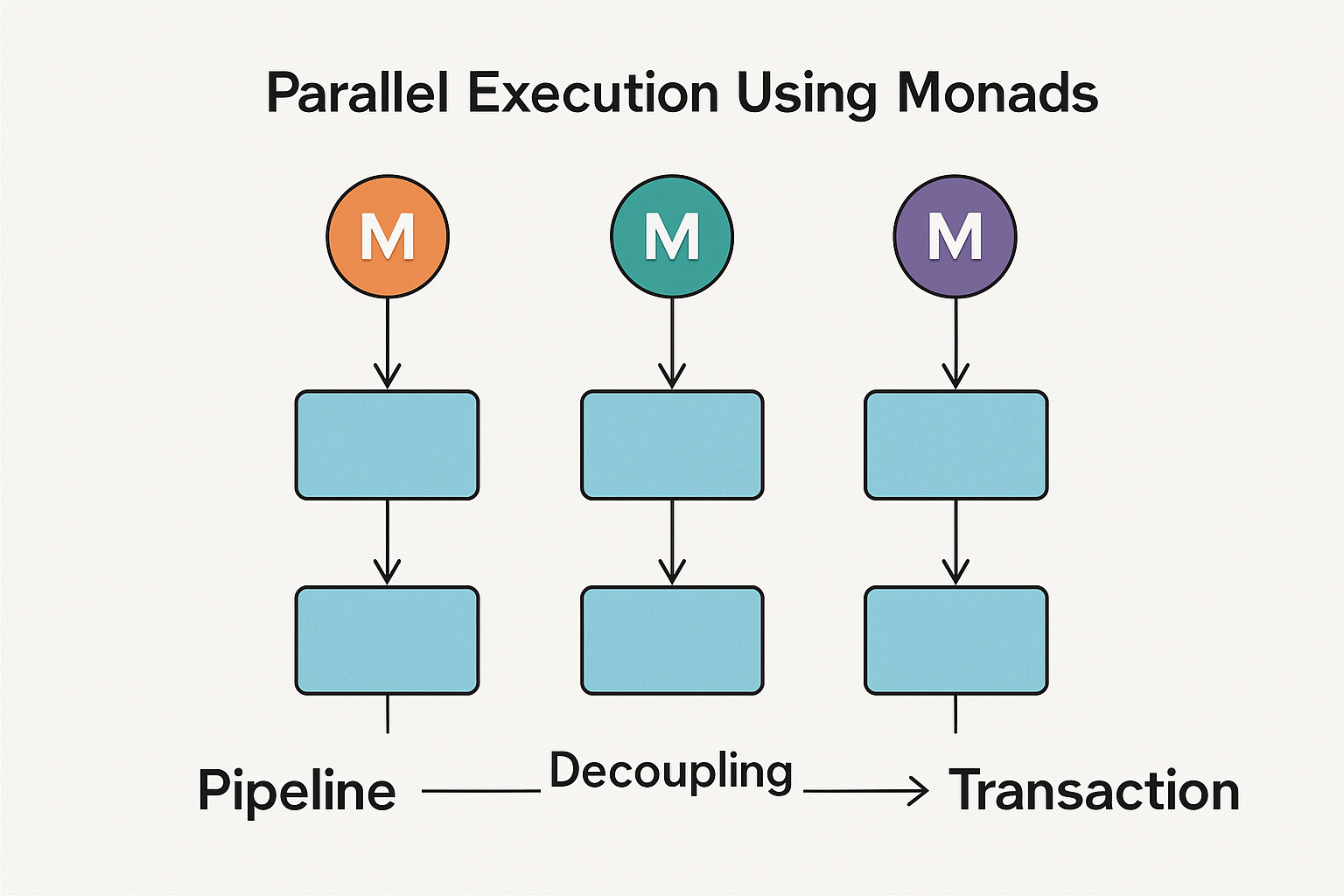
At its heart, Monad's innovation lies in decoupling transaction ordering from execution. Traditional EVM chains like Ethereum process transactions sequentially, creating inherent bottlenecks as each tx awaits the previous one's state updates. Monad flips this script: nodes first agree on a total order via consensus, then execute non-conflicting transactions in parallel. This deferred execution architecture unlocks massive parallelism without introducing reordering risks, a nuance often overlooked in scalability debates. The outcome? Throughput that rivals centralized databases while maintaining decentralized trust.
Parallel Execution Engine: Superscalar Pipelining in Action
The Monad tech stack employs superscalar pipelining, borrowing from CPU design principles to overlap transaction stages, fetch, decode, execute, and write-back. Non-conflicting txs, those not touching the same accounts or storage slots, race ahead concurrently. Conflicts are detected optimistically during execution, with rollbacks handled efficiently to minimize wasted compute. This isn't blind optimism; Monad's runtime meticulously tracks read/write sets, ensuring atomicity akin to Ethereum but at warp speed.
Consider the numbers: Monad 10000 TPS translates to handling DeFi trades, NFT mints, and oracle updates simultaneously, all on Monad EVM compatible smart contracts. Testnet data exceeding 2.44 billion transactions underscores this capability, with gas throughput hitting 500 million per second. Yet, balance demands scrutiny, parallelism shines in diverse workloads but could falter under pathological conflict-heavy scenarios. Monad mitigates this through adaptive scheduling, prioritizing low-conflict batches.

MonadBFT Consensus: Sub-Second Finality Without Compromise
Parallel execution alone doesn't suffice; consensus must keep pace. Enter MonadBFT consensus, a HotStuff-inspired protocol streamlined for high throughput. By reducing communication rounds to two phases, pre-commit and commit, MonadBFT delivers 800ms finality, outpacing Ethereum's probabilistic model. Validators propose blocks with ordered txs, achieving agreement swiftly even under network latency.
This mechanism dovetails seamlessly with deferred execution: ordering finalizes first, execution follows asynchronously per node. Security holds via threshold signatures and slashing for equivocation, maintaining BFT guarantees with just one-third honest validators needed. From a risk perspective, this hybrid pipelining reduces liveness failures compared to naive leader-based systems, though it assumes honest-majority, a standard but non-trivial assumption in adversarial environments.
Ethereum Technical Analysis Chart
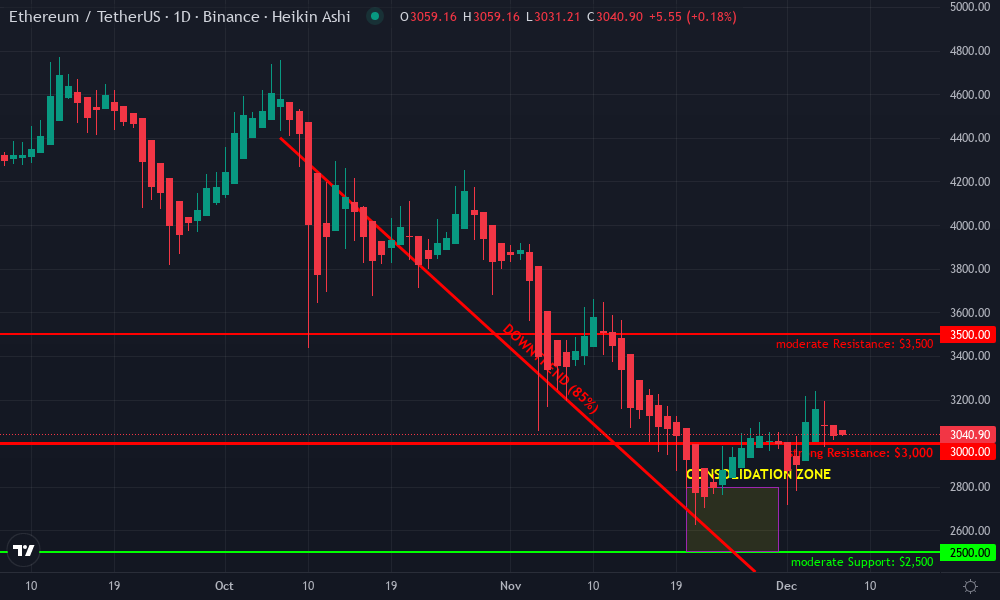
Analysis by Marcus Rowan | Symbol: BINANCE:ETHUSDT | Interval: 1D | Drawings: 6
Technical Analysis Summary
As Marcus Rowan, start by drawing a primary downtrend line connecting the October 2025 high around 4400 USDT on 2025-10-07 to the December low near 2200 USDT on 2025-12-03, using 'trend_line' with downtrend type, confidence 0.85. Add horizontal support at 2200 USDT (strong) and 2500 USDT (moderate), resistance at 3000 USDT (strong) and 3500 USDT (moderate). Mark a consolidation rectangle from 2025-11-20 to 2025-11-30 between 2500-2800 USDT. Use fib_retracement from Oct high to Dec low for potential retracement levels. Place arrow_mark_down at recent breakdown on 2025-12-01. Add callouts for volume divergence and MACD bearish crossover. Finally, draw long_position entry zone at 2450 USDT with stop_loss at 2180 and profit_target at 2950.
Risk Assessment: medium
Analysis: Downtrend intact but oversold near 2200 support; Monad's 10k TPS threatens ETH but could spark rebound on ecosystem adoption. Medium tolerance suits scaled entries with tight stops.
Marcus Rowan's Recommendation: Hedge with ETH puts or wait for 2200 hold before longing; target 3000 on confirmation.
Key Support & Resistance Levels
📈 Support Levels:
- $2,200 - Strong demand zone at recent swing low, high volume capitulation. strong
- $2,500 - Moderate interim support, prior consolidation base. moderate
📉 Resistance Levels:
- $3,000 - Key overhead resistance from Nov highs, seller concentration. strong
- $3,500 - Secondary resistance from late Oct peak. moderate
Trading Zones (medium risk tolerance)
🎯 Entry Zones:
- $2,450 - Bounce from 2500 support with volume pickup, aligning with fib 23.6% retrace. medium risk
🚪 Exit Zones:
- $2,180 - Below strong support invalidates long bias. 🛡️ stop loss
- $2,950 - Profit target at 38.2% fib retrace and resistance confluence. 💰 profit target
Technical Indicators Analysis
📊 Volume Analysis:
Pattern: declining on rallies, spiking on breakdowns
Bearish divergence: low volume on recent green candles suggests weak buying.
📈 MACD Analysis:
Signal: bearish crossover persisting
MACD line below signal with expanding histogram negative, confirming downtrend momentum.
Applied TradingView Drawing Utilities
This chart analysis utilizes the following professional drawing tools:
Disclaimer: This technical analysis by Marcus Rowan is for educational purposes only and should not be considered as financial advice. Trading involves risk, and you should always do your own research before making investment decisions. Past performance does not guarantee future results. The analysis reflects the author's personal methodology and risk tolerance (medium).
MonadDB: The Unsung Hero of I/O Optimization
No tech stack thrives without robust storage. MonadDB, a custom key-value store, banishes I/O bottlenecks plaguing sequential EVMs. Optimized for asynchronous operations, it supports parallel reads/writes via a two-tiered structure: an in-memory cache for hot data and a disk layer with batched persistence. This enables nodes to process thousands of state accesses per block without stalling.
Key to monad 500m gas per second is MonadDB's elimination of Merkle trie traversal overheads. Instead, it uses a flat namespace with conflict detection at the execution layer, slashing latency by orders of magnitude. Benchmarks reveal sustained performance under load, but thoughtful analysis reveals trade-offs: larger state sizes demand vigilant pruning to curb node resource creep.
Pruning mechanisms integrated into MonadDB address this, automating state bloat control while preserving historical data accessibility for light clients. This foresight reflects a mature design philosophy, prioritizing long-term node viability in resource-constrained environments.
EVM Bytecode Fidelity: Porting dApps Without Rewrites
Monad's crowning achievement remains its Monad EVM compatible execution layer, processing identical bytecode as Ethereum down to the opcode level. No forks, no subset restrictions; every ERC standard, from 20 to 721, operates natively. Developers drop in their Solidity contracts, and they hum at Monad 10000 TPS without modification. This frictionless portability slashes migration risks, a boon for DeFi protocols eyeing multi-chain expansion.
Yet compatibility demands vigilance. Monad's parallelism introduces subtle state access patterns invisible in sequential Ethereum, potentially exposing dormant race conditions. Early audits on testnet-integrated apps reveal minimal issues, thanks to runtime verifiers simulating Ethereum semantics. As a risk practitioner, I applaud this; it hedges against the 'works on testnet, breaks on mainnet' syndrome plaguing optimistic rollups.
Benchmark Validation: From Testnet to Mainnet Reality
Over 2.44 billion testnet transactions paint a compelling picture: sustained 10,000 TPS, peaking at 500M gas per second, with fees averaging $0.004 to $0.007. These aren't cherry-picked spikes; diverse workloads, from mempool floods to complex perpetuals, hold steady. Monad's devnet launch corroborated this, processing real dApps under adversarial conditions.
Comparative edges sharpen the case. Ethereum crawls at 15-30 TPS under load, Solana grapples with outages despite raw speed. Monad threads the needle: EVM tooling ecosystem intact, no VM rewrites needed. Mainnet, live since late 2024, continues this trajectory, drawing builders with RPC infrastructure scaling to hyperspeed queries.
Ethereum Technical Analysis Chart
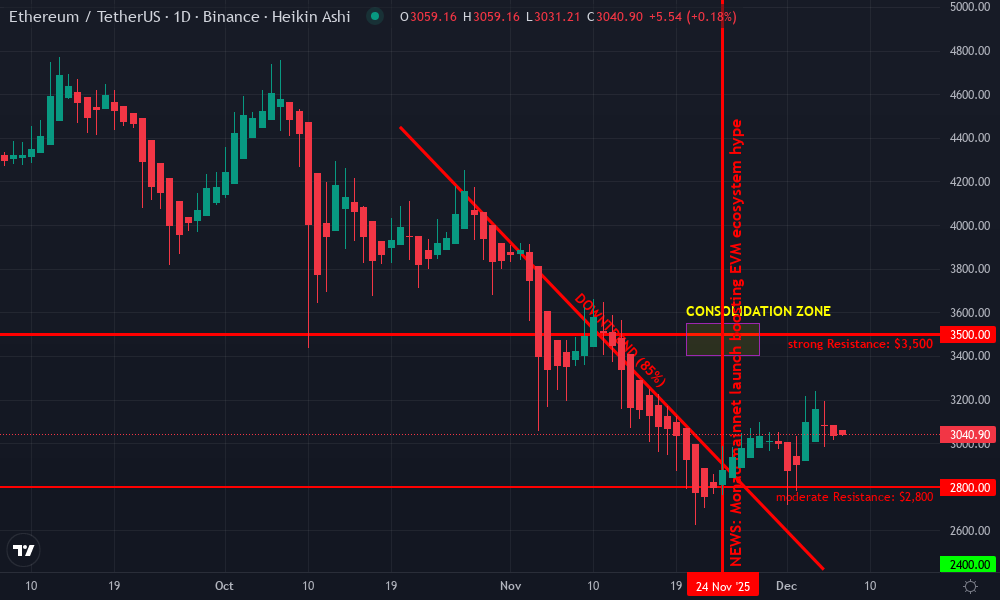
Analysis by Marcus Rowan | Symbol: BINANCE:ETHUSDT | Interval: 1D | Drawings: 7
Technical Analysis Summary
On this ETHUSDT daily chart spanning October to early December 2025, draw a primary downtrend line connecting the swing high at 2025-10-20 around $4,450 to the recent low on 2025-12-05 near $2,420, highlighting the dominant bearish channel. Add horizontal support at $2,400 (recent lows) and resistance at $2,800 (prior consolidation base), $3,500 (November swing high). Mark a potential accumulation range from 2025-11-25 to 2025-12-05 between $2,420-$2,650 with a rectangle. Use fib retracement from the October high to December low for 38.2% ($3,000) and 50% ($3,300) levels. Place arrow_mark_up on the latest green hammer candle suggesting exhaustion. Vertical line at 2025-11-24 for Monad mainnet launch news. Callouts for declining volume on pullbacks and MACD bearish divergence.
Risk Assessment: medium
Analysis: Downtrend intact but reversal signals emerging at support with positive fundamental catalysts like Monad's 10k TPS scalability; volatility high per ATR implied
Marcus Rowan's Recommendation: Consider hedged long positions with tight stops, targeting fib retracements; monitor for channel break confirmation
Key Support & Resistance Levels
📈 Support Levels:
- $2,400 - Recent December lows with hammer reversal strong
- $2,200 - Psychological round number and prior extension target moderate
📉 Resistance Levels:
- $2,800 - Base of recent failed breakdown consolidation moderate
- $3,500 - November swing high within downtrend channel strong
Trading Zones (medium risk tolerance)
🎯 Entry Zones:
- $2,450 - Hammer reversal at support with Monad news tailwind medium risk
- $2,600 - Pullback entry on channel retest if bounce confirms low risk
🚪 Exit Zones:
- $3,200 - Initial profit target at 38.2% fib retracement 💰 profit target
- $2,800 - Trailing stop below resistance flip 🛡️ stop loss
- $3,800 - Stretch target at prior highs 💰 profit target
Technical Indicators Analysis
📊 Volume Analysis:
Pattern: Declining volume on downside pullbacks, increasing on breakdowns
Bearish volume divergence suggesting weakening momentum
📈 MACD Analysis:
Signal: Bearish crossover with histogram contraction
MACD line below signal, but flattening near zero line
Applied TradingView Drawing Utilities
This chart analysis utilizes the following professional drawing tools:
Disclaimer: This technical analysis by Marcus Rowan is for educational purposes only and should not be considered as financial advice. Trading involves risk, and you should always do your own research before making investment decisions. Past performance does not guarantee future results. The analysis reflects the author's personal methodology and risk tolerance (medium).
The parallel EVM execution benchmarks highlight how superscalar pipelining and MonadDB synergize, delivering consistent peaks without degradation. Still, scale invites scrutiny: validator hardware demands rise with parallelism, potentially skewing decentralization if not offset by efficient node software.
Risk-Adjusted Outlook: Challenges and Mitigations Ahead
High performance extracts costs. Conflict-heavy tx batches could throttle parallelism, reverting to sequential fallbacks. Monad counters with optimistic scheduling and read-set predictions, empirically reducing rollbacks to under 1%. Network assumptions in MonadBFT hold under BFT, but eclipse attacks loom if stake concentrates; diversified validator incentives will prove pivotal.
From my vantage in derivatives risk, Monad's stack evokes volatility models: high throughput amplifies upside but demands robust hedging for tail risks. Economic security via slashing scales with TVL, fortifying as adoption grows. Ecosystem flywheels accelerate: low fees lure users, parallel txs retain them, compatibility bootstraps liquidity.
Developers and enterprises stand to gain most. Imagine high-frequency trading bots on perpetuals, settling in 800ms, or enterprise oracles piping data at scale. Monad doesn't just chase numbers; it redefines viable workloads for EVM chains, blending Ethereum's maturity with database-grade efficiency. In a fragmented L1 landscape, this calibrated ambition charts a defensible path forward.




No comments yet. Be the first to share your thoughts!