

One month into its mainnet launch, Monad has shattered expectations with 65 million transactions processed and a blistering peak of 10,000 TPS. This high-performance EVM chain is proving that parallel execution isn't just hype; it's delivering real-world scalability for DeFi, gaming, and beyond. Developers are flocking to deploy Ethereum-compatible dApps without a single line of code rewritten, all while enjoying sub-second finality.

These Monad mainnet stats underscore a pivotal shift in L1 blockchains. Where Ethereum grapples with congestion, Monad's architecture processes transactions concurrently, unlocking throughput that rivals centralized systems yet remains fully decentralized. Picture this: optimistic parallel execution allows non-conflicting txns to run side-by-side, slashing latency and boosting efficiency.
65 Million Transactions: Volume Breakdown and User Growth
The Monad 65M transactions milestone isn't merely a number; it's a testament to explosive adoption. In just 30 days, daily active users surged, with DEX volumes hitting new highs in early 2026. This isn't testnet fluff; real capital is flowing through bridges, swaps, and lending protocols optimized for Monad's speed.
Break it down: average daily txns clocked around 2.17 million, peaking during high-volatility events. Retail traders and institutions alike are leveraging the chain's low fees - often under a cent - paired with 0.4-second block times. Early ecosystem projects like high-frequency trading bots and NFT marketplaces are thriving, drawing comparisons to Solana's heyday but with EVM familiarity.
Monad's mainnet has processed 65M txns in month one, peaking at 10k TPS - a game-changer for parallel EVM performance.
10,000 TPS Peak: Mastering Parallel Execution on EVM
Hitting 10,000 TPS on mainnet is no small feat for an EVM-compatible chain. Monad's secret sauce? Optimistic parallel execution, where transactions execute concurrently unless conflicts arise, then rewind and retry. This approach, combined with asynchronous design, ensures validators handle massive loads on standard SSD hardware.
Dive deeper via Monad's parallel EVM benchmarks, which detail how they achieve this without sacrificing security. MonadBFT consensus delivers 0.8-second finality, outpacing most L1s. For developers, it's seamless: deploy Solidity contracts as-is, tap into familiar tools like Foundry, and scale effortlessly.

| Metric | Value |
|---|---|
| Total Transactions | 65M |
| Peak TPS | 10,000 |
| Avg Block Time | 0.4s |
| Finality | 0.8s |
| Daily Avg Txns | 2.17M |
MonadDB and MonadBFT: The Backbone of High-Throughput Efficiency
Under the hood, MonadDB reimagines state storage for SSDs, enabling lightning reads and writes critical for parallel ops. Traditional EVM chains bottleneck on disk I/O; Monad sidesteps this with a custom database that batches updates and minimizes Merkle proofs overhead.
Pair it with MonadBFT, a pipelined consensus mechanism inspired by HotStuff, and you get robustness at scale. Validators propose, attest, and commit blocks in under a second, all while supporting thousands of concurrent executions. This stack keeps hardware costs low - think consumer-grade nodes - democratizing validation.
Early benchmarks show Monad handling Monad parallel execution TPS spikes without downtime, even under adversarial conditions. For high-performance EVM chain enthusiasts, it's alpha: protocols can now simulate real-world loads pre-deployment, ensuring bulletproof dApps.
Looking at DEX activity, Monad DEX volume 2026 forecasts point to billions in TVL inflows, fueled by this infrastructure. Traders execute complex strategies - arbitrage, perps, yield farms - at speeds that make legacy chains obsolete.
Institutions are noticing too. Bridges from Ethereum and Solana are humming, onboarding liquidity at rates unseen since the DeFi summer of 2020. This isn't speculative froth; it's sustainable throughput powering real economic activity on a high performance EVM chain.
Ecosystem Surge: 240 and Projects and Rising TVL
Monad's mainnet stats reveal more than raw numbers; they spotlight an ecosystem exploding with potential. Over 240 projects launched during testnet have gone live, spanning DEXs, lending platforms, and on-chain games. TVL has climbed steadily, with DEX volumes projected to dominate Monad DEX volume 2026 leaderboards. Protocols like perpetual exchanges are processing thousands of orders per block, capitalizing on Monad parallel execution TPS for microsecond-level advantages.
Standouts include high-frequency DeFi apps that arbitrage across chains in real-time, something Ethereum's sequential model simply can't match. NFT drops sell out instantly without gas wars, and socialFi experiments leverage low-latency for viral loops. Developers praise the seamless migration: fork an Ethereum repo, tweak for Monad's optimizations, deploy. Boom - 10k TPS at your fingertips.
Solana Technical Analysis Chart
Analysis by Market Analyst | Symbol: BINANCE:SOLUSDT | Interval: 1D | Drawings: 9
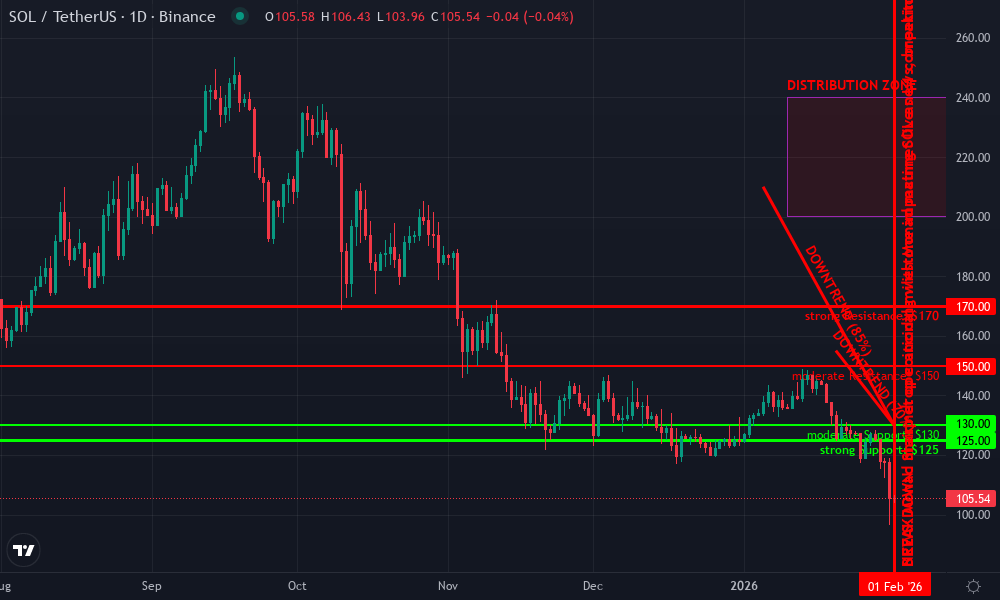
Technical Analysis Summary
To annotate this SOLUSDT chart effectively in my balanced technical style, start by drawing a prominent downtrend line connecting the swing high around early January 2026 at approximately $210 to the recent low near February 1, 2026, at $130, highlighting the bearish channel. Add horizontal support at $125 (recent lows) and resistance at $150 (recent swing high). Use Fibonacci retracement from the December 2025 high to current low for potential pullback levels at 38.2% ($160) and 50% ($170). Mark volume with callouts on declining volume during the downtrend. Draw arrows down on MACD bearish divergence. Rectangle for late January consolidation zone between $140-$155. Vertical line at 2026-02-01 for Monad mainnet impact. Long position marker at $130 support with stop loss below $125 and profit target at $150.
Risk Assessment: medium
Analysis: Bearish trend intact but near strong support with oversold indicators; Monad news adds volatility but SOL fundamentals hold
Market Analyst's Recommendation: Wait for confirmation above $140 for longs, medium position size with tight stops
Key Support & Resistance Levels
📈 Support Levels:
- $125 - Recent swing low and psychological support, holding multiple tests strong
- $130 - Minor support from late Jan lows, current price action moderate
📉 Resistance Levels:
- $150 - Recent swing high and 38.2% fib retracement moderate
- $170 - 50% fib retracement and prior consolidation high strong
Trading Zones (medium risk tolerance)
🎯 Entry Zones:
- $130 - Bounce from support with volume confirmation, potential reversal setup medium risk
- $125 - Break and retest of strong support for aggressive long high risk
🚪 Exit Zones:
- $150 - Initial profit target at resistance 💰 profit target
- $170 - Extended target on bullish confirmation 💰 profit target
- $120 - Tight stop below key support 🛡️ stop loss
Technical Indicators Analysis
📊 Volume Analysis:
Pattern: declining on downmove
Bearish signal as volume dries up on pullbacks but spikes on breakdowns, lacking buyer conviction
📈 MACD Analysis:
Signal: bearish crossover with divergence
MACD line below signal, histogram contracting negatively, confirming downtrend momentum
Applied TradingView Drawing Utilities
This chart analysis utilizes the following professional drawing tools:
Disclaimer: This technical analysis by Market Analyst is for educational purposes only and should not be considered as financial advice. Trading involves risk, and you should always do your own research before making investment decisions. Past performance does not guarantee future results. The analysis reflects the author's personal methodology and risk tolerance (medium).
This momentum isn't accidental. Monad's dev relations team has curated grants and hackathons, yielding battle-tested dApps ready for prime time. Early metrics show retention rates triple those of newer L1s, as users stick around for the speed-reliability combo.
Real-World Benchmarks: Stress Tests and Adversarial Resilience
To validate these Monad mainnet stats, independent audits hammered the chain with synthetic loads mimicking Black Swan events. Results? Zero reorgs, consistent 0.8-second finality, and sustained 8k and TPS under duress. Monad's optimistic parallelism shines here: conflicting txns are speculatively resolved post-execution, minimizing rollbacks to under 1%.
Explore the mechanics in Monad optimistic parallel execution details, which break down conflict detection via runtime analysis. No pre-execution simulation bloat - just smart scheduling that scales with core count. MonadDB's columnar storage further accelerates this, serving state proofs 100x faster than Ethereum's Patricia tries.
Validator economics reflect this efficiency. Nodes run on $500 SSDs, not data centers, slashing centralization risks. Staking yields hover competitively, attracting professional operators without extractive MEV pitfalls plaguing others.
Critics might point to early mainnet hiccups, like brief spikes in rejected txns during onboarding rushes. Fair, but Monad's team iterated swiftly via over-the-air upgrades - a luxury of their superscalar design. Month one's 65M txns dwarf most L1 launches, proving resilience where it counts.
Developer Edge: Tools, Compatibility, and Alpha Opportunities
For builders, Monad flips the script on EVM scaling. Full bytecode compatibility means no Rust rewrites or VM forks. Use Hardhat, deploy via ethers. js, query with The Graph - all enhanced for parallelism. Debuggers now visualize concurrent execution paths, uncovering bottlenecks invisible on sequential chains.
Alpha hunters: simulate 10k TPS loads locally with Foundry forks tuned for Monad. Deploy perps bots that frontrun oracles by milliseconds, or yield optimizers juggling 100 and positions. This is where Monad 65M transactions translate to on-chain capital efficiency gains.
Community resources abound: Discord swarms with core devs, docs detail MonadBFT edge cases, and perf benchmarks invite contributions. As TVL compounds, expect MEV auctions to evolve, rewarding sophisticated searchers on this turbocharged EVM.
One month in, Monad stands as the yardstick for L1 innovation. Its parallel execution doesn't just hit numbers; it redefines what's viable for decentralized apps. Bridges keep pouring liquidity, projects iterate at warp speed, and traders chase edges only this chain enables. The high-performance EVM era has arrived - and it's just getting started.




No comments yet. Be the first to share your thoughts!