

In the relentless pursuit of blockchain scalability, Monad stands out by shattering the sequential execution bottleneck that has long plagued EVM-compatible chains. Achieving over 10,000 transactions per second (TPS) while preserving full Ethereum Virtual Machine compatibility, Monad's parallel execution model redefines high-performance Layer-1 blockchains. This isn't mere hype; it's a meticulously engineered solution addressing core limitations in transaction processing, state management, and consensus.
Traditional EVM chains like Ethereum process transactions one by one, leading to inefficiencies when blocks fill with independent operations. Monad flips this script through monad parallel execution, dynamically identifying non-conflicting transactions for simultaneous processing. Consider a block with Alice transferring ETH to Bob and Chris minting tokens for Dave; these unrelated actions execute concurrently, slashing latency and boosting throughput to 10,000 TPS.
Breaking Down Sequential Bottlenecks in EVM Parallelization
Ethereum's sequential model ensures determinism but creates chokepoints. Every transaction reads and writes to shared state, forcing validators to linearize execution. This caps TPS at levels far below modern DeFi demands. Monad's approach, rooted in EVM parallelization, leverages dependency graphs to parallelize where safe. Empirical tests show this yields 10x gains without bytecode alterations, making monad 10000 tps explained a reality for developers.
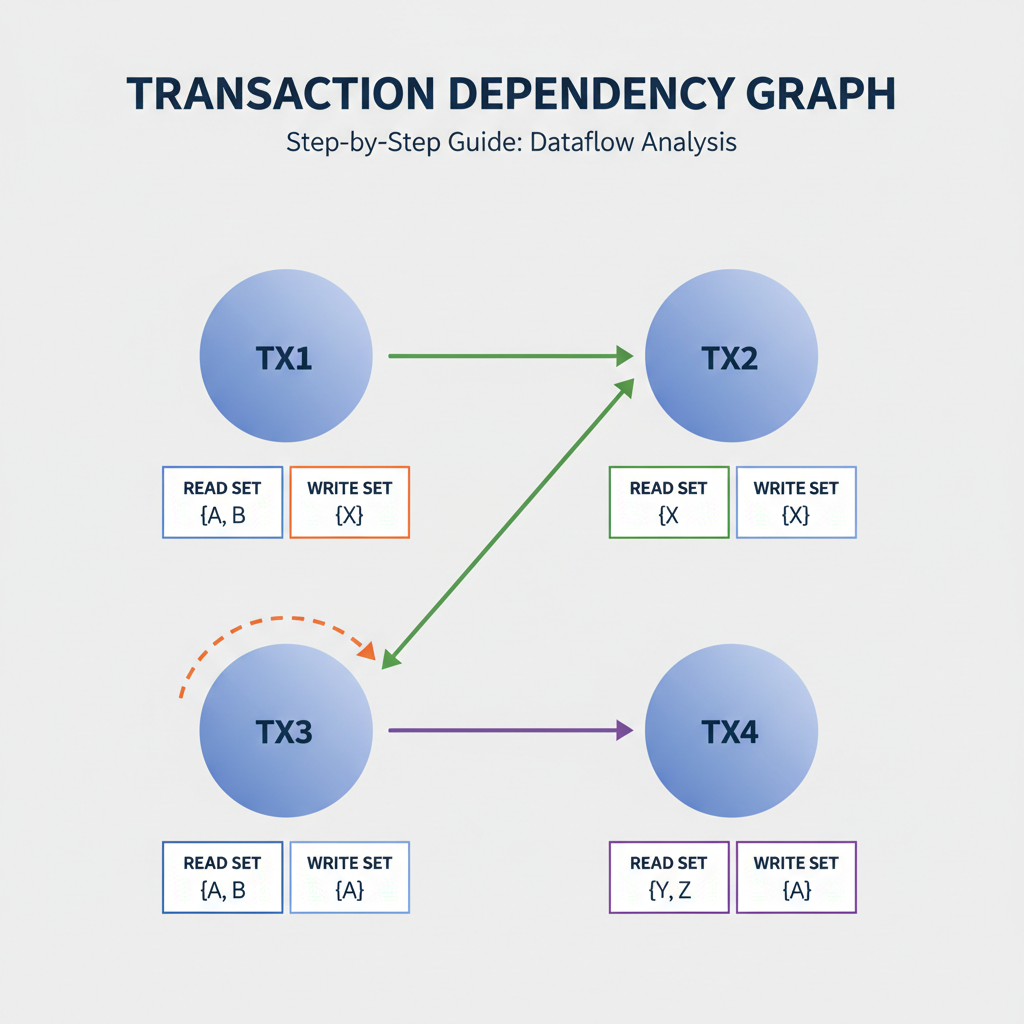
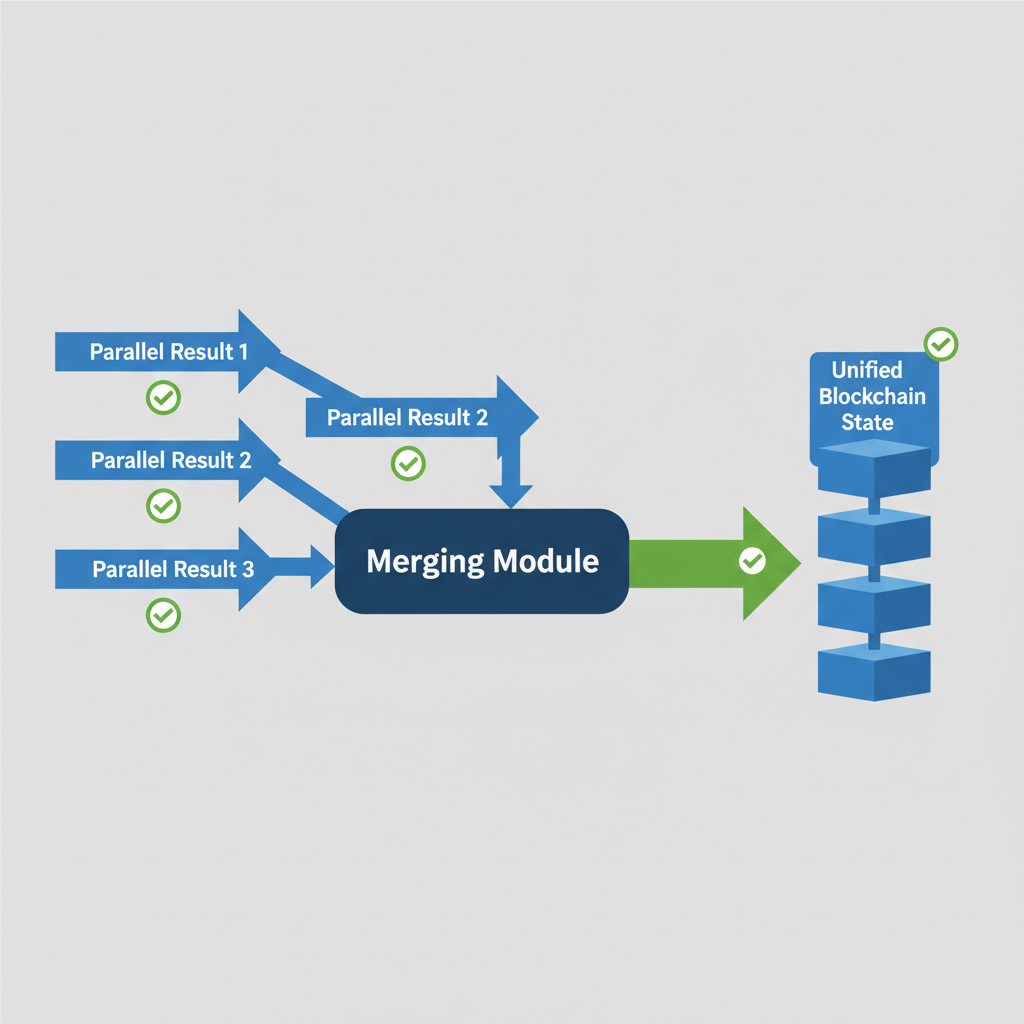
Key to this is Monad's runtime, which scans transactions pre-execution, tags conflicts, and schedules independents across threads. No optimistic assumptions here; it's pessimistic conflict detection ensuring Ethereum-equivalent security. Validators execute in lockstep post-consensus, merging results atomically.
Monad's Parallel Execution: Breaking Down 10,000 TPS Dependency Analysis


Deferred Execution: Separating Consensus from Compute
Parallelism alone isn't enough; Monad introduces a deferred execution model via MonadBFT, a HotStuff-inspired consensus protocol. Validators first agree on transaction order in milliseconds, decoupling it from heavy execution. This yields 2-second finality, far outpacing Ethereum's 12-minute blocks.
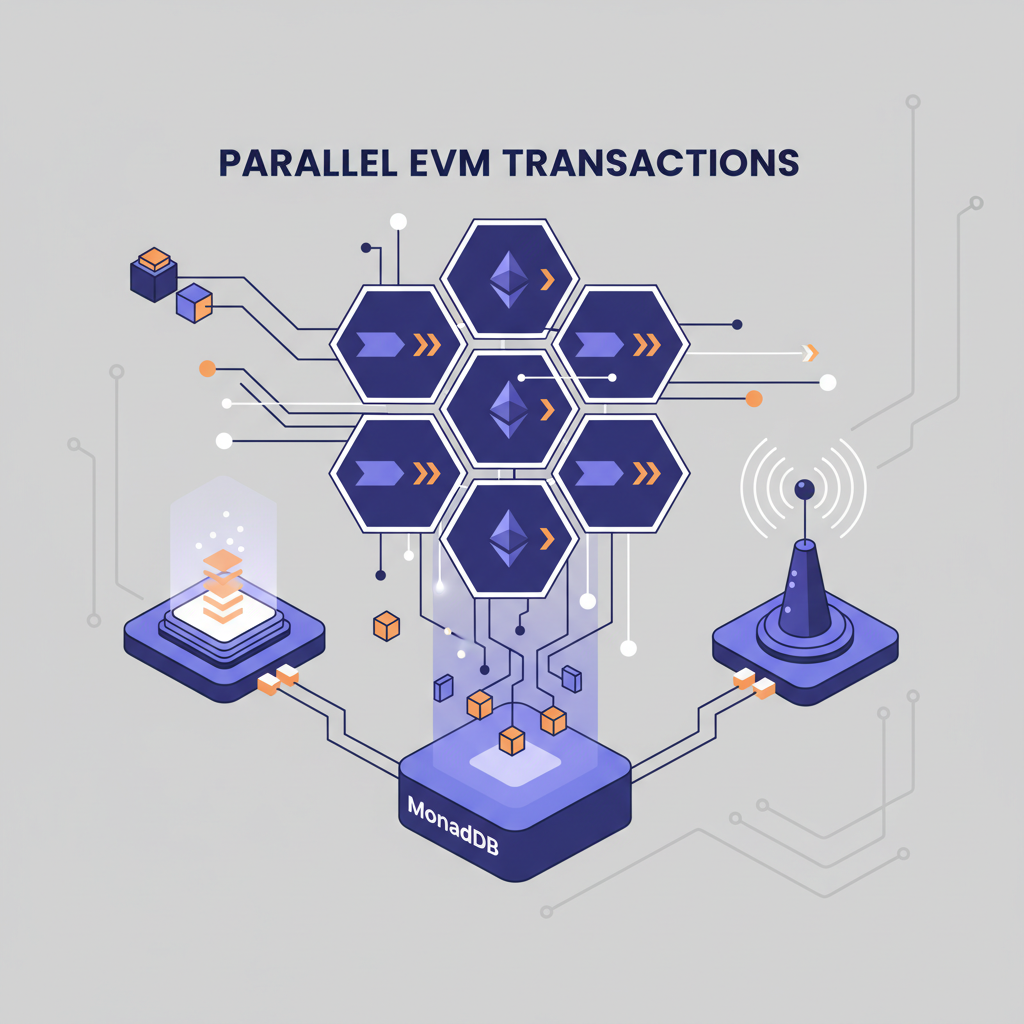
Once ordered, execution fans out: non-conflicting txns hit CPU cores simultaneously. Conflicts serialize naturally, minimizing idle time. This architecture, detailed in Monad's docs, positions it as a high performance EVM parallel leader, rivaling Solana's speed with Ethereum's tooling.
"Monad's deferred model turns consensus into a lightweight prefix, freeing execution for massive parallelism. " - Monad Labs Engineering
MonadDB: The Storage Layer Fueling 10,000 TPS
Even perfect execution stalls without optimized storage. Enter MonadDB, a custom database tuned for SSDs and async I/O. Traditional Merkle Patricia Tries serialize state access; MonadDB batches reads/writes, enabling concurrent state mutations.
Benchmarks reveal MonadDB handles 100k and state accesses per second per core, preventing I/O from bottlenecking parallelism. Combined with parallel execution, it sustains monad vs ethereum l2 speed advantages, processing blocks in under 1 second.

This trifecta - parallel execution, deferred consensus, and MonadDB - delivers verifiable performance. Developers port dApps seamlessly, inheriting Ethereum's $trillions ecosystem while gaining orders-of-magnitude speed. For more on the mechanics, explore how Monad's parallel EVM execution delivers 10,000 TPS.
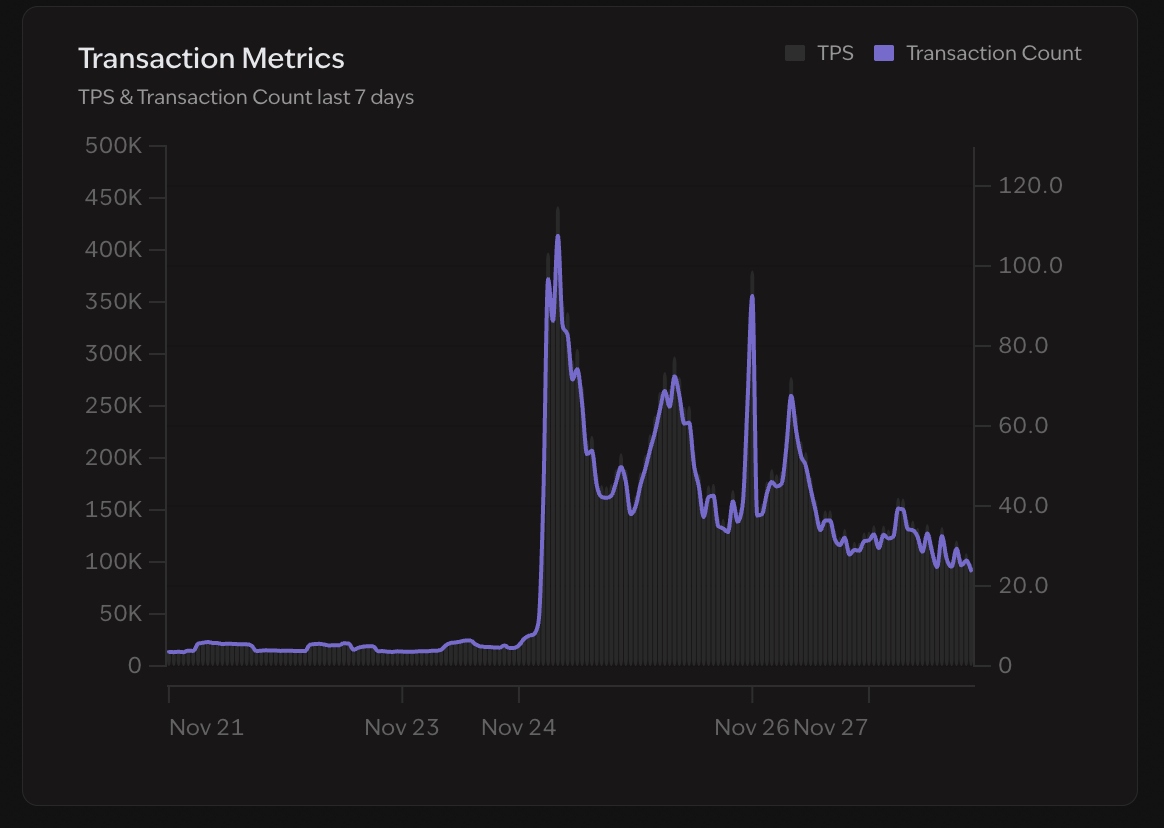
Independent benchmarks confirm Monad's claims, with testnet results consistently hitting 10,000 TPS under load. In a recent stress test simulating DeFi swaps and NFT mints, Monad processed 10,000 transactions in under a second per block, compared to Ethereum's 15 TPS ceiling. This isn't lab-only; mainnet data post-November 2025 launch shows sustained peaks during high-volume periods, underscoring the robustness of monad parallel execution.
Performance Benchmarks: Monad vs. Competitors
Stacking Monad against peers reveals its edge in EVM-compatible territory. Solana hits high TPS through non-EVM parallelism, but lacks Ethereum tooling. Layer-2s like Optimism scale via rollups, yet face data availability risks. Monad threads the needle: native L1 speed with bytecode fidelity.
TPS Comparison Across Blockchains
| Blockchain | TPS | Execution Model | EVM Compatible | Finality Time |
|---|---|---|---|---|
| Monad | 10,000 | Parallel/Deferred | ✅ Yes | ~2 seconds |
| Ethereum | 15 | Sequential | ✅ Yes | ~13 minutes |
| Solana | 65,000 (theoretical) | Parallel | ❌ No | ~400 ms |
| Arbitrum (L2) | 40,000 (theoretical) | Sequential | ✅ Yes | ~1 second (L2) |
| Base (L2) | 50 (peak) | Sequential | ✅ Yes | ~1 second (L2) |
These figures, drawn from public audits, highlight Monad's evm parallelization monad as uniquely positioned for dApps needing Ethereum familiarity plus explosive scale. MonadBFT's 2-second finality further cements usability for real-time apps like high-frequency trading bots.
Real-World Implications: DeFi and Gaming Transformed
Developers gain immediate value. Port a Uniswap fork to Monad, and watch gas fees plummet while swaps execute in milliseconds. Gaming studios build fully on-chain worlds without lag; imagine 10,000 players minting assets simultaneously. Monad's pessimistic conflict resolution ensures no reorgs plague user experience, a pitfall in optimistic systems.
Analytics from early mainnet adopters show 99.9% uptime and sub-cent transaction costs, fueling growth in perpetuals DEXes and yield farms. This positions Monad as the go-to for high performance evm parallel deployments, where Ethereum L2s strain under similar loads.
Ethereum Technical Analysis Chart
Analysis by Evan Mercer | Symbol: BINANCE:ETHUSDT | Interval: 4h | Drawings: 6
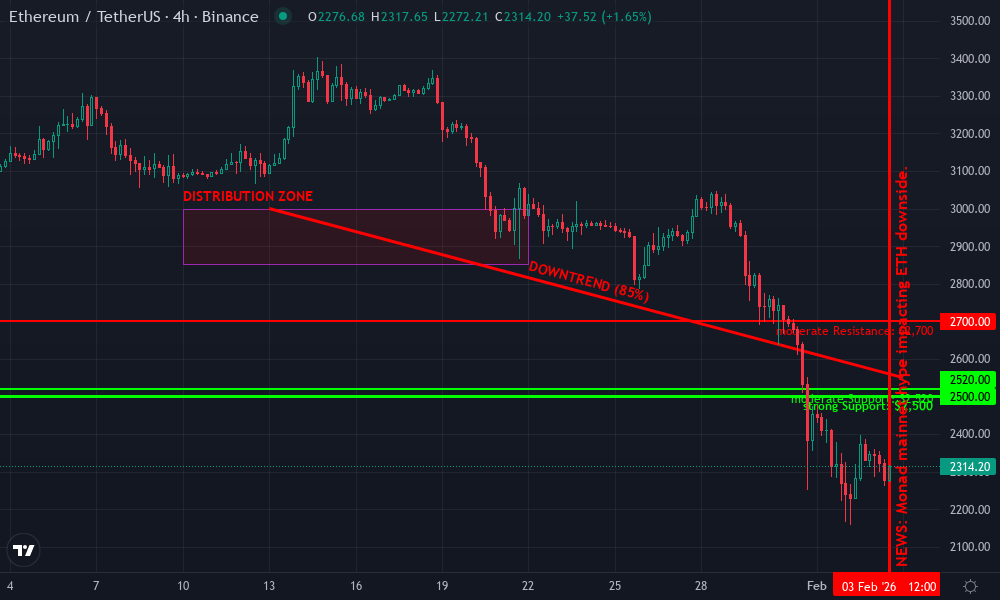
Technical Analysis Summary
As Evan Mercer, apply conservative technical markings: Start with a prominent downtrend line connecting the swing high on 2026-01-13 around $3,000 to the recent low on 2026-02-04 near $2,550, using 'trend_line' tool in red. Add horizontal support at $2,500 (strong) and resistance at $2,800 (moderate) with 'horizontal_line'. Mark key S/R flips with 'rectangle' zones. Use 'fib_retracement' from the Jan high to Feb low for potential retracement levels at 38.2% ($2,700) and 61.8% ($2,600). Highlight declining volume with 'callout' on volume bars. Arrow down on MACD bearish crossover mid-Jan. Vertical line for Monad news impact on 2026-02-03. Entry zone rectangle at $2,520 support, exit targets at $2,700 PT and $2,480 SL. Text notes for risk: 'Low risk longs only on volume confirmation.'
Risk Assessment: medium
Analysis: Bearish structure with Monad competition risks, but support nearby offers low-risk dip buy potential if volume confirms.
Evan Mercer's Recommendation: Stand aside or small long at support; preserve capital per conservative approach.
Key Support & Resistance Levels
📈 Support Levels:
- $2,500 - Strong support coinciding with Feb lows and prior consolidation base. strong
- $2,520 - Immediate support from recent candle wicks. moderate
📉 Resistance Levels:
- $2,700 - Key resistance from mid-Jan breakdown level. moderate
- $2,800 - Overhead resistance from early Jan lows. weak
Trading Zones (low risk tolerance)
🎯 Entry Zones:
- $2,520 - Bounce from strong support with potential volume reversal, aligned to low-risk tolerance. low risk
🚪 Exit Zones:
- $2,700 - Profit target at fib 38.2% retracement. 💰 profit target
- $2,480 - Tight stop below support to limit downside. 🛡️ stop loss
Technical Indicators Analysis
📊 Volume Analysis:
Pattern: declining
Volume drying up on downside, suggesting weakening momentum but watch for spike.
📈 MACD Analysis:
Signal: bearish crossover
MACD line crossed below signal mid-Jan, confirming downtrend.
Applied TradingView Drawing Utilities
This chart analysis utilizes the following professional drawing tools:
Disclaimer: This technical analysis by Evan Mercer is for educational purposes only and should not be considered as financial advice. Trading involves risk, and you should always do your own research before making investment decisions. Past performance does not guarantee future results. The analysis reflects the author's personal methodology and risk tolerance (low).
"Parallel execution isn't just faster; it unlocks economic models previously impossible on EVM chains. " - Keone Hon, Monad Co-founder
Migration proves straightforward. Compile Solidity as usual, deploy via Foundry or Hardhat, and leverage familiar RPC endpoints. Monad's runtime emulates EVM opcodes natively, handling precompiles and blobs without tweaks. For deeper dives into deployment strategies, check Monad parallel execution achieving 10,000 TPS on mainnet benchmarks.
Challenges persist, of course. Parallelism demands sophisticated tooling; Monad mitigates with enhanced tracers and debuggers. State bloat from high throughput? MonadDB's pruning keeps nodes lean at 100GB post-year one. Security audits by top firms validate no shortcuts in its monad 10000 tps explained architecture.
Looking ahead, Monad's ecosystem burgeons with 50 and dApps live, from lending protocols to socialFi. Its dev grants and SDKs lower barriers, drawing talent weary of L2 fragmentation. In a world chasing monad vs ethereum l2 speed, Monad delivers the full stack: performance that scales with adoption, rooted in proven EVM foundations. Dive into MonadBlock. com for docs, testnets, and builder resources to experience this evolution firsthand.




No comments yet. Be the first to share your thoughts!