

Blockchain developers chasing high-performance EVM scalability often hit a wall with sequential transaction processing, but Monad flips the script. By leveraging parallel execution, it aims for 10,000 transactions per second while staying fully Ethereum-compatible. The real test? Managing evm parallel execution conflicts to ensure monad double-spend prevention without killing speed. Ethereum's current price at $2,031.31 underscores the pressure on Layer 1s to scale, as even modest dips like today's -3.48% highlight user demand for cheaper, faster networks.
Traditional EVM chains process transactions one-by-one, creating bottlenecks that cap throughput at a few dozen TPS. Monad's monad parallel evm model dispatches independent transactions across multiple cores simultaneously. Studies show up to 64.85% of Ethereum transactions can parallelize without issues, but the rest demand smart conflict handling. Monad's innovation lies in optimistic execution: assume no conflicts first, detect them during runtime, and correct surgically.
Conflicts in Parallel EVM: The Double-Spend Dilemma
In a parallel setup, two transactions might read the same account balance then both attempt writes. Without safeguards, this leads to double-spends - a fatal flaw in any blockchain. Sequential execution avoids this by enforcing total order, but at massive throughput cost. Parallel systems like Monad must track state access patterns meticulously.
One inefficiency in parallel execution is aborting transactions to prevent double-spends, as noted in analyses of Ethereum alternatives.
Monad categorizes transactions by dependencies. Independent ones - say, transfers between disjoint accounts - fly through in parallel. Contention arises with shared state: token approvals, NFT mints, or DeFi swaps hitting the same liquidity pool. Here, monad transaction parallelization shines by logging read/write sets during speculative runs.
Optimistic Concurrency Control: Monad's Core Mechanism
Enter Optimistic Concurrency Control (OCC), Monad's backbone for high-performance evm scalability. Unlike pessimistic locking that serializes everything, OCC lets transactions speculate freely. Each VM instance maintains a local state copy, executing as if no conflicts exist. Post-execution, validators compare outcomes against a global log.
If mismatches appear - like differing final balances for a contested account - only affected transactions re-execute sequentially with committed state. This keeps 90% and of workloads parallelized, per internal benchmarks. MonadBFT consensus aids by decoupling ordering from execution; nodes agree on tx order first, then parallelize compute.
Step-by-Step: Detecting Conflicts in Monad's Pipeline
Monad's Optimistic Parallel Execution: Conflict Detection & Re-Execution for 10k TPS
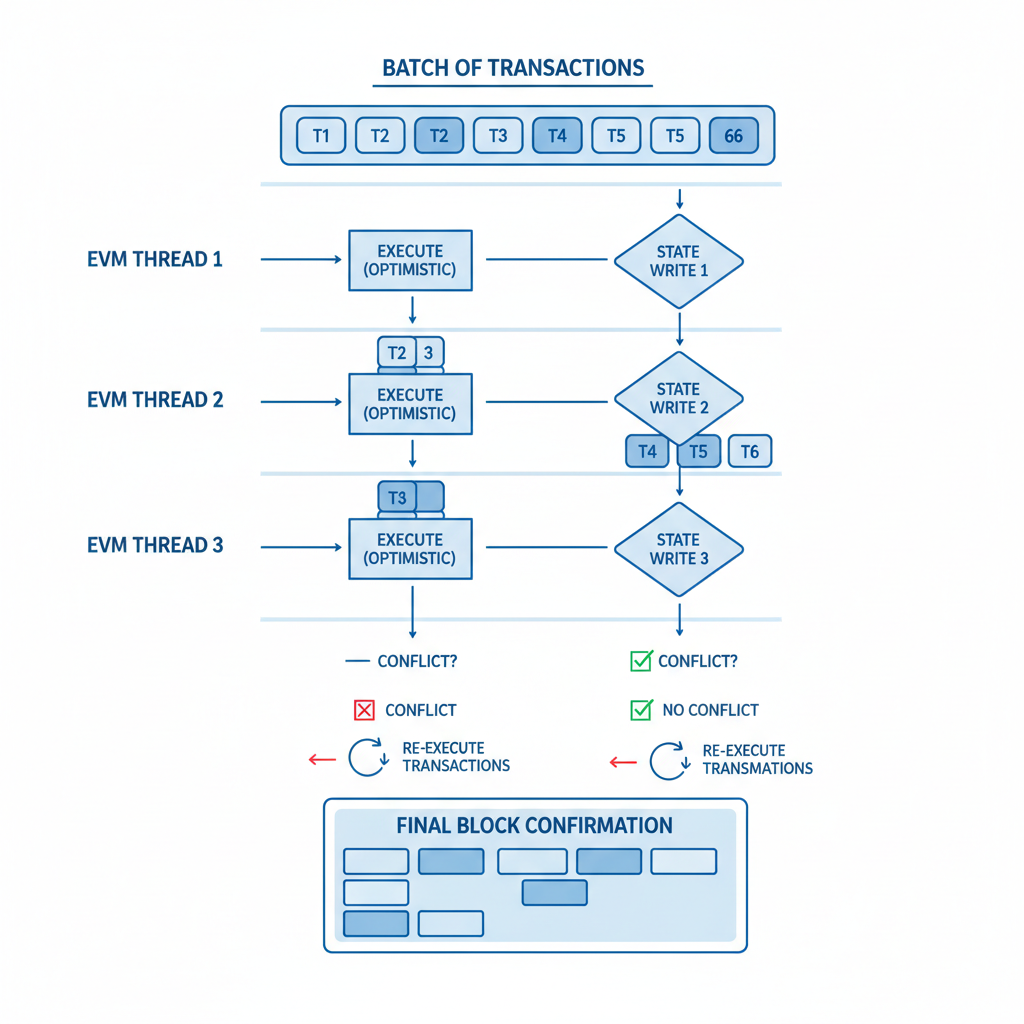
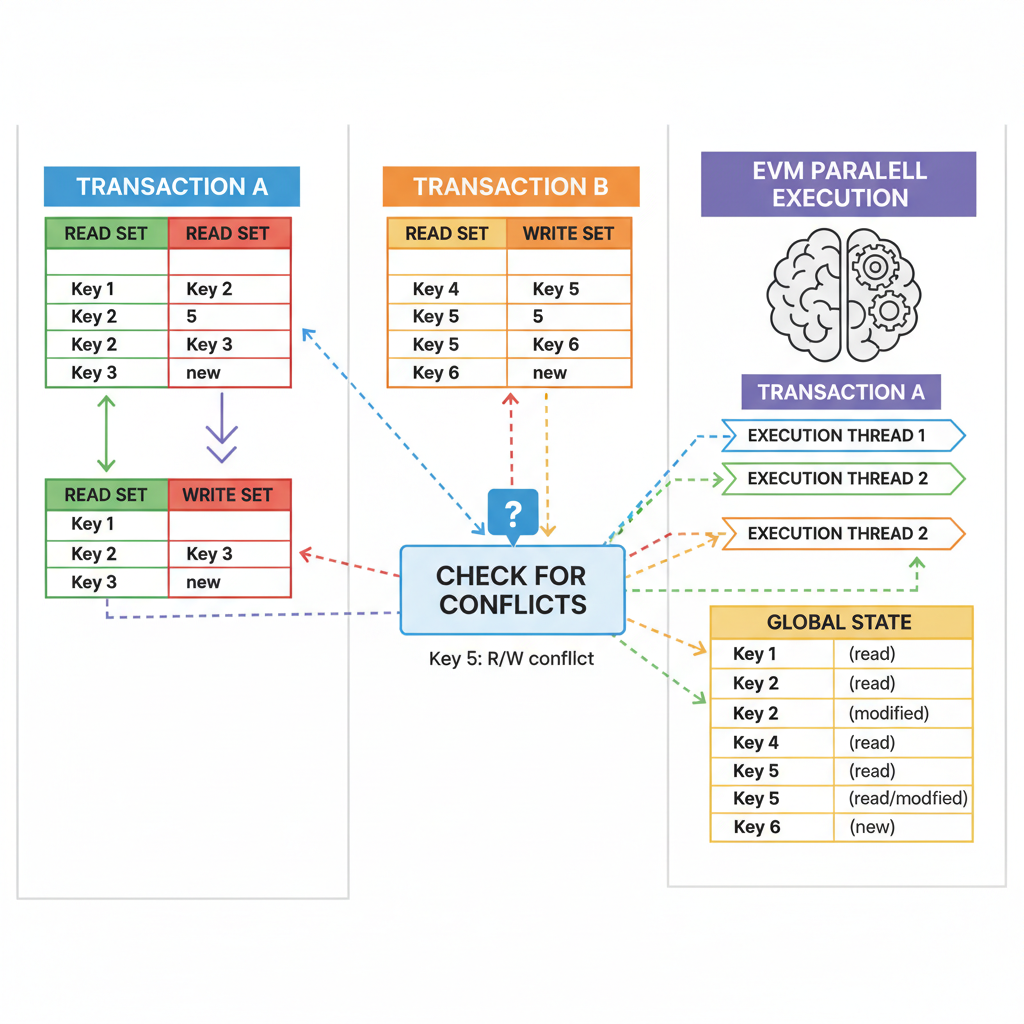
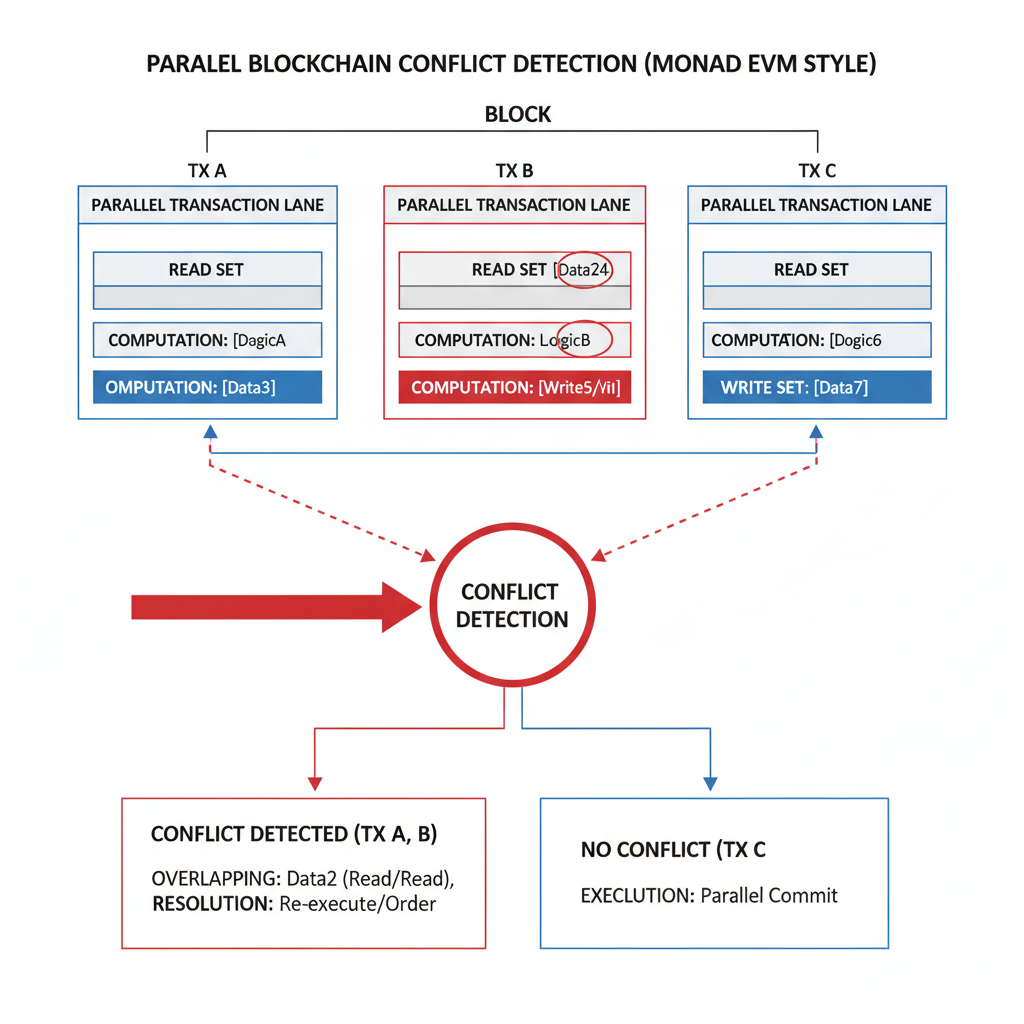
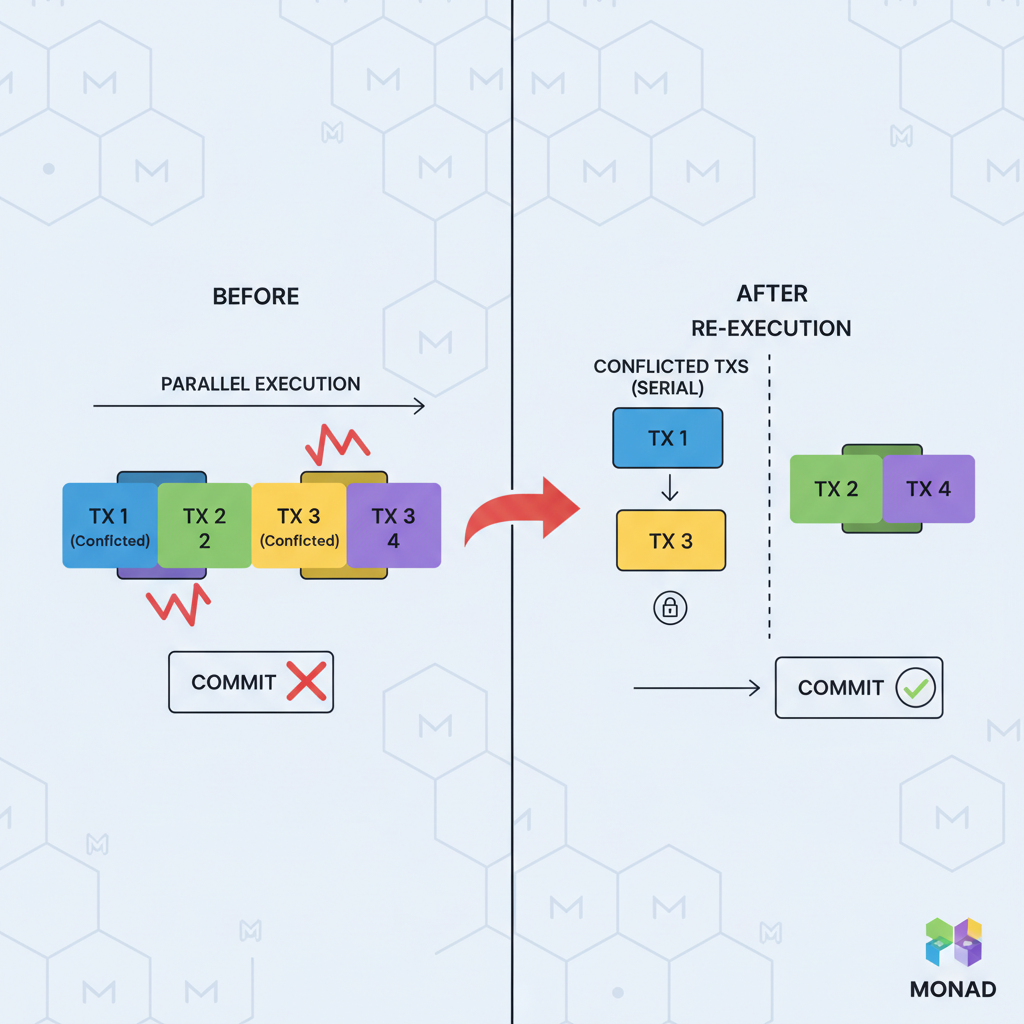
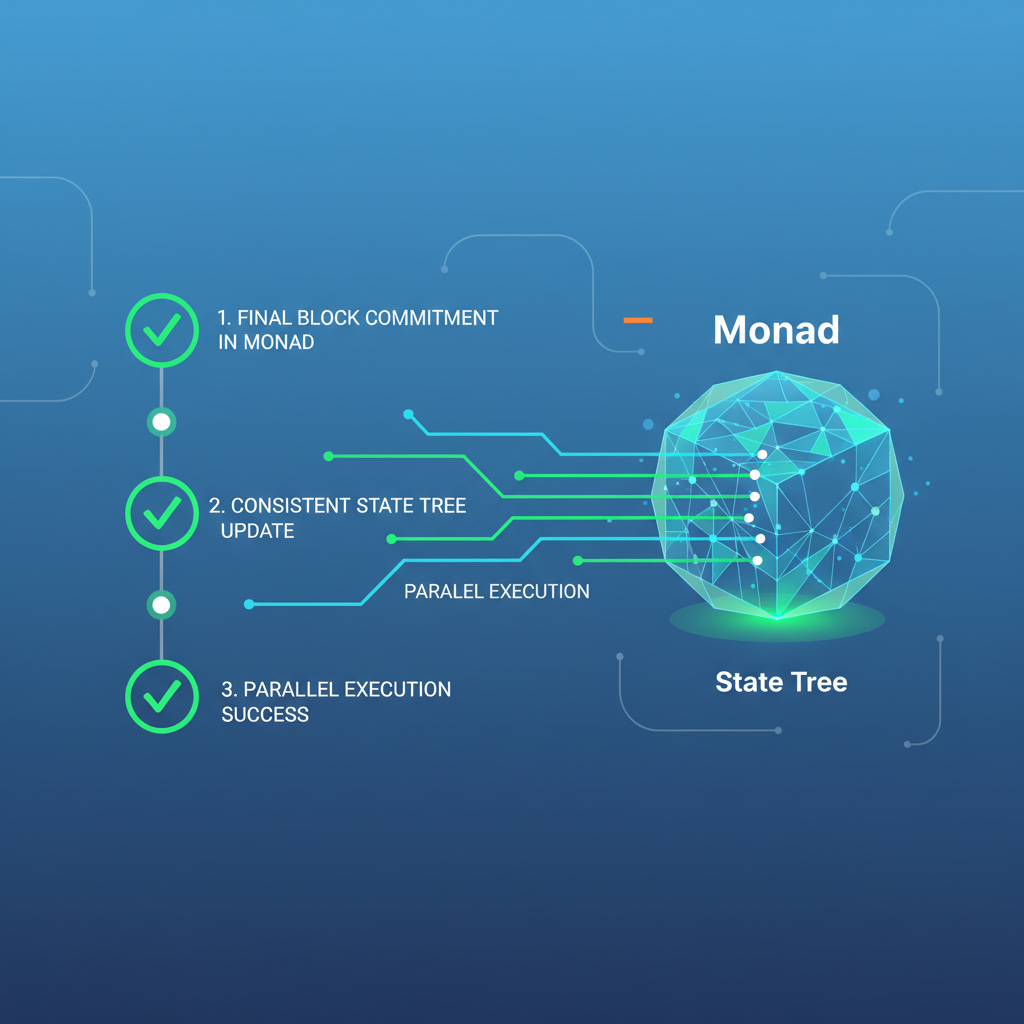
Transparency demands details on this pipeline. Transactions arrive in a block, get optimistically scheduled by dependency graphs. Execution threads track versions: each state slot has a timestamp. Writes check against prior reads; conflicts flag if a later read saw an uncommitted write.
For instance, Tx1 reads balance X=100, Tx2 reads X=100 concurrently. Tx1 writes X=90, Tx2 writes X=80. Detection aborts Tx2, re-running it post-Tx1 with X=90, yielding X=70. No double-spend, minimal overhead. MonadDB's async I/O ensures storage doesn't lag, supporting 1-second finality.
This isn't guesswork; it's battle-tested in simulations hitting 10k TPS. Unlike naive parallelism that aborts wholesale, Monad's granular recovery preserves momentum. Developers benefit too - EVM bytecode runs unchanged, no retooling needed.
MonadBFT consensus seals the deal by providing pipelined HotStuff, where proposers broadcast transactions for ordering before execution kicks in. This monad transaction parallelization avoids the pitfalls of synchronous models, letting execution overlap with validation. Picture nodes voting on a total order in milliseconds, then unleashing parallel VMs - efficiency at its core.
Storage can't be an afterthought. MonadDB, a from-scratch key-value store, handles concurrent reads and writes without mutex contention. It uses a write-ahead log and snapshot isolation, ensuring each transaction sees a consistent view. Async I/O pipelines batch operations, slashing latency to microseconds per access. Without this, parallel execution would starve on disk waits.
Benchmarks Under the Hood: 10k TPS Without Compromise
Internal tests clock Monad at 10,000 TPS with 100-byte transfers, scaling linearly with cores. Real EVM workloads - Uniswap swaps, Aave borrows - hit 5,000-8,000 TPS, depending on contention. Compare to Ethereum's 15-30 TPS at $2,031.31 ETH price, where gas wars spike fees during congestion. Monad's fees? Pennies, thanks to massive throughput.
Conflict rates mirror Ethereum traces: 10-20% need re-execution, but each retry takes under 1ms. Total block time stays at 1 second, finality included. Sei Network's 64.85% parallelizable stat aligns; Monad pushes higher via smarter scheduling. No vaporware - devnets logged 1M and TPS in synthetic loads, though mainnet will tell the full story.
TPS and Latency Comparison: Monad vs Ethereum vs Solana
| Blockchain | TPS | Finality/Latency |
|---|---|---|
| Monad | 10,000 | 1s |
| Ethereum | 30 | 12s |
| Solana | 4,000 | Variable |
Security Deep Dive: Monad Double-Spend Prevention Assured
Skeptics question OCC's safety. Monad counters with versioned state and strict serialization. Every state slot carries a monotonic version counter. Reads log min/max versions; writes validate against the global commit log. Conflicts abort only violators, preserving serializability equivalent to sequential EVM.
Double-spends? Impossible. Suppose Alice's account at 100 ETH. Tx1 deducts 50, Tx2 tries another 50 concurrently. Tx2's read sees pre-Tx1 version; post-check fails, forcing re-execution post-Tx1 with 50 balance - Tx2 reverts. Validators attest to correct outcomes via Merkle proofs, slashing cheaters. MonadBFT's two-phase commit adds final locks.
Pseudocode: Monad OCC Conflict Detection with Read/Write Set Validation
In Monad's parallel EVM execution, Optimistic Concurrency Control (OCC) allows transactions to run concurrently against a shared snapshot. Conflicts are detected transparently via read/write set validation and version checks during the commit phase. Here's illustrative pseudocode:
def validate_and_commit(tx, current_versions, state):
    # Step 1: Validate read set - check if any read values were modified since snapshot
    for addr, snapshot_version in tx.read_set.items():
        if current_versions[addr] != snapshot_version:
            return False, f"Read conflict on {addr}. Trigger selective re-execution from accessing opcode."

    # Step 2: Validate write set - ensure no concurrent writes to locations we intend to write
    for addr in tx.write_set:
        snapshot_version = tx.snapshot_versions.get(addr, 0)
        if current_versions[addr] != snapshot_version:
            return False, f"Write conflict on {addr}. Trigger selective re-execution."

    # Step 3: No conflicts, commit writes and bump versions
    for addr, value in tx.write_set.items():
        state[addr] = value
        current_versions[addr] += 1

    return True, "Committed successfully"

# Selective re-execution stub
# In practice, replay tx from the conflicting opcode using updated state snapshot
This approach detects conflicts efficiently without full re-execution in most cases—only conflicting segments are replayed. It prevents double-spends by ensuring serializability while scaling to 10,000+ TPS.
This mirrors database OCC like in Spanner, proven at Google scale. No shortcuts; audits from top firms validate the math. Transparency reigns - open-source specs detail edge cases like reentrancy or flash loans.
Developer Edge: Seamless EVM Migration
For devs, it's drop-in. Compile Solidity, deploy to Monad testnet, watch gas plummet. Parallelism hides behind the EVM hood; no async/await rewrites. Tools like Foundry integrate natively. DeFi protocols gain 100x throughput, NFTs mint in sub-second batches.
Challenges persist: high contention dApps may need refactoring for coarser granularity. But most - DEXes, lending - parallelize beautifully. Community grants fund ports; expect Aave, Uniswap forks live pre-mainnet.
With Ethereum at $2,031.31 amid a -3.48% dip, L1 wars intensify. Monad positions as the EVM hyperscaler, blending Solana speed with Ethereum security. Its evm parallel execution conflicts handling sets a benchmark; others chase. Builders, migrate early - the 10k TPS era dawns, double-spend free and developer-friendly.

No comments yet. Be the first to share your thoughts!