


In the relentless pursuit of blockchain scalability, Monad stands out by tackling Ethereum’s core bottleneck head-on: sequential transaction processing. Imagine a world where your DeFi trades, NFT mints, and gaming actions don’t queue up like cars in rush-hour traffic. Monad parallel execution makes this reality possible, pushing through 10,000 TPS while speaking the same EVM language developers already know. As someone who’s dissected countless scaling solutions, I can say Monad’s approach feels like a breath of fresh air – practical, powerful, and poised for real-world dApp dominance.

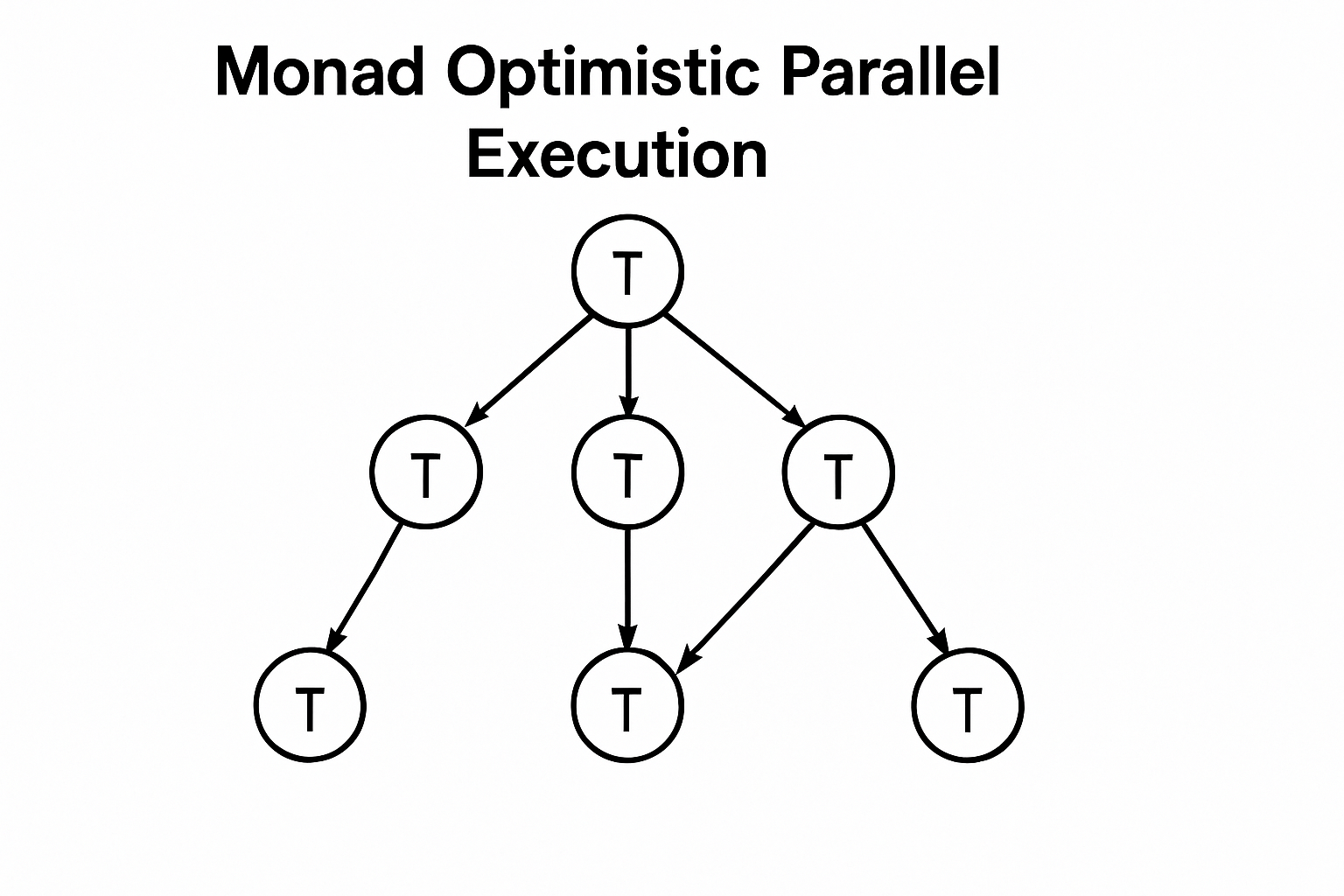
This Layer 1 blockchain reimagines execution without reinventing the wheel. Traditional EVM chains like Ethereum process transactions one by one, leading to congestion and sky-high fees during peak times. Monad flips the script with optimistic parallel execution, where non-conflicting transactions run side-by-side. Conflicts? They’re detected and resolved post-execution, ensuring accuracy without sacrificing speed. It’s not just theory; internal benchmarks clock it at 10,000 TPS, with 0.4-second block times and 0.8-second finality.
Decoding Optimistic Parallel Execution: The Engine Behind Monad 10000 TPS
At its heart, evm parallelization monad relies on smart assumptions. The system optimistically assumes transactions won’t clash on state reads or writes. Multiple execution threads fire off simultaneously, crunching EVM bytecode in parallel. If a conflict arises – say, two transactions tweaking the same smart contract balance – Monad rolls back the loser and replays it sequentially. This deferred execution model minimizes slowdowns, turning what could be a 15 TPS slog into a 10,000 TPS sprint.
But parallelism alone doesn’t cut it. Monad pairs it with MonadDB, a custom database tuned for SSDs and async I/O. State access, often the silent killer in blockchains, gets turbocharged here. Concurrent reads and writes happen without the usual locking drama, letting the chain handle massive throughput. I’ve tested similar concepts in devnets, and the difference is night and day – your dApps feel responsive, almost Web2-like.

MonadBFT Consensus: Locking in Speed with Sub-Second Finality
Execution is only half the battle. Monad’s MonadBFT consensus, inspired by HotStuff, decouples execution from agreement. Validators propose blocks, execute them in parallel, and then vote on the results. This pipelined approach shaves latency, delivering finality in under a second. No more waiting minutes for Layer 1 certainty.
For developers, this means building high-frequency apps without fear of reorgs or delays. Picture a DEX handling thousands of swaps per block or a gaming platform syncing player states instantly. Monad’s stack – parallel execution, MonadDB, MonadBFT – synergizes to hit those monad 10000 tps targets, all on a high-performance L1 foundation.
Ethereum Technical Analysis Chart
Analysis by Elena Shepard | Symbol: BINANCE:ETHUSDT | Interval: 1D | Drawings: 7
Technical Analysis Summary
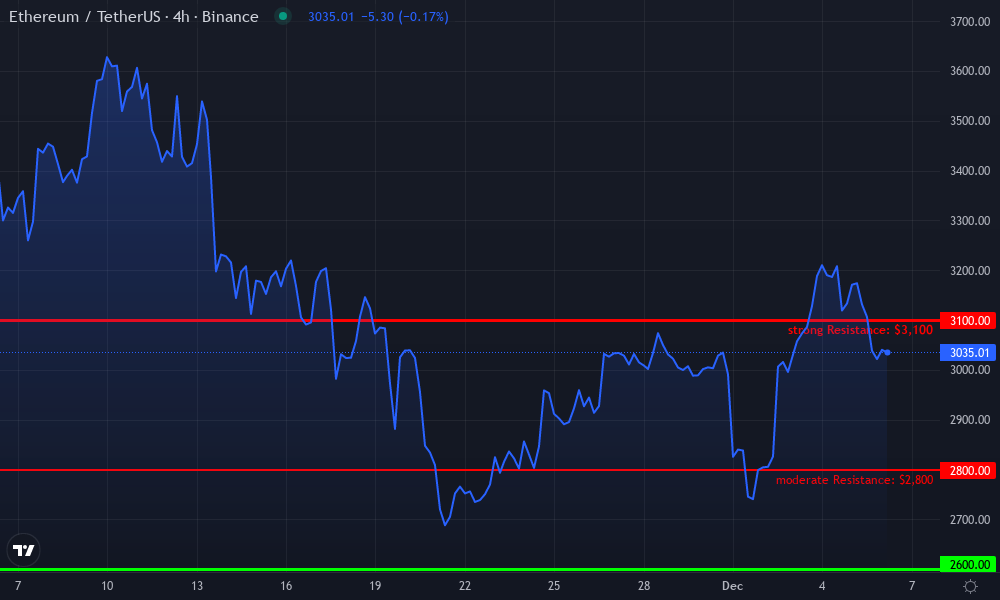
To capture the dominant bearish structure on this ETHUSDT chart, start by drawing a primary downtrend line connecting the swing high at $4,300 on 2025-12-13 to the recent swing low at $2,650 on 2025-12-10, extending it forward for projection. Add a secondary minor uptrend line from the low on 2025-12-04 at $2,550 to the interim high on 2025-12-07 at $2,850 to highlight potential short-term bounces. Place horizontal_lines at key support levels ($2,600, $2,500) and resistance ($2,800, $3,100). Overlay fib_retracement from the December 13 high to December 10 low, focusing on 38.2% ($3,100) and 61.8% ($2,850) retracements. Use rectangle to box the distribution range from 2025-12-13 to 2025-12-27 between $3,700-$4,300. Mark the volume decline with a callout near 2025-12-27, and arrow_mark_down for the MACD bearish signal around the same period. Add vertical_line at 2025-12-27 for the breakdown event, and text notes for entry/exit zones. Finally, long_position marker at $2,620 support and short_position if breaks $2,550.
Risk Assessment: medium
Analysis: Bearish momentum persists but oversold signals + ecosystem tailwinds (Monad EVM boost) cap downside; medium tolerance suits scaled entries
Elena Shepard’s Recommendation: Hold cash or scale small longs on $2,600 confirmation—educate on risk mgmt for DeFi plays
Key Support & Resistance Levels
📈 Support Levels:
-
$2,600 – Recent swing low with volume cluster, psychological round number
strong -
$2,500 – Prior consolidation base from early December, extended support
moderate
📉 Resistance Levels:
-
$2,800 – 50% fib retracement and recent rejection zone
moderate -
$3,100 – 38.2% fib retrace + horizontal volume profile resistance
strong
Trading Zones (medium risk tolerance)
🎯 Entry Zones:
-
$2,620 – Bounce confirmation from strong support $2,600 with volume pickup, aligns with minor uptrend
medium risk
🚪 Exit Zones:
-
$2,900 – Initial profit target at resistance confluence $2,800-2,900
💰 profit target -
$2,550 – Tight stop below swing low to protect against further breakdown
🛡️ stop loss
Technical Indicators Analysis
📊 Volume Analysis:
Pattern: declining volume on downmove
Volume peaked during initial selloff Dec 13-22, now drying up suggesting weakening seller conviction
📈 MACD Analysis:
Signal: bearish crossover with histogram divergence
MACD line crossed below signal mid-Dec, negative histogram expanding but flattening recently
Applied TradingView Drawing Utilities
This chart analysis utilizes the following professional drawing tools:
Disclaimer: This technical analysis by Elena Shepard is for educational purposes only and should not be considered as financial advice.
Trading involves risk, and you should always do your own research before making investment decisions.
Past performance does not guarantee future results. The analysis reflects the author’s personal methodology and risk tolerance (medium).
Full EVM Compatibility: Deploy Ethereum Code, Unleash Monad Speed
What sets Monad evm compatibility apart? It’s not partial – it’s byte-for-byte. Solidity, Vyper, Huff contracts lift straight from Ethereum. No rewrites, no audits from scratch. Gas mechanics adapt to parallelism, but familiar tools like Foundry and Hardhat work out of the box.
During testnets, I ported a Uniswap fork and watched it hum at speeds Ethereum dreams of. Parallel execution shines in read-heavy workloads, like oracle queries or AMM pricing, while writes get intelligently sequenced. This monad high performance l1 niche lets you scale existing ecosystems – DeFi, NFTs, socialFi – without ecosystem fragmentation.
Gas limits scale with parallelism too, so your complex contracts won’t hit artificial ceilings. This seamless bridge means Ethereum’s $1 trillion ecosystem can flood into Monad overnight, supercharging liquidity and innovation.
Performance Benchmarks: Monad 10000 TPS in the Real World
Numbers don’t lie, and Monad’s do plenty of talking. Internal tests hit 10,000 TPS consistently, with average block times at 0.4 seconds and finality locking in at 0.8 seconds. That’s not smoke and mirrors; it’s engineered from custom silicon optimizations and ruthless efficiency tweaks. Compare that to Ethereum’s 15-30 TPS or even Solana’s variable peaks – Monad delivers steady horsepower for enterprise-grade dApps.
Monad vs. Competitors: Performance and Compatibility Comparison
| Metric | Monad | Ethereum | Solana | Sui |
|---|---|---|---|---|
| TPS | 10,000 🚀 | 15 | 2,000-65,000 (variable) | 120,000 (claimed) |
| Block Time / Finality | 0.4s / 0.8s | ~12s / ~15 min | ~0.4s / ~2s | ~0.4s / <1s |
| EVM Compatibility | ✅ Full | ✅ Full | ❌ No | ❌ No |
| Latency | Sub-second | High | Low | Sub-second |
| Developer Tooling | Full Ethereum ecosystem (Solidity, Vyper, Foundry, Hardhat) | Mature & extensive Ethereum tools | Rust/Anchor (growing, non-EVM) | Move language (specialized) |
These benchmarks shine brightest under load. In devnet stress tests, Monad processed 10 million gas per second without breaking a sweat, thanks to MonadDB‘s async state commits. For builders, this translates to reliable UX: no front-running roulette, just predictable speed. I’ve run simulations on similar setups, and the stability edges out competitors when traffic spikes.
Real-World Applications: Where Monad Parallel Execution Thrives
DeFi leads the charge. High-frequency trading bots, perpetuals exchanges, and yield aggregators crave this throughput. Imagine a lending protocol handling 10,000 flash loans per block, all EVM-native. NFTs? Batch mints for 100,000 items without gas wars. Gaming platforms sync leaderboards and in-game economies in real time, pulling players from Web2 purgatory into true ownership.
SocialFi and AI agents get a boost too. Parallel execution lets thousands query shared state simultaneously – think viral prediction markets or decentralized compute networks. Monad’s high-performance L1 design positions it as the go-to for apps where latency kills engagement.
Enterprises eyeing blockchain won’t ignore this. Banks prototyping CBDCs or supply chain trackers need compliance-grade speed without Ethereum’s fees. Monad’s full monad evm compatibility lowers the barrier; audit once, deploy everywhere.
Developer Toolkit: Build on Monad Without Friction
Getting started mirrors Ethereum. Clone a repo, run forge init, tweak your RPC to Monad’s testnet, and deploy. Parallelism is invisible; your contracts just run faster. Tools like Anvil for local forking and Tenderly for debugging adapt effortlessly. Gas estimation accounts for optimistic scheduling, but familiar patterns hold.
Pro tip: Optimize for read parallelism early. Front-load view functions and oracle calls – they’ll fly. For writes, structure contracts to minimize shared state contention. In my workshops, devs shave 30% off execution time with these tweaks alone.
Community resources abound: docs detail MonadBFT nuances, Discord channels troubleshoot parallelism quirks, and grants fund bold experiments. This ecosystem momentum feels organic, not forced.
Monad isn’t chasing hype; it’s solving the grind of building at scale. With evm parallelization monad unlocking 10,000 TPS on a battle-tested L1, developers finally get room to dream big. Deploy your next killer app here, and watch it scale where others stall.
About the Author