

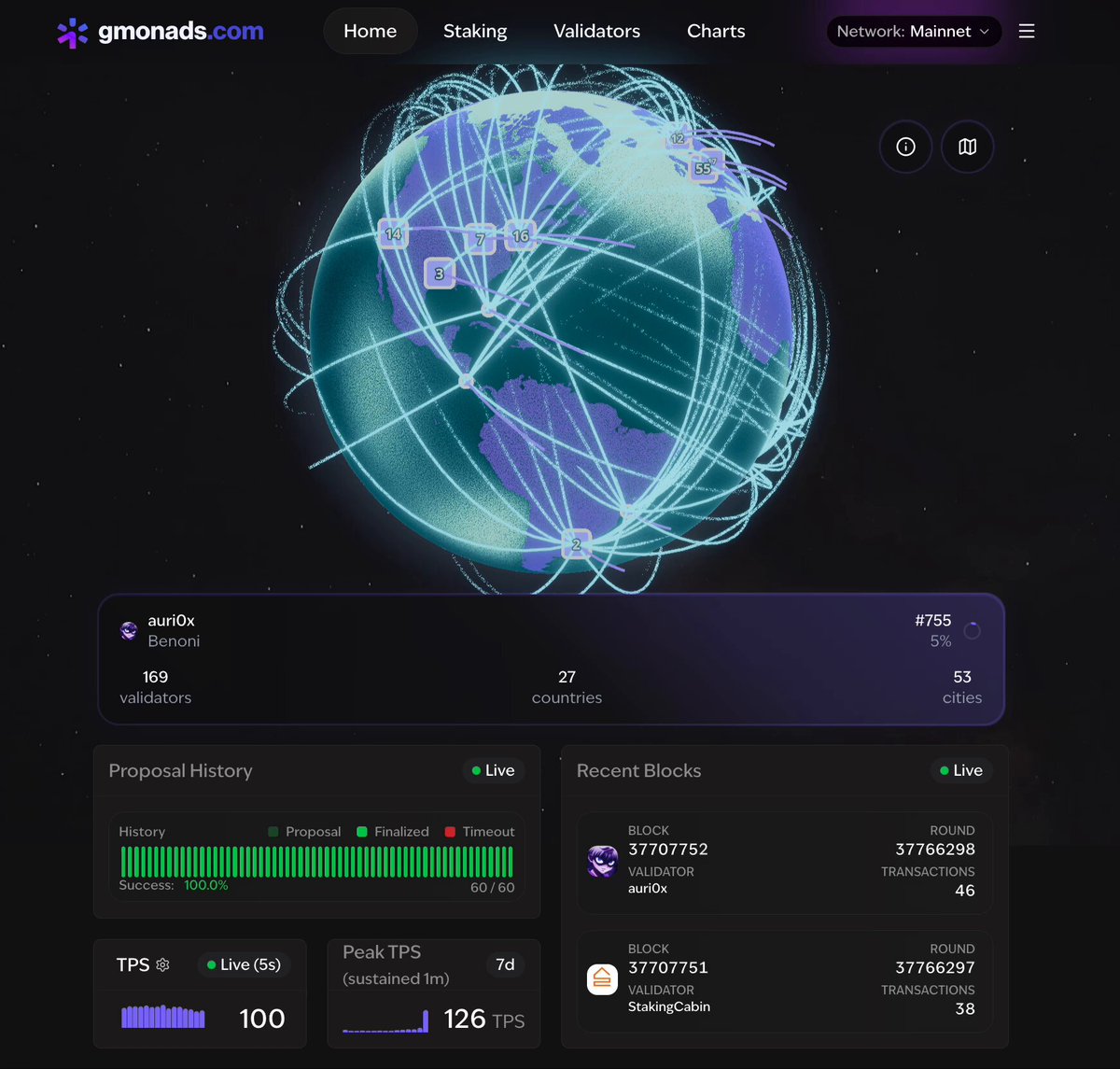
In the high-stakes arena of EVM-compatible blockchains, few milestones signal maturity like a testnet validator network spanning 170 nodes across 27 countries and 53 cities, all powered by consumer-grade hardware. This isn’t just incremental growth; it’s a strategic masterstroke in decentralization, proving Monad’s architecture can scale globally without relying on datacenter elites or foundation-controlled nodes. Zero validators run by the Monad team underscores a community-driven ethos that’s rare in Layer 1 rollouts.
A Network Forged in Global Diversity
Picture this: validators humming from North America to Asia, Europe to Oceania, forming a resilient web that shrugs off regional disruptions. The leap from 99 validators in 19 countries back in May 2025 to today’s 170 across 27 nations reflects explosive organic adoption. This Monad testnet validators surge isn’t hype; it’s validated by real-world uptime and transaction throughput exceeding 2.44 billion successful blocks since launch, with a 98% success rate.
Strategic thinkers recognize this as the big-picture shift toward true permissionless infrastructure. Unlike chains tethered to a handful of institutional operators, Monad’s setup invites solo stakers and small teams worldwide. Peak daily transactions hit 34 million in August 2025, fueled by 3 million creators deploying over 34 million smart contracts. Daily active users hover at 20,000, with 200 newcomers joining routinely, signaling sustained momentum en route to mainnet.
Consumer Hardware: The Great Equalizer
Here’s where Monad flips the script on blockchain economics. Validator specs mirror Ethereum’s modest demands: 32GB RAM, dual 2TB SSDs, 300 Mbps bandwidth, and a 16-core 4.5 GHz CPU like the AMD Ryzen 7950X, clocking in at roughly $1,500 total hardware cost. No need for hyperscale servers or colocation fees. This Monad decentralization consumer hardware model democratizes participation, slashing barriers that plague resource-intensive networks.
Parallel Testnet-2 stress-tested 100-150 validators across 19 countries, honing mainnet readiness without compromising accessibility. Gas fees? Negligible at $0.004-$0.007 per transaction, even under peak loads. For developers and enterprises eyeing Monad, this translates to predictable costs and explosive scalability. Over 240 ecosystem projects are already building, from DeFi protocols to gaming dApps, leveraging the network’s low-latency backbone.
400ms Blocks: Speed Meets Stability
At the core pulses Monad’s engineered edge: 400ms block times enabling 10,000 TPS and 0.8s finality, all while preserving full EVM compatibility. Validators execute transactions in parallel, budgeting precious milliseconds for consensus rounds without bottlenecks. This Monad 400ms block times prowess isn’t theoretical; testnet data confirms it handles enterprise-grade volumes on everyday rigs.
In a landscape crowded with EVM pretenders, Monad’s high performance EVM testnet stands out by marrying velocity with reliability. MEV resistance baked into consensus further shields against extractor dominance, fostering fairer markets. As a macro strategist, I see this validator network as the precursor to Monad dominating next-gen dApps, where speed dictates survival.
Institutions eyeing Layer 1s for real deployments will note how this setup mirrors Ethereum’s ethos but amplifies it with parallel execution. No longer do validators need to frontload capital for exotic rigs; Monad’s design anticipates a staking economy where thousands can participate, diluting centralization risks from day one.
Strategic dispersion matters in macro cycles. Geopolitical tensions or energy crunches in one region? Monad’s web reroutes seamlessly. Community operators, untainted by foundation influence, have clocked those 2.44 billion transactions at 98% success, with 20,000 daily actives and steady inflows. This organic ramp-up positions Monad as the EVM chain primed for mass adoption, where dApps thrive on sub-second responsiveness.
Ecosystem Ignition: 240 Projects and Counting
Developers aren’t waiting for mainnet ribbon-cutting. Over 240 projects span DeFi, NFTs, gaming, and infra tools, with 3 million creators dropping 34 million smart contracts. Gas at $0.004-$0.007 keeps experimentation frictionless, even at peaks. Imagine yield farms settling in 0.8 seconds or on-chain games rendering frames without lag; that’s the playground Monad built.
This high performance EVM testnet isn’t a sandbox, it’s a forge for production-grade apps. Early movers gain first-mover edges in liquidity and mindshare, much like Solana’s gaming surge but with Ethereum’s toolchain intact. For enterprises, the combo of consumer hardware and MEV safeguards means deploying at scale without vendor lock-in or frontrunning headaches.
Monad Testnet Key Metrics
| Metric | Value |
|---|---|
| Total Txns | 2.44B (98% success) |
| Validators | 170 (27 countries, 53 cities) |
| Daily Actives | 20K (200 new/day) |
| Smart Contracts | 34M (3M creators) |
| Gas Fees | $0.004-$0.007 |
| TPS | 10K |
| Block Time | 400ms |
Mainnet Horizon: Precision Deployment Ahead
As a cross-market analyst, I track cycles where tech meets timing. Monad’s testnet validator network signals peak readiness: decentralized, performant, accessible. Consumer-grade entry lowers the validator moat, inviting a broader staking pool that could rival Ethereum’s post-Merge distribution. With 400ms blocks as the rhythm section, expect dApps to pulse at velocities that redefine user tolerance for Web3.
The big picture? Monad doesn’t chase hype; it engineers inevitability. In a world of congested chains and cartel validators, this 170-node sprawl on $1,500 rigs heralds EVM’s high-octane evolution. Builders, stakers, and strategists: position now. The network that scales on laptops today will power tomorrow’s trillion-dollar ecosystems.
About the Author