


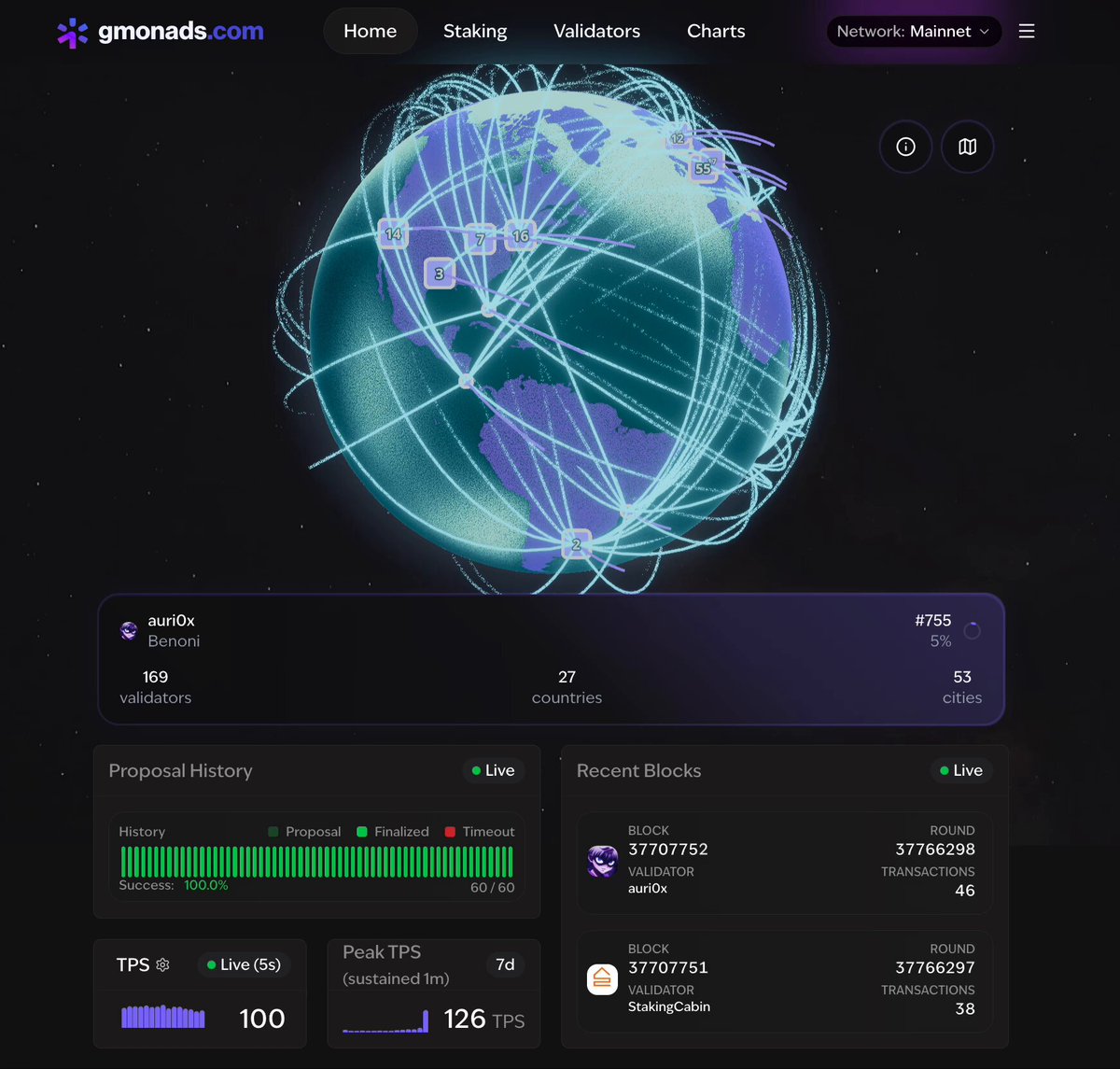
In the relentless pursuit of blockchain scalability, Monad’s validator network achieves a remarkable feat: global data synchronization in just 400ms. This isn’t hyperbole; it’s the reality of MonadBFT consensus, where validators scattered across continents exchange state updates with surgical precision. Picture a digital nervous system pulsing in unison, as captured in the immersive Cassini 3D World Map, revealing the intricate dance of nodes that powers this high-performance EVM chain.

Monad’s architecture redefines what’s possible for EVM-compatible blockchains. With over 10,000 transactions per second, 400ms block times, and 800ms finality, it shatters Ethereum’s bottlenecks while preserving bytecode equivalence. Developers redeploy Ethereum contracts seamlessly, unlocking hyperscale dApps without rewrite headaches. But the true magic lies in how Monad’s monad validator network maintains this velocity across a decentralized sprawl.
MonadBFT Consensus: Single-Round Speculative Finality in 400ms
At the heart of Monad’s speed is MonadBFT, a Byzantine Fault Tolerant protocol tailored for parallel execution. Validators propose and vote on blocks in a single consensus round, achieving speculative finality in 400ms. This low-latency design contrasts sharply with multi-round systems like Tendermint, where delays compound. Research from Monad’s docs and validators like Chorus One highlights how optimistic parallelization anticipates conflicts, resolving them post-execution to minimize idle time.
Global propagation is the linchpin. Validators constantly communicate, gossiping headers and state diffs worldwide. Cassini0x’s analysis on X nails it: this Monad 400ms sync time stems from peer-to-peer overlays optimized for geography, not just raw bandwidth. In tests, nodes in Tokyo sync with New York peers faster than centralized alternatives could dream, all while tolerating faults up to one-third of the set.
Visualizing Decentralization: Cassini 3D World Map Reveals Network Dynamics
The Cassini 3D World Map transforms abstract metrics into visceral insight. By plotting validator locations, sync latencies, and data flows on a rotating globe, it demystifies the Cassini Monad 3D world map. Watch pings bounce between high-performance EVM validators in data centers from Singapore to Frankfurt, clustering not by central fiat but by performance incentives. This visualization exposes resilience: even if Asia dips, Europe picks up seamlessly.
Imperator. co’s validator rankings underscore this. Top delegates prioritize infrastructure with redundant links and low-jitter connections, ensuring the network’s 400ms pulse never skips. Figment’s first look confirms scalability across large sets, projecting 10,000 and TPS without validator centralization. It’s strategic genius: Monad bets on distributed compute, turning geographic diversity into a strength.
Ethereum Technical Analysis Chart
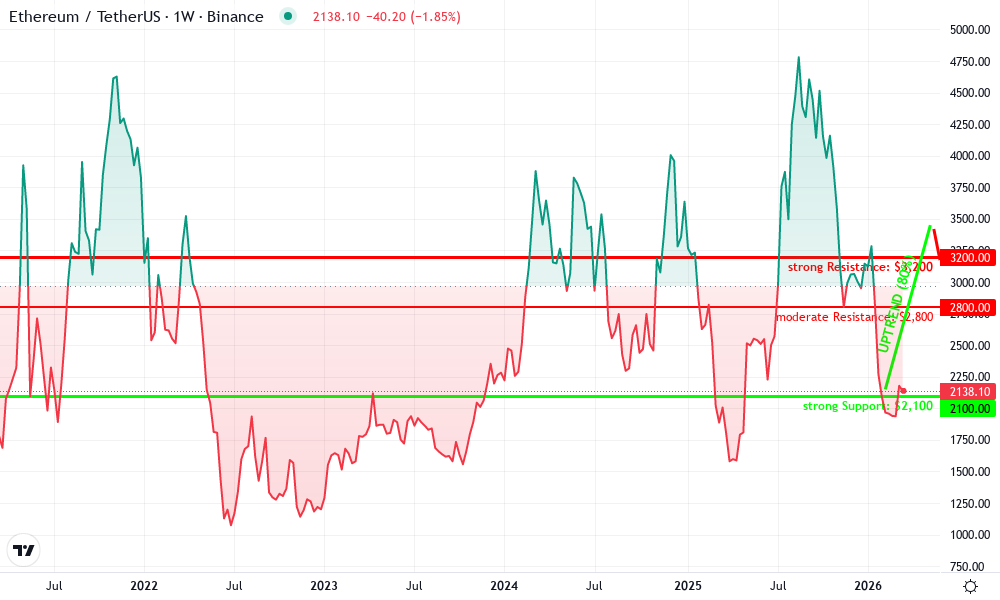
Analysis by Ethan Rowley | Symbol: BINANCE:ETHUSDT | Interval: 1W | Drawings: 6
Technical Analysis Summary
In my conservative style as Ethan Rowley, a macro-focused blockchain strategist, start by drawing two key trend lines on this ETHUSDT chart: an uptrend line connecting the swing low at 2026-02-10 around $2,150 to the peak at 2026-05-15 around $3,450, extending forward with 0.8 confidence; then a short-term downtrend from 2026-05-20 $3,420 to recent low 2026-07-22 $2,180. Add horizontal lines for support at $2,100 (strong, recent lows), $1,950 (weak, prior test); resistance at $2,800 (moderate), $3,200 (strong). Use rectangle for consolidation range 2026-06-01 to 2026-07-25 between $2,200-$2,800. Fib retracement from recent high-low for potential bounce levels. Mark volume spike at bottom with callout ‘Climax volume suggesting exhaustion’. MACD bearish divergence with arrow_mark_down but watch for crossover. Entry zone horizontal at $2,200 with low risk long if holds. Overall, big picture favors ETH amid EVM scaling like Monad.
Risk Assessment: low
Analysis: Chart shows exhaustion in downtrend with fundamental tailwinds from EVM scaling; conservative entries minimize downside
Ethan Rowley’s Recommendation: Accumulate longs conservatively on support hold, big picture bullish for ETH in 2026 adoption cycle
Key Support & Resistance Levels
📈 Support Levels:
-
$2,100 – Strong support at recent swing lows, multiple tests with volume
strong -
$1,950 – Weak prior low extension, potential if breaks
weak
📉 Resistance Levels:
-
$2,800 – Moderate resistance from prior consolidation highs
moderate -
$3,200 – Strong resistance aligning with 0.618 fib retracement
strong
Trading Zones (low risk tolerance)
🎯 Entry Zones:
-
$2,200 – Bounce from uptrend support with volume confirmation, aligns with macro ETH strength
low risk
🚪 Exit Zones:
-
$3,000 – Initial profit target at prior resistance flip
💰 profit target -
$2,050 – Tight stop below key support to preserve capital
🛡️ stop loss
Technical Indicators Analysis
📊 Volume Analysis:
Pattern: Climax selling volume at recent lows suggesting exhaustion
High red volume bars tapering, potential bullish reversal signal
📈 MACD Analysis:
Signal: Bearish crossover but histogram contracting
Divergence from price lows indicates weakening momentum
Applied TradingView Drawing Utilities
This chart analysis utilizes the following professional drawing tools:
Disclaimer: This technical analysis by Ethan Rowley is for educational purposes only and should not be considered as financial advice.
Trading involves risk, and you should always do your own research before making investment decisions.
Past performance does not guarantee future results. The analysis reflects the author’s personal methodology and risk tolerance (low).
Decentralization Tradeoffs: 400ms Global Sync Over 50ms Centralization
Centralized setups tempt with 50ms latencies, but Monad rejects that siren song. A Monad decentralization tradeoffs analysis reveals the cost: single points of failure, regulatory chokepoints, and eroded trust. Monad’s 400ms strikes an optimal balance, per CryptoCrew and Chainstack deep dives. Statesync exemplifies this, letting new nodes fetch state near the tip from peers, bypassing full archival downloads.
Everstake’s mainnet roadmap details validator expansion, stress-testing thousands of nodes. Blockdaemon’s institutional RPC and validator support signals enterprise buy-in, fortifying the high performance EVM validators ecosystem. Yet, MonadWhisper’s MonadBFT breakdown warns of growing pains: as sets scale, latency tuning via better routing protocols becomes paramount. My take? This measured approach future-proofs against quantum threats and regulatory flux, where true decentralization isn’t optional.
KeoneHD’s network parameters summary reinforces EVM fidelity: no gas schedule tweaks or opcode changes disrupt the stack. Developers gain low-latency oracles and DeFi at Ethereum costs, visualized in Cassini’s map as a thriving, global web.
Stakeholders in the Monad ecosystem stand to reap outsized rewards from this engineered equilibrium. Delegators eyeing Monad validator network performance turn to Imperator. co for vetted options, where infrastructure rigor translates to consistent uptime and yield. Chorus One’s architecture deep dive quantifies the edge: Monad’s parallel EVM execution slashes compute costs by orders of magnitude, making high-stakes DeFi viable on a truly decentralized base.
Staking Incentives: Backing High-Performance EVM Validators
Delegating MON to top validators isn’t just about APY; it’s a bet on network vitality. CryptoCrew Validators spotlight Monad’s tech stack, from superscalar pipelining to MonadDb for state access at sub-millisecond speeds. This empowers high performance EVM validators to handle 10,000 TPS surges without balking. Everstake’s infrastructure research maps the expansion: from testnet stress tests processing millions of blocks to a mainnet poised for enterprise floods.
Top Monad Validator Advantages
-
10,000+ TPS Performance: Monad delivers over 10,000 transactions per second with 400ms block times and 800ms finality via MonadBFT.
-
Global 400ms Sync: Validators synchronize data worldwide in 400ms, prioritizing decentralization over 50ms centralized latency.
-
Institutional Uptime: Providers like Blockdaemon offer enterprise-grade validator infrastructure for reliable operations.
-
Reward Optimization: Top validators maximize MON staking returns through superior performance and infrastructure.
Chainstack’s performance breakdown adds nuance: developers benefit from single-slot finality, enabling real-time apps like prediction markets or gaming that Ethereum chokes on. No more waiting epochs for confirmations; Monad’s 800ms finality closes the loop instantaneously.
Enterprise Horizons: Blockdaemon Bolsters Monad Infrastructure
Blockdaemon’s validator and RPC launch catapults Monad toward institutional orbits. Picture compliance-grade nodes syncing in 400ms, feeding low-latency feeds to trading desks and supply chain oracles. This isn’t speculative; Figment’s analysis pegs Monad for hyperscaling across validator sets ballooning past hundreds, where others falter.
Yet, MonadWhisper’s MonadBFT scrutiny tempers hype: fault tolerance demands vigilant slashing conditions and stake concentration caps. My strategic lens sees this as deliberate: by prioritizing Monad decentralization tradeoffs, the protocol inoculates against collusion risks that plague lesser chains. Statesync streamlines onboarding, letting validators spin up near-tip without gigabyte hauls, a boon for global proliferation.
Zoom out to the Cassini 3D World Map, and the strategy crystallizes. Nodes pulse in azure clusters across hemispheres, latencies visualized as taut arcs under 400ms. Disruptions in one quadrant? The mesh reroutes, embodying resilience. KeoneHD’s parameters affirm the purity: EVM bytecode verbatim, no hidden gotchas for porting yield farms or NFT mints.
For developers, this manifests as unbridled potential. Build once, deploy to a network that digests volume like Ethereum on steroids. Enterprises gain audit-ready scalability, validators secure premium delegations. Monad doesn’t just sync data in 400ms; it synchronizes an industry around velocity without sacrificing sovereignty.
The map’s rotating vista isn’t mere eye candy; it’s a manifesto. In a Web3 fractured by speed versus security debates, Monad plots a third path: both, amplified. As mainnet beckons, stake in this global sync isn’t passive; it’s positioning for the EVM’s next epoch.
About the Author