
Set up the monad dev environment
To build on Monad, you first need a local development environment that connects to the live testnet. Monad’s architecture relies on parallel EVM execution, which requires specific tooling to interact with its high-throughput nodes. This section walks you through installing the necessary CLI tools and verifying your connection to the network.
Begin by installing the Monad Command Line Interface (CLI). This tool manages your local node configuration and provides commands for interacting with the testnet. Ensure your system has Node.js (v18 or higher) and Git installed, as these are required for the build process. Run the standard installation command provided in the official Monad documentation to set up the core binaries.
Once the CLI is installed, you need to point your development environment to the Monad testnet RPC endpoint. Unlike mainnet, the testnet uses a different network ID and RPC URL to isolate experimental transactions. Update your project’s configuration file (often .env or hardhat.config.js) to include the testnet RPC URL. This ensures your local scripts send transactions to the correct parallel execution nodes.

After configuration, verify that your environment can communicate with the network. Use the CLI to check the latest block number and sync status. A successful connection will return current block data without timeout errors. If the sync is lagging, ensure your firewall allows outbound connections on the required ports. This step confirms your local node is ready to deploy and test smart contracts on the Monad testnet.
With the environment configured, you are ready to write and deploy your first smart contract. The parallel execution engine will handle transaction ordering automatically, allowing you to focus on logic rather than gas optimization.
Structure contracts for parallel execution
Monad’s EVM compatibility allows you to write standard Solidity, but leveraging parallel execution requires a different architectural mindset. The network processes transactions concurrently across multiple cores, meaning your contract’s state access patterns determine whether you benefit from this throughput or create bottlenecks.
In a traditional single-threaded EVM, transactions execute sequentially. On Monad, the execution engine identifies independent operations and runs them in parallel. If two transactions interact with the same storage slot or contract instance, they must serialize, creating contention. To maximize performance, design your contracts to minimize shared state dependencies.
Isolate State Access
Structure your smart contracts to separate high-throughput logic from shared state. Use distinct storage slots for frequently accessed variables to avoid cache line contention. When possible, use separate contract instances for different user segments or functional modules. This isolation allows the parallel executor to process transactions targeting different contracts simultaneously without locking.
Avoid complex cross-contract calls within a single transaction batch. Each call introduces synchronization overhead. Instead, batch independent operations into single transactions or use off-chain indexing for read-heavy queries. Keep your critical sections small and focused on immutable or frequently updated independent variables.
Optimize for Concurrency
Write functions that are idempotent and side-effect isolated where possible. This allows the network to reorder or parallelize execution safely. Use view and pure functions for data retrieval, as these do not modify state and can be executed in parallel without contention. For state changes, ensure that the data being modified is not accessed by other transactions in the same block.
Consider using a modular design pattern. Separate core logic from auxiliary functions. This reduces the likelihood of accidental state collisions during parallel execution. By keeping state access patterns predictable and isolated, you enable Monad’s parallel engine to process your transactions at maximum speed.
// SPDX-License-Identifier: MIT
pragma solidity ^0.8.20;

contract ParallelOptimized {
    // Separate storage slots to reduce contention
    mapping(address => uint256) public balances;
    mapping(address => uint256) public nonces;

    function transfer(address to, uint256 amount) public {
        require(balances[msg.sender] >= amount, "Insufficient balance");
        require(nonces[msg.sender] < 1000, "Nonce limit");

        balances[msg.sender] -= amount;
        balances[to] += amount;
        nonces[msg.sender]++;
    }
}
This pattern minimizes shared state conflicts, allowing Monad’s parallel execution engine to process multiple transfers concurrently. By isolating state access, you ensure your contract scales with the network’s throughput capabilities.
Test transactions for contention
Monad’s parallel execution engine processes transactions in batches rather than a strict linear sequence. This architecture delivers the throughput needed for high-frequency applications, but it introduces a specific risk: state contention. If two transactions in the same block attempt to modify the same storage slot simultaneously, one will fail or revert. Testing for these collisions is the final checkpoint before mainnet deployment.
1. Simulate high-throughput batches
Use a local Monad testnet node to replicate the network’s parallel processing environment. Configure your load generator to send transactions that target the same contract state concurrently. The goal is to mimic the concurrency levels expected during peak usage.
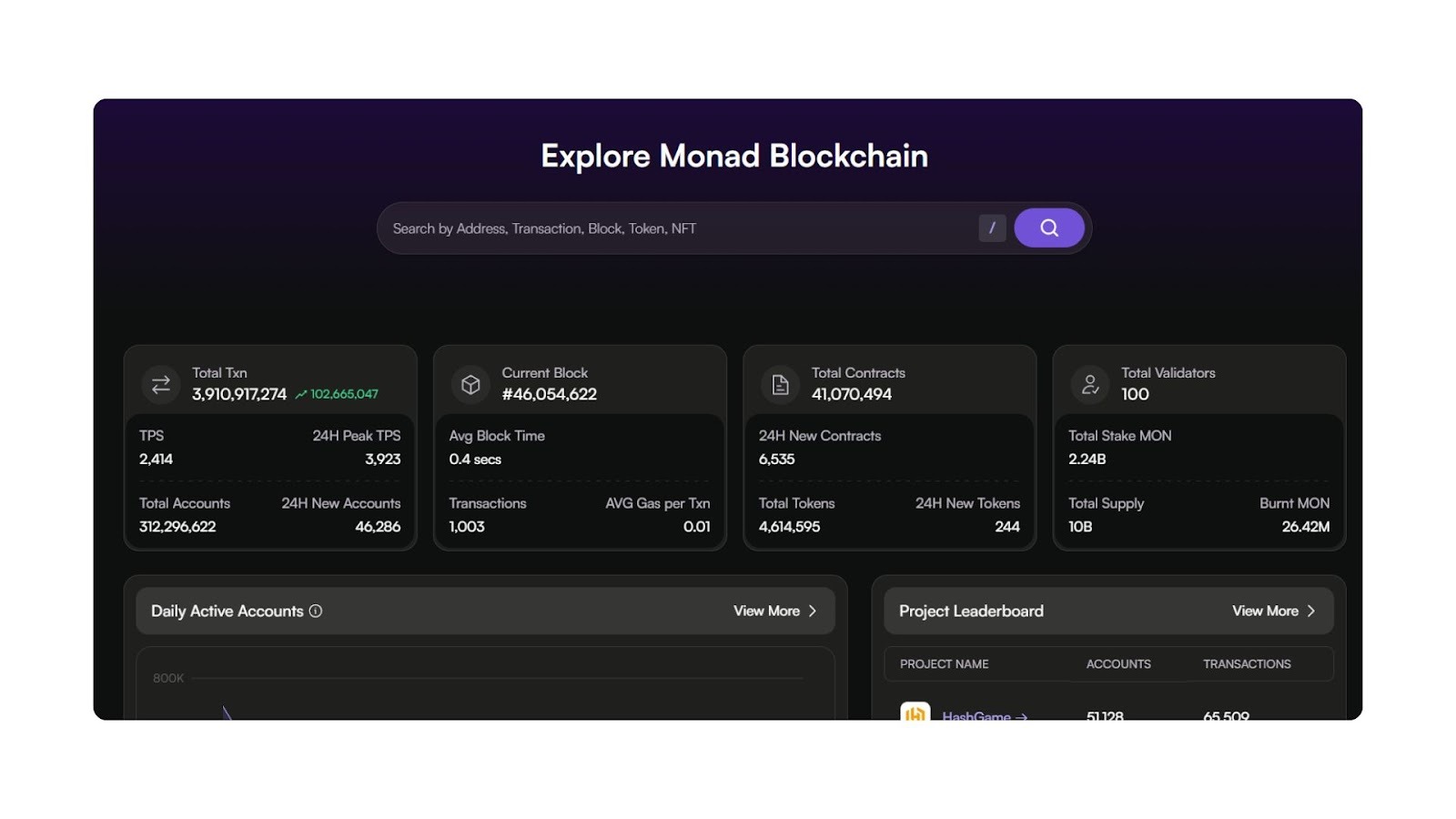
Set up a local Monad node with the latest testnet fork. Ensure your node is configured to accept and process parallel transactions. This environment mirrors the mainnet’s execution logic, allowing you to catch ordering conflicts early.
Write a script using Hardhat or Foundry that sends multiple transactions to the same contract function in a single block. Focus on functions that update storage variables. Monitor the transaction pool to ensure they are grouped together.
Review the block output for reverted transactions. Monad’s parallel execution will flag conflicts where state modifications overlap. Identify which specific storage slots or contract functions are causing the contention.
2. Optimize for parallel compatibility
Once you identify contention points, refactor your smart contract logic to minimize shared state dependencies. The goal is to allow transactions to execute independently whenever possible.
-
Use separate storage slots for unrelated variables to avoid cache line contention.
-
Implement optimistic locking or version checks for critical state updates.
-
Batch independent user actions into separate blocks if possible.
-
Test gas costs under parallel execution conditions.
3. Verify mainnet readiness
Before deploying, run a final stress test using a simulated mainnet environment. This ensures that your optimizations hold up under real-world network conditions. Monad’s 2026 ecosystem status relies on stable, high-throughput contracts that can handle the 10,000 TPS target without frequent reverts.
Monitor liquidity and throughput
Tracking your dApp’s on-chain activity is the only way to verify that Monad’s parallel execution is actually helping your users. Once deployed, you need to watch two specific metrics: transaction throughput and liquidity depth. These numbers tell you if your smart contracts are handling load efficiently and if your users can trade without slippage.
Use a block explorer like Blockscout or a dedicated analytics dashboard to view real-time throughput. Look for consistent block times and low latency during peak activity. If your dApp relies on high-frequency interactions, monitor the gas usage per transaction. Monad’s parallel processing should keep gas fees low even when many users interact simultaneously. A sudden spike in latency or failed transactions indicates your contracts might be contending for the same state slots.
Liquidity monitoring ensures your token pairs remain stable. Check the depth of your liquidity pools on Monad-native DEXs. Thin liquidity leads to high slippage, which drives users away. Tools like DefiLlama or the DEX’s own analytics page show total value locked (TVL) and trading volume. For example, Aave V3 crossed $100 million in TVL on Monad shortly after launch in July 2026, showing how quickly liquidity can concentrate on high-performance chains. Keep an eye on your pool’s reserve ratios to detect imbalances before they impact user trades.
Set up alerts for significant drops in throughput or liquidity. Sudden changes often signal network congestion or a liquidity exit. Regular monitoring lets you adjust your contract parameters or add liquidity before small issues become critical failures.
Common monad development: what to check next
Developers and investors frequently ask about Monad’s 2026 status, pricing, and technical capabilities. Below are answers to the most common questions regarding building on the platform and its market outlook.
No comments yet. Be the first to share your thoughts!