Parallel execution engine and performance metrics
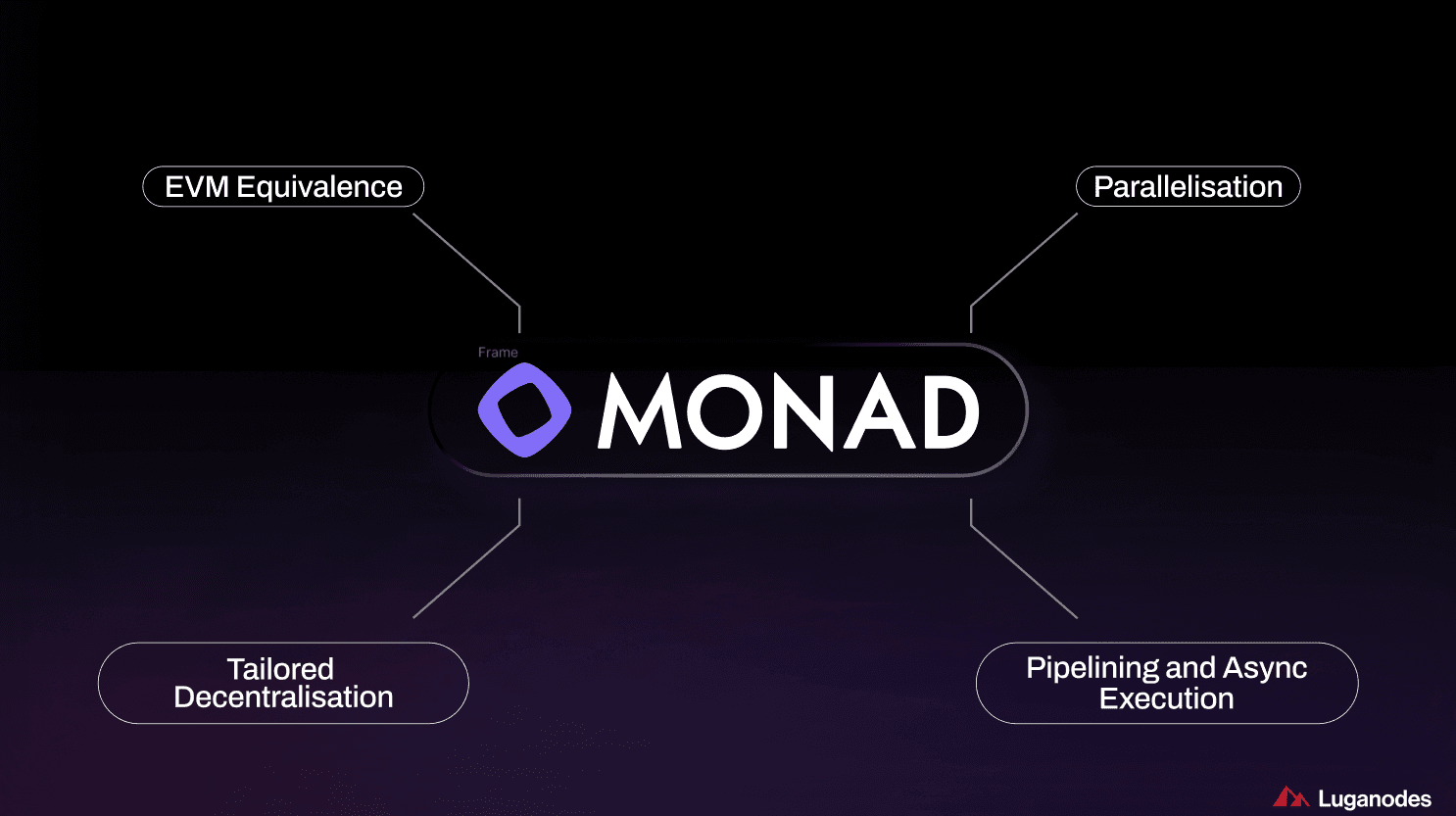
Monad addresses the EVM's historical bottleneck: sequential transaction processing. By introducing parallel execution, the network processes independent transactions simultaneously rather than one after another. This architectural shift allows Monad to handle significantly higher throughput while maintaining full compatibility with existing Ethereum tooling, smart contracts, and developer workflows.
The technical baseline centers on two primary metrics: 10,000 transactions per second (TPS) and 0.8-second finality. Block times are further reduced to 0.4 seconds, enabling near-instant confirmation for users. These figures are not theoretical projections but the result of a custom-built execution engine designed to maximize hardware utilization without sacrificing decentralization or security guarantees.
The infrastructure supports institutional-grade DeFi applications that require predictable latency and high throughput. For developers, this means deploying existing Solidity contracts with minimal modification. The parallel execution model ensures that transaction ordering remains deterministic, a critical requirement for complex financial instruments and automated market makers.
This performance profile positions Monad as a high-throughput layer for the broader Ethereum ecosystem. It does not compete with Layer 2 rollups on cost efficiency but rather offers a distinct alternative for applications that prioritize speed and parallelism over the shared security inheritance of L2s. The focus remains on providing a robust, high-performance execution environment for the next generation of decentralized finance.
Institutional Capital and Ecosystem Growth
The narrative around Monad is shifting from speculative trading to tangible institutional usage. Early 2026 data shows institutional capital is already active, signaling a transition toward serious enterprise adoption rather than just retail hype. This shift is critical for validating the chain's parallel EVM architecture as a viable alternative to established incumbents.
The most visible indicator of this maturation is the steady growth in Total Value Locked (TVL). While early metrics were driven by airdrop farming, recent inflows reflect genuine utility. Projects are deploying real liquidity, attracted by the high throughput and EVM compatibility that allows for easy migration of existing tools.
Enterprise interest is following the TVL. Several high-profile DeFi protocols have announced mainnet deployments, citing Monad's parallel processing as a solution to the congestion that plagues other EVM chains. This isn't just about speed; it's about the ability to handle complex financial instruments without network failure.
The market is watching these developments closely. As infrastructure risks are mitigated through successful mainnet operations, the focus is shifting to long-term sustainability. Analysts suggest that while near-term price targets like $1 remain speculative, the foundational growth in ecosystem value provides a more concrete basis for future valuation.
This transition is not without challenges. Regulatory scrutiny remains a key concern for institutional players. However, Monad's compliance-ready architecture and transparent on-chain activity are helping to address these hurdles. The goal is to build a trustless system that still meets the rigorous standards of traditional finance.
As the ecosystem expands, the distinction between speculative assets and utility tokens will likely become clearer. Monad is positioning itself to be the latter, offering a robust platform for the next generation of decentralized financial applications.
MetaMask money account integration
The launch of MetaMask Money Account on June 30, 2026, marked a significant shift in how retail users interact with blockchain infrastructure. By integrating this feature exclusively on Monad, MetaMask leveraged the network’s parallel EVM capabilities to offer seamless fiat on-ramps and off-ramps directly within the wallet interface. This move was designed to lower the barrier to entry for millions of potential users who have previously been deterred by the complexity of managing private keys and bridging assets across different chains.
"The integration of MetaMask Money Account on Monad is a testament to the network's ability to handle high-throughput transactions with near-zero fees, paving the way for mass adoption." — MetaMask Engineering Team
The technical foundation of this integration relies on Monad’s ability to process 10,000 transactions per second. This parallel processing capability ensures that the gas fees associated with frequent micro-transactions typical of fiat on-ramping remain negligible. For users, this means that buying cryptocurrency with a credit card or withdrawing funds to a bank account feels as simple as a traditional banking app, rather than a complex blockchain operation.
The immediate impact on the Monad network has been a noticeable increase in active addresses and transaction volume. As users test the new fiat on-ramp capabilities, the network is demonstrating its capacity to handle real-world financial flows without congestion. This real-world usage is a critical step in validating Monad’s parallel EVM architecture under live market conditions.
2026 price scenarios and valuation
Monad’s current trading range sits near $0.0206 as of early June 2026, with daily volumes hovering around $82 million. This baseline reflects the post-airdrop market equilibrium, where initial sell pressure has stabilized but broader ecosystem adoption is still maturing. The path to higher valuations depends heavily on whether parallel EVM utility can drive sustained demand for the $MON token.
Conservative outlook: $0.05 to $0.08
A conservative 2026 scenario assumes Monad successfully absorbs post-airdrop supply while ecosystem usage expands at a steady pace. In this case, the token could reclaim the $0.05 to $0.08 range. This outcome relies on gradual developer onboarding and modest transaction volume growth, without any major regulatory headwinds or competitive disruptions. It represents a realistic floor if the network continues to operate as a niche parallel EVM rather than a mass-market leader.
Bullish outlook: $0.15 to $0.25
The bullish case hinges on Monad becoming a primary infrastructure layer for institutional DeFi and high-frequency trading applications. If parallel execution delivers measurable throughput advantages that attract significant TVL and daily active users, the token could reach $0.15 to $0.25. This scenario requires strong network effects, successful partnerships with major financial institutions, and favorable regulatory clarity for EVM-based derivatives.
Key valuation drivers
| Scenario | Target Range | Primary Assumption |
|---|---|---|
| Conservative | $0.05 - $0.08 | Steady supply absorption and modest ecosystem growth |
| Bullish | $0.15 - $0.25 | Institutional DeFi adoption and high throughput demand |
| Long-term | $1.00+ | Mass-market parallel EVM utility and regulatory tailwinds |
Most analysts treat the $1 price point as a long-term possibility rather than a near-term expectation. Achieving this valuation would require Monad to justify its market cap through real application usage and infrastructure dominance. Until then, price movements will likely remain tied to broader crypto market cycles and network-specific adoption metrics.
Will monad crypto reach $1?
Reaching a $1 price tag for MON is a realistic long-term possibility, but it is not a near-term expectation. The primary barrier is market capitalization. At a $1 price, Monad would require a fully diluted valuation comparable to top-tier established Layer 1 blockchains, assuming its current token supply remains static. Without significant token burns or massive utility-driven demand, this valuation is difficult to justify in the immediate post-launch phase.
Infrastructure success and real application usage are the only paths to that valuation. Monad’s parallel EVM architecture offers theoretical speed advantages, but the network must prove its utility to developers and users. As noted in recent outlooks, the early months after launch are unlikely to be explosive. The proving ground for 2026 is about building sustainable usage rather than speculative hype.
Analysts generally treat the $1 target as a milestone that depends on sustained adoption. If Monad secures key institutional DeFi partnerships and sees high transaction volumes, the network could eventually support that price level. For now, the focus should remain on network health and developer activity rather than short-term price targets.
No comments yet. Be the first to share your thoughts!