Why Monad Parallel EVM Matters
The Ethereum Virtual Machine (EVM) has long been the standard for decentralized applications, but its sequential processing model creates a bottleneck. Traditional EVMs handle transactions one by one, like cars passing through a single-lane toll booth. Monad Parallel EVM changes this architecture by allowing transactions that do not share state dependencies to execute simultaneously. This parallel execution model unlocks throughput that traditional blockchains simply cannot match.
Monad achieves 10,000 transactions per second with 0.4-second block times and 0.8-second finality. This performance leap is not just a theoretical upgrade; it transforms the user experience for high-frequency DeFi interactions. For traders and developers, this means near-instant settlement and the ability to run complex strategies without the network congestion that plagues legacy chains.
Because Monad is fully EVM-compatible, developers can deploy existing smart contracts and applications without rewriting code. This compatibility lowers the barrier to entry, allowing the ecosystem to grow rapidly by leveraging the vast existing library of Ethereum tools and standards. Monad Parallel EVM represents the next generation of scalable, high-performance decentralized infrastructure.
The Architecture Behind the Speed
Monad achieves high throughput through a mechanism called optimistic parallel execution. Traditional Ethereum processes transactions sequentially, one after another, like cars waiting at a single toll booth. Monad changes this by allowing the blockchain to process multiple transactions simultaneously, provided they do not conflict with each other.
The system works by first speculatively executing transactions in parallel. It assumes these transactions are valid to save time. If a conflict is detected—such as two transactions trying to spend the same token at the same time—the system rolls back the conflicting transactions and processes them sequentially. This approach keeps the network fast while ensuring the same security guarantees as sequential processing.
This parallel processing is built on a custom-built infrastructure that spans the entire blockchain stack. By optimizing the consensus layer and the execution engine, Monad can handle approximately 10,000 transactions per second (TPS) with block times of 0.4 seconds. This speed is significantly faster than standard Ethereum L1 networks.
Maintaining EVM Compatibility
A major advantage of this architecture is that Monad remains 100% EVM-compatible. Developers can deploy existing Ethereum smart contracts and decentralized applications (dApps) on Monad without making any code changes. This means tools built for Ethereum, such as MetaMask or Uniswap, can run on Monad just as they do on the mainnet.
This compatibility lowers the barrier to entry for developers. Instead of rewriting code in a new language or learning a different ecosystem, they can simply port their projects. This creates a seamless experience for users, who can interact with familiar interfaces while benefiting from the network's speed and lower costs.
The combination of parallel execution and EVM compatibility positions Monad as a high-performance Layer-1 blockchain. It offers the scalability needed for complex DeFi applications while maintaining the developer-friendly environment that has made Ethereum popular.
| Metric | Monad | Ethereum L1 |
|---|---|---|
| Throughput | ~10,000 TPS | ~15-30 TPS |
| Block Time | 0.4 seconds | ~12 seconds |
| Finality | ~0.8 seconds (optimistic) | ~12-15 minutes |
| EVM Compatibility | 100% | Native |
Top DeFi Apps on Monad
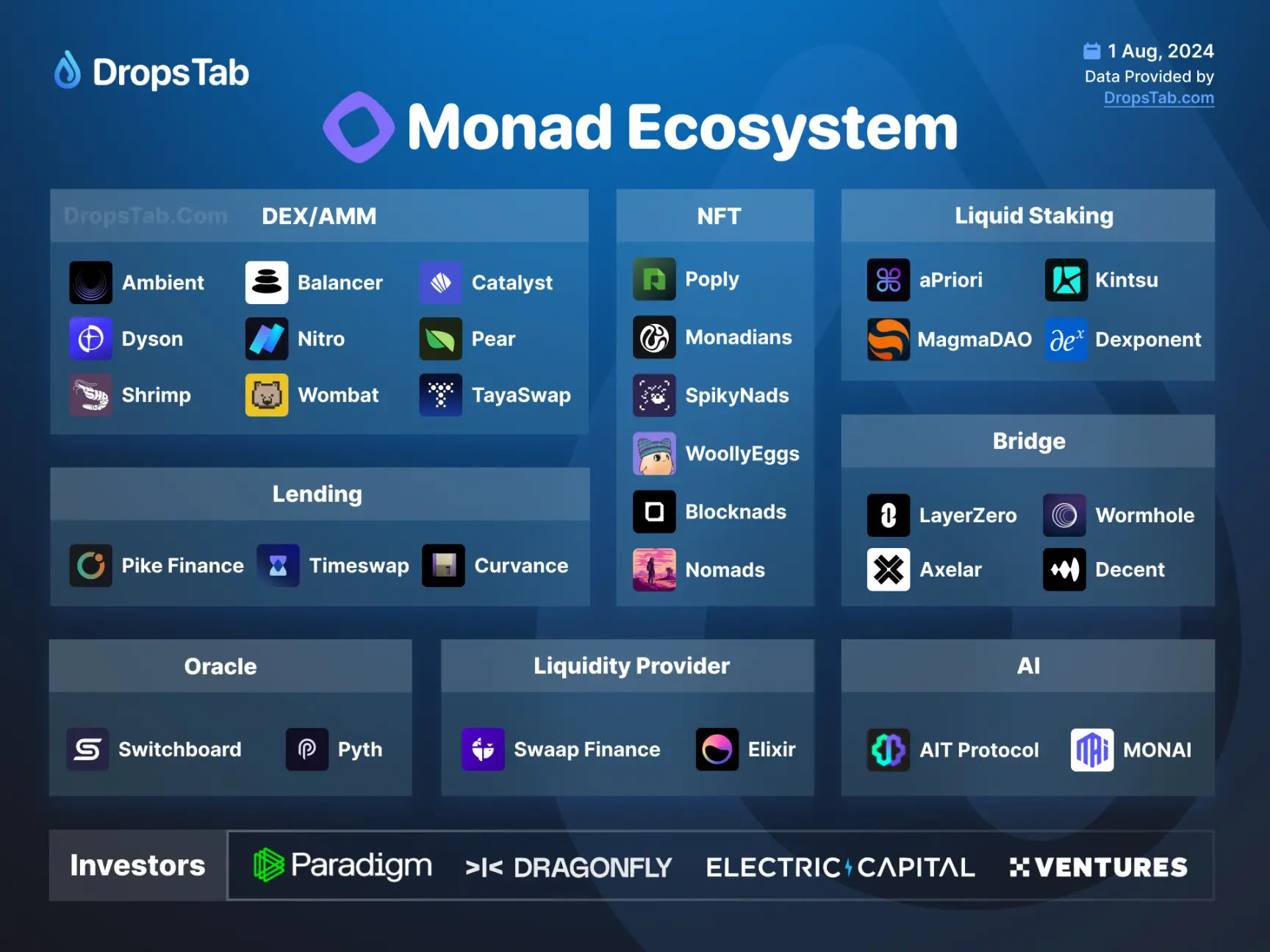
Monad’s parallel EVM architecture is shifting from theoretical benchmarks to live, high-throughput applications. The network’s ability to process transactions in parallel allows DeFi protocols to handle complex interactions—like rapid arbitrage or high-frequency trading—without the congestion that plagues traditional EVM chains. As the ecosystem matures, developers are building specialized tools that leverage this speed for real-world utility.
0x Protocol
0x has integrated with Monad to provide decentralized exchange infrastructure that capitalizes on the network’s low latency. By leveraging Monad’s parallel processing, 0x can aggregate liquidity from multiple sources with minimal slippage, offering traders faster execution speeds compared to legacy chains. This integration is critical for traders who need to execute large orders without impacting market prices, making 0x a foundational piece of Monad’s DeFi stack.
Monad Bridge
The official Monad Bridge serves as the secure gateway for moving assets between Ethereum and Monad. It uses a proof-of-stake bridge mechanism to ensure that assets transferred to the high-speed L1 are backed 1:1 on Ethereum. This is the primary entry point for liquidity, allowing users to access Monad DeFi apps without relying on risky third-party wrappers. The bridge’s design prioritizes security and finality, ensuring that users can move capital in and out of the ecosystem with confidence.
Securing Your Monad Assets
Interacting with high-throughput DeFi apps requires robust security, especially when managing tokens like MON. Hardware wallets provide an offline layer of protection for your private keys, ensuring that even if your computer is compromised, your assets remain safe. When selecting a wallet, look for devices that support EVM-compatible chains and have active community support for new networks.


As an Amazon Associate, we may earn from qualifying purchases.
Developer Experience and Tooling
Monad is designed to be a frictionless destination for Ethereum developers. The network offers 100% EVM compatibility, which means you can deploy existing smart contracts and dApps without writing a single line of new code. You do not need to refactor your Solidity or change your deployment pipelines. This zero-code-change approach removes the biggest barrier to entry for new Layer-1 networks, allowing teams to focus on performance rather than porting legacy code.
The tooling ecosystem supports this seamless transition through established infrastructure providers. Infura has integrated Monad into its network suite, giving developers access to reliable node services that work with their existing configurations. Because Monad mirrors the Ethereum execution environment, tools like Hardhat, Foundry, and standard wallets recognize the network immediately. You can switch your RPC endpoints and continue testing and deploying exactly as you would on Ethereum Mainnet or Sepolia.
This compatibility extends to parallel execution. While Ethereum processes transactions sequentially, Monad uses a parallel EVM architecture to handle multiple transactions simultaneously. This means your existing contracts run faster and cheaper without requiring modifications to their logic. The result is a high-performance environment that feels familiar to anyone who has built on Ethereum.
Monad Ecosystem Growth in 2026
The Monad parallel EVM is moving from testnet anticipation to a live ecosystem. Developers are porting existing Ethereum applications without code changes, leveraging the network’s 10,000 TPS and sub-second finality. This compatibility allows established DeFi protocols to deploy immediately on Monad’s high-throughput layer.
The ecosystem is currently defined by a wave of early adopters rather than a saturated marketplace. Projects are focusing on high-frequency trading and complex financial instruments that were previously bottlenecked by Ethereum’s sequential processing. This shift is attracting significant developer activity, as teams seek to capitalize on the network’s unique parallel execution capabilities.
While total value locked (TVL) is still in its growth phase, the quality of projects launching on Monad is gaining attention. Early partnerships and integrations signal a strong foundation for long-term adoption. As the mainnet stabilizes, the focus is shifting from infrastructure building to user-facing applications that demonstrate the speed advantage of parallel EVM technology.
No comments yet. Be the first to share your thoughts!