
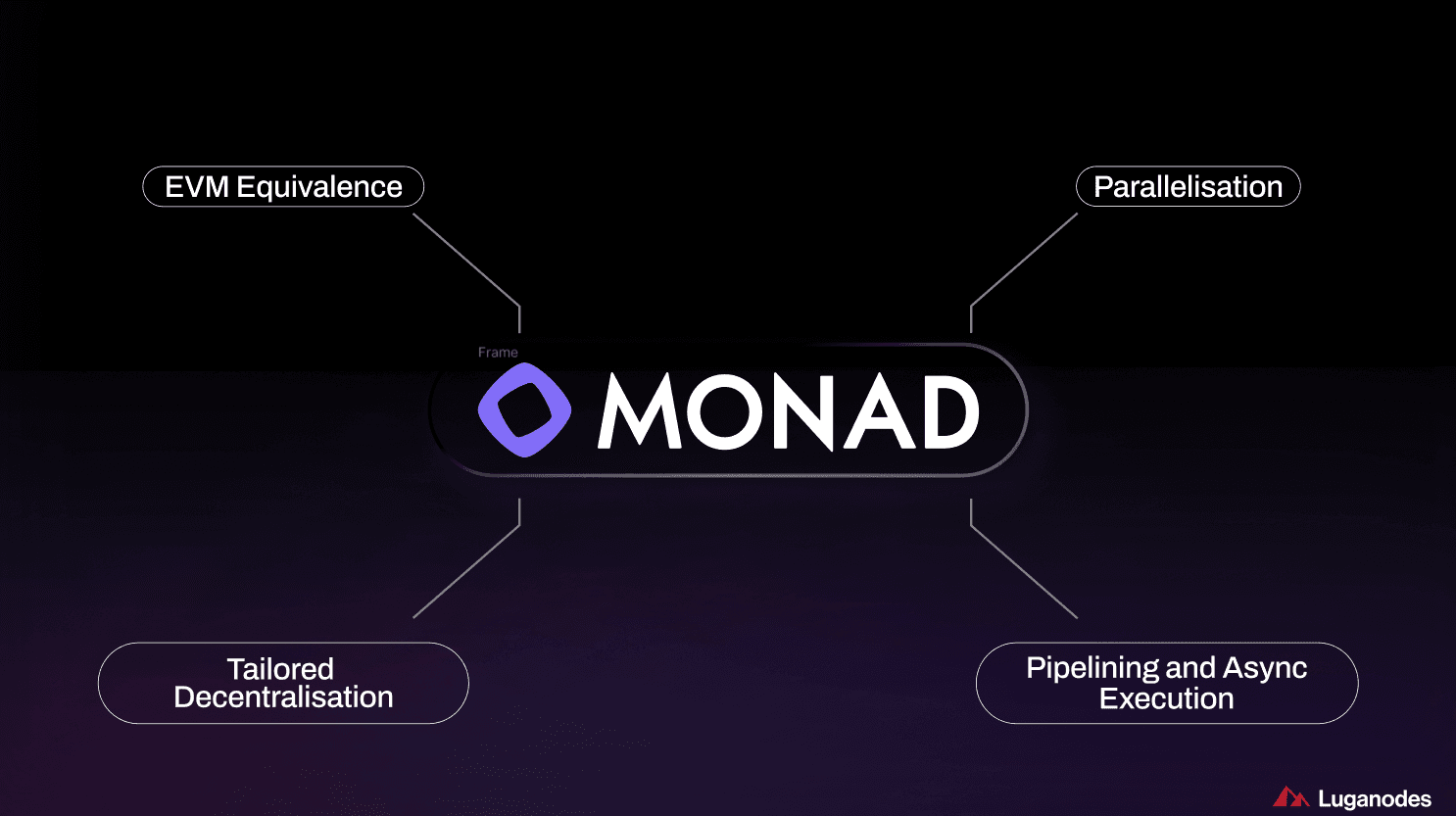
Monad blockchain performance metrics
Monad positions itself as the most performant EVM-compatible blockchain, claiming 10,000 transactions per second (TPS), 0.8-second finality, and 0.4-second block times. These figures represent a significant departure from legacy Ethereum Layer 1s, which are constrained by sequential block production. Monad’s architecture achieves this throughput through parallel EVM execution, allowing it to process multiple transactions simultaneously rather than one after another.
The technical foundation relies on parallelizing the execution layer while maintaining EVM compatibility. This design choice aims to eliminate the bottlenecks that have historically limited Ethereum’s scalability. By processing transactions in parallel, Monad can theoretically handle the volume required for high-frequency financial applications without the latency typical of traditional smart contract platforms.
However, these metrics are current claims rather than proven on-chain statistics. The network has not yet launched its mainnet, meaning the 10,000 TPS figure represents theoretical maximums under ideal conditions. Investors and developers should treat these numbers as projected capabilities rather than historical performance data. The gap between testnet benchmarks and mainnet reality often widens under real-world load conditions.
The live price action of MON/USD reflects the speculative nature of pre-launch assets. With a current price around $0.018 and a market cap near $222 million, the token trades in a highly volatile environment. The low trading volume relative to larger cap assets indicates that price discovery is still in early stages. Any analysis of Monad’s market position must account for the lack of historical data and the inherent risks associated with unproven infrastructure.
While the technical specs are ambitious, the true test will be mainnet stability. The parallel execution model introduces new complexity in consensus and state management. Monitoring the transition from testnet to mainnet will provide the first concrete evidence of whether Monad can deliver on its throughput promises without compromising security or decentralization.
2026 mainnet launch timeline
The Monad mainnet launch is the critical inflection point for the project’s transition from experimental code to a production-grade financial network. While the protocol has demonstrated 100,000 TPS in isolated test environments, the 2026 release marks the shift to a permissionless, open network where real capital and decentralized applications will operate. This phase distinguishes itself from previous testnet iterations by introducing full economic security and finality guarantees required for institutional adoption.
Current testnet phases have served as stress tests for Monad’s parallelized EVM execution. These environments allow developers to optimize smart contracts and verify that the 0.4-second block times hold under simulated load. However, testnet tokens carry no monetary value, and the network is not subject to the same censorship resistance or economic incentives as the live chain. The gap between testnet performance and mainnet stability remains the primary risk factor for early participants.
The 2026 timeline is anchored by the Monad Foundation, the organization tasked with overseeing the protocol’s growth and governance. Official communications from monad.foundation indicate a phased rollout approach, prioritizing network stability over aggressive feature deployment. This cautious strategy aims to prevent the exploits and instability that have plagued other high-performance EVM competitors in their early stages.
Market participants should monitor the official Monad website for precise launch dates and validator onboarding details. Until the mainnet is live, all trading activity involves speculative derivatives or testnet assets, not the primary MON token. The transition to mainnet will likely trigger significant volatility as liquidity providers and early adopters establish initial market depth.
Parallel EVM ecosystem growth
The Monad developer ecosystem is shifting from speculative anticipation to tangible infrastructure deployment. As a high-performance, EVM-compatible Layer 1, Monad allows developers to port existing Ethereum dApps with minimal friction while leveraging parallel execution for throughput [src-serp-7]. This compatibility lowers the barrier to entry, accelerating the migration of liquidity and user bases from congested legacy networks.
To contextualize Monad’s market position, it is essential to compare its technical specifications against the established benchmarks of Ethereum and Solana. The following table outlines the core performance metrics that define the current parallel EVM landscape.
| Metric | Monad | Ethereum | Solana |
|---|---|---|---|
| Execution Model | Parallel EVM | Sequential | Parallel |
| Target TPS | 10,000+ | ~15-30 | ~4,000 |
| Finality | Sub-second | ~12-15 min | ~400 ms |
| EVM Compatibility | Full | Native | No (via bridges) |
The divergence in execution models highlights the primary value proposition of the parallel EVM approach. While Ethereum relies on sequential processing to maintain security, Monad’s architecture processes transactions in parallel, significantly reducing latency and cost. This structural advantage is critical for high-frequency applications, such as decentralized exchanges and gaming, where traditional EVM bottlenecks often degrade user experience.
Market risks and tokenomics
Use this section to make the Monad Blockchain decision easier to compare in real life, not just on paper. Start with the reader's actual constraint, then separate must-have requirements from details that are merely nice to have. A practical choice should survive normal use, maintenance, timing, and budget. If a recommendation only works in an ideal situation, call that out plainly and give the reader a fallback path.
The simplest way to use this section is to write down the must-have criteria first, then compare each option against those criteria before weighing nice-to-have features.
No comments yet. Be the first to share your thoughts!