
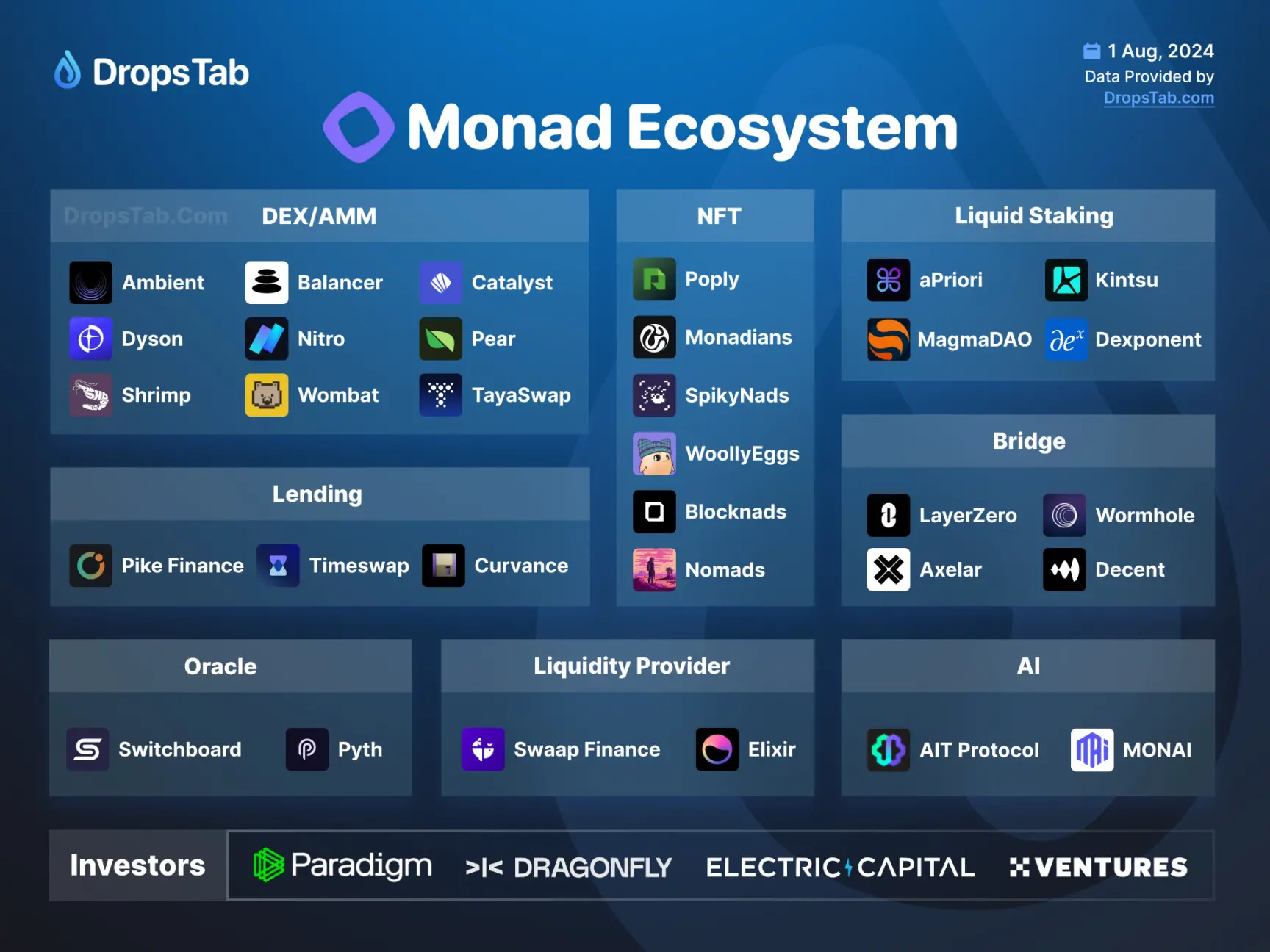
Parallel EVM Architecture
Monad distinguishes itself through a parallel execution engine designed to resolve the throughput limitations inherent in traditional Ethereum Virtual Machine (EVM) chains. While the EVM was originally built for sequential processing, Monad re-engineers the underlying execution layer to process multiple transactions simultaneously. This architectural shift allows the network to achieve 10,000 transactions per second (TPS) with 0.8-second finality and 0.4-second block times, as stated in their official technical documentation [1].
The core mechanism relies on a two-phase execution model. In the first phase, Monad uses a novel scheduling algorithm to identify independent transactions—those that do not conflict on state access—and executes them in parallel across multiple cores. In the second phase, dependent transactions are processed sequentially to ensure deterministic outcomes. This approach preserves the EVM’s composability and developer familiarity while dramatically increasing capacity. As noted on the Monad homepage, this design enables builders to "build beyond limits" without sacrificing the security guarantees of the EVM standard [1].
This parallelism is not merely a theoretical improvement but a structural necessity for high-frequency decentralized applications. By reducing block times to 0.4 seconds, Monad minimizes the latency that often hinders user experience on congested networks. The result is a blockchain infrastructure that can support complex DeFi protocols, high-volume gaming, and real-time data applications without the gas fee spikes typical of sequential EVM chains.
Technical performance and finality metrics
Monad’s architecture is engineered to resolve the throughput bottlenecks inherent in sequential EVM execution. By leveraging parallel processing, the network achieves a theoretical capacity of 10,000 transactions per second (TPS). This performance metric is not merely a marketing figure but a structural outcome of its optimized execution layer, which allows for concurrent transaction validation without compromising EVM compatibility.
The network’s speed is defined by its block time and finality intervals. Monad targets a block time of 0.4 seconds, enabling rapid transaction inclusion. More critically, it achieves finality in approximately 0.8 seconds. This near-instant finality significantly reduces the latency typically associated with blockchain confirmations, making the infrastructure suitable for high-frequency applications and real-time financial settlements.
To contextualize these metrics within the broader market, the following chart illustrates the current price action of the MON token. While technical performance establishes the network's capability, market valuation reflects investor sentiment regarding its adoption trajectory.
Ecosystem growth and developer adoption
The viability of Monad as a high-performance EVM chain depends on its ability to convert technical specifications into active economic usage. As the network transitions from testnet phases to mainnet readiness, the focus has shifted from raw throughput metrics to tangible developer engagement and decentralized application (dApp) deployment. This section evaluates the current state of the ecosystem, analyzing whether the projected 10,000 TPS and 0.8-second finality are translating into sustained network activity and institutional interest.
Competitive Positioning in the EVM Landscape
To understand Monad’s market position, it is necessary to compare its technical architecture against established leaders in the high-throughput segment. While Solana has proven the viability of non-EVM parallel execution, Monad aims to capture the Ethereum developer base by offering parallel EVM execution. The following table compares key performance indicators, highlighting the trade-offs between monolithic L1s and modular L2s.
| Metric | Monad | Solana | Major L2s |
|---|---|---|---|
| Execution Model | Parallel EVM | Sealevel (Non-EVM) | Sequential EVM |
| Target TPS | 10,000+ | 65,000+ | 4,000-10,000 |
| Finality | ~0.8s | ~400ms | 1-15s |
| Developer Tooling | Full EVM Compatibility | Rust/Solana SDK | Solidity/Foundry |
Developer Activity and Institutional Signals
Technical performance alone does not guarantee ecosystem longevity; developer adoption serves as the primary proxy for long-term sustainability. Early indicators suggest a growing interest from institutional capital, driven by Monad’s promise of removing technical risks associated with non-EVM chains while delivering L1-level performance. According to market analysis, strong TVL growth and active institutional participation are emerging as key pros for the network’s future outlook.
However, the ecosystem remains in a formative stage. The density of dApp launches is currently lower than that of established competitors like Solana or Ethereum L2s such as Arbitrum and Optimism. The success of Monad will likely depend on its ability to onboard top-tier DeFi protocols and NFT platforms that require low-latency, high-throughput environments without sacrificing EVM compatibility. Until a critical mass of applications is deployed, the network’s theoretical capabilities remain unproven in real-world market conditions.
Market Outlook and Viability
The intersection of technical capability and market adoption defines Monad’s trajectory for 2026. While the protocol offers a compelling value proposition for developers seeking to scale EVM applications, the competitive landscape is intense. Investors and analysts are closely monitoring on-chain metrics, such as unique active addresses and transaction volume, to assess whether the network can sustain its growth post-mainnet launch. The removal of technical risk is a significant milestone, but the transition to a self-sustaining ecosystem requires consistent developer retention and user adoption.
2026 market outlook and price scenarios
The 2026 market outlook for Monad (MON) centers on the intersection of post-airdrop supply absorption and actual ecosystem utility. Current market analysis suggests a wide variance in price trajectories, heavily dependent on whether the network can sustain transaction volume sufficient to absorb circulating supply. Analysts generally categorize these projections into conservative accumulation phases and optimistic expansion scenarios.
Conservative models, such as those cited by Yahoo Finance, project Monad reclaiming the $0.05 to $0.08 range in 2026. This baseline assumes gradual ecosystem usage expansion without significant speculative volatility. In this scenario, the token functions primarily as a utility asset for EVM parallelism, with price stability driven by steady demand from decentralized applications rather than broad market speculation.
Conversely, bearish forecasts from sources like StealthEX and 3Commas suggest a slower accumulation phase, with estimates placing the price near $0.02 to $0.023. These projections reflect a cautious view where supply overhangs persist and real-world application adoption lags behind technical capability. While some long-term models treat a $1 valuation as a distant possibility, most current data treats this as unlikely for 2026, requiring infrastructure success and sustained user engagement to justify such a premium.
Regulatory and governance considerations
Investors in Monad must account for the evolving regulatory landscape surrounding decentralized infrastructure. As the project moves toward mainnet operations, compliance with financial regulations and data privacy laws remains a critical variable. The legal framework for EVM parallelism is still emerging, creating uncertainty that could impact adoption rates and institutional participation.
On the governance front, the community is closely monitoring proposal MIP-12, which seeks to upgrade the MonadBFT consensus mechanism. This proposal aims to reduce voting cycles from 400ms, a change that could significantly influence network efficiency and decentralization metrics. Such technical adjustments often precede major governance votes that determine token utility and staking rewards.
The interplay between technical governance and regulatory scrutiny defines the risk profile for long-term holders. While parallel execution offers speed advantages, it does not exempt the protocol from existing securities laws. Stakeholders should track official announcements regarding MIP-12 and related governance updates to assess the project's alignment with legal standards.
Frequently Asked Questions About Monad
Investors evaluating Monad often seek clarity on its price potential and investment viability relative to its technical roadmap. The following analysis addresses common queries regarding valuation targets and market positioning, grounded in current ecosystem metrics and analyst projections.
For real-time price monitoring, traders often track Monad against major fiat pairs. The live widget below provides current market data sourced directly from Binance.
No comments yet. Be the first to share your thoughts!