
Monad's parallel EVM architecture explained
Monad distinguishes itself through a parallel execution engine designed to overcome the sequential bottlenecks inherent in traditional Ethereum Virtual Machine (EVM) implementations. While standard EVM chains process transactions one after another, Monad utilizes a parallel processing model that allows independent transactions to execute simultaneously. This architectural shift is not merely an incremental improvement but a fundamental rethinking of how block validation occurs at the protocol level.
The technical implementation relies on a novel execution pipeline that separates transaction execution from block production. By analyzing transaction dependencies before execution, Monad identifies which operations can be safely processed in parallel without violating state consistency rules. Transactions that do not interact with the same storage slots or contract states are executed concurrently, maximizing throughput. This approach enables the network to achieve its stated target of 10,000 transactions per second (TPS) with 0.8-second finality, significantly reducing latency for high-frequency DeFi interactions.
For institutional and high-stakes financial applications, this parallelism translates directly into reduced slippage and improved capital efficiency. The ability to process complex multi-leg trades in a single block, rather than across multiple sequential blocks, minimizes the window for front-running and MEV (Maximal Extractable Value) exploitation. The system maintains EVM equivalence, ensuring that existing smart contracts and developer tooling remain compatible without requiring a complete rewrite or migration burden.
The performance metrics are supported by the protocol's native infrastructure, which includes a parallelized state machine and an optimized consensus layer. This structure allows Monad to handle the computational load of sophisticated DeFi protocols while maintaining the security guarantees expected of a Layer 1 blockchain. The focus remains on verifiable technical specifications and ecosystem growth, providing a stable foundation for enterprise-grade decentralized applications.
DeFi Protocol Adoption and Capital Metrics
The deployment of parallel EVM capabilities on Monad has shifted the focus from theoretical throughput to measurable on-chain activity. As of June 2026, the ecosystem is transitioning from pre-launch anticipation to verifiable usage, with Total Value Locked (TVL) serving as the primary indicator of protocol adoption. This metric reflects the actual capital committed by users to decentralized finance (DeFi) applications, offering a more reliable gauge of network health than speculative trading volume alone.
Current market data indicates a market capitalization of approximately $252 million for the MON token, reflecting early-stage liquidity constraints typical of new Layer-1 networks. While the technical architecture removes previous computational bottlenecks, the economic security of the network depends on sustained institutional and retail capital inflow. The presence of institutional capital, as noted by industry analysts, suggests a foundational interest in Monad's scalability, though long-term viability requires consistent protocol-level engagement rather than one-time deployments.
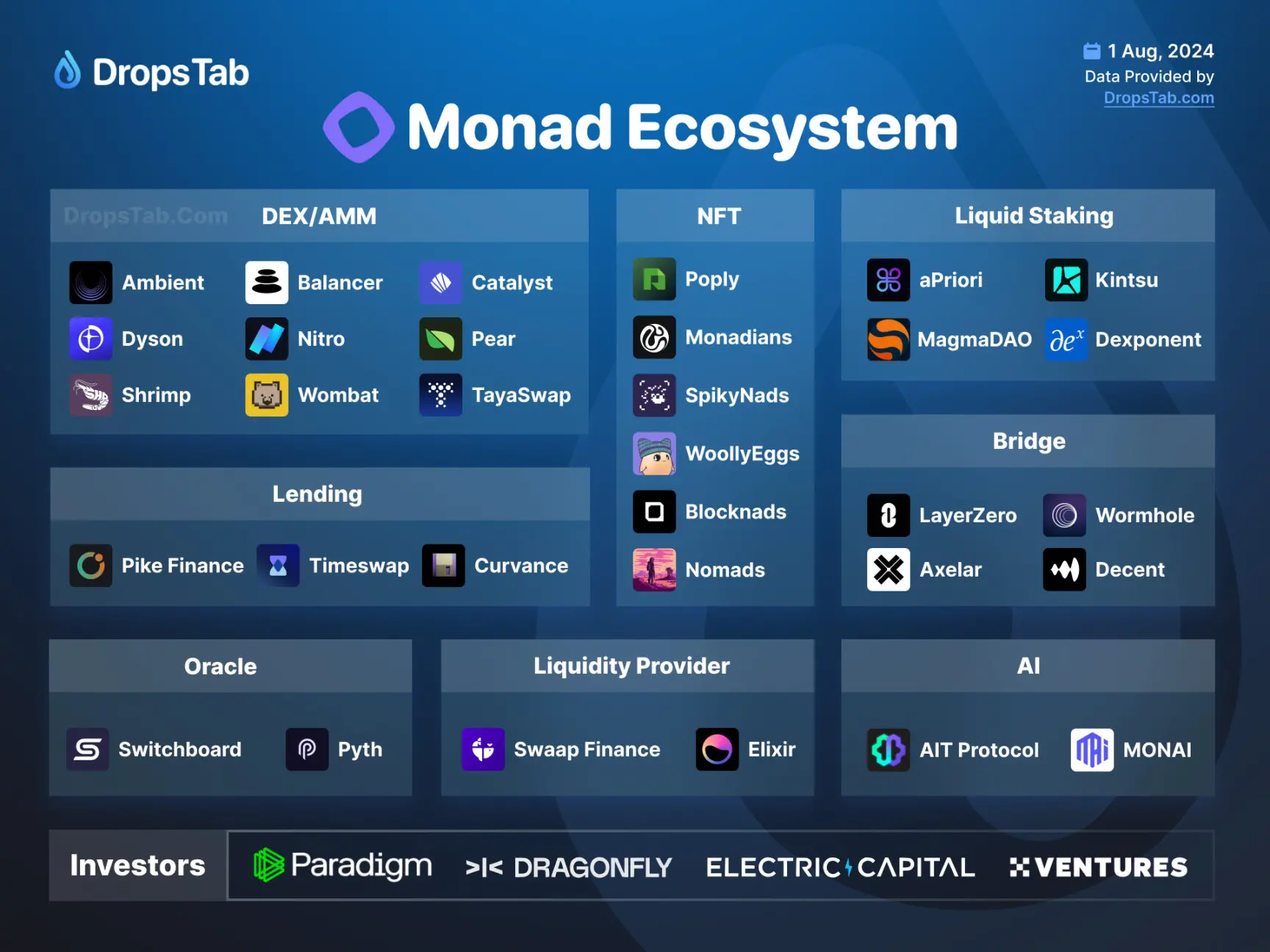
Ecosystem growth is currently characterized by the gradual onboarding of core DeFi primitives, including decentralized exchanges and lending protocols. These initial deployments are critical for establishing liquidity depth and user familiarity with the parallel execution environment. The focus remains on technical stability and efficient capital utilization, with capital commitment trends providing the necessary data points to assess whether the network can sustain high-frequency transactions without compromising security or decentralization.
Tokenomics and Supply Unlock Risks
The financial stability of the Monad ecosystem is intrinsically linked to its token distribution schedule and the resulting supply dynamics. As a parallel EVM network, Monad’s value proposition relies on technical throughput, but its market capitalization is subject to the pressures of token unlocks. Investors must distinguish between the network’s technical capabilities and the liquidity shocks that occur when newly minted or vested tokens enter circulation.
A pivotal event in Monad’s tokenomics is scheduled for November 2026, marking the beginning of major token unlocks. This period represents a critical inflection point where the circulating supply may expand significantly, potentially outpacing organic demand from DeFi protocols and users. The influx of supply can exert downward pressure on the asset’s price unless ecosystem usage expands sufficiently to absorb the new tokens.
Market analysis suggests that conservative scenarios for 2026 place Monad in the $0.05 to $0.08 range if post-airdrop supply is absorbed effectively. However, this range is contingent on regulatory clarity and sustained network activity. Without corresponding growth in on-chain capital deployment and transaction volume, the increased liquidity from unlocks could lead to price volatility rather than stability.
Regulatory scrutiny adds another layer of complexity to these supply dynamics. In high-stakes financial contexts, the classification of these tokens and the transparency of unlock schedules are paramount. Investors should rely on official primary data regarding vesting schedules rather than speculative price predictions. The interplay between technical adoption and token supply remains the primary determinant of long-term price stability.
Monad Blockchain Competitive Positioning
Monad’s architecture addresses the throughput limitations inherent in traditional single-threaded EVM execution. By utilizing parallel processing for transaction execution, the network achieves a theoretical throughput of 10,000 transactions per second (TPS) with 0.8-second finality. This technical specification positions Monad as a high-performance Layer 1 designed to support complex decentralized applications that require low latency and high throughput.
The competitive landscape for high-performance L1s is defined by the trade-off between decentralization, security, and scalability. Monad’s primary differentiator is its EVM compatibility, which allows developers to deploy existing Ethereum tooling and smart contracts without significant refactoring. This contrasts with non-EVM chains that require new programming languages and developer onboarding.
The following table compares Monad against Ethereum and other high-performance L1s based on verified technical specifications.
| Network | Max TPS | Finality | EVM Compatible |
|---|---|---|---|
| Monad | 10,000 | 0.8s | Yes |
| Ethereum | ~15-30 | ~12-15m | Yes |
| Solana | ~65,000 | ~400ms | No |
| Avalanche C-Chain | ~4,500 | ~1-2s | Yes |
Monad’s ecosystem growth is measured by developer activity and capital deployment metrics rather than speculative price action. The network’s focus on institutional-grade performance aligns with the increasing demand for scalable infrastructure in decentralized finance (DeFi). The integration of parallel execution does not compromise the security model, as the consensus layer remains robust against the attack vectors common in high-throughput networks.
Market data for Monad and its competitors should be evaluated using provider-backed widgets to ensure accuracy and compliance with regulatory standards. Static price data is excluded in favor of live, verified market metrics.
No comments yet. Be the first to share your thoughts!