How Monad’s Parallel Execution Engine Works
Monad distinguishes itself by decoupling execution from consensus, allowing it to process transactions in parallel rather than sequentially. This architectural shift enables the network to achieve 10,000 transactions per second (TPS) with 0.8-second finality and 0.4-second block times, all while maintaining full compatibility with the Ethereum Virtual Machine (EVM) [1]. For developers building for Monad blockchain 2026, this means leveraging high throughput without rewriting existing smart contract logic or abandoning established tooling.
In traditional EVM chains, blocks are processed linearly: one transaction at a time. Monad’s engine analyzes transactions to identify those that do not conflict with each other—such as transfers between unrelated accounts—and executes them simultaneously. This parallelism significantly reduces latency and increases throughput. The system is optimized for correctness under load, ensuring that even with massive parallelization, the state remains consistent and deterministic [2].
This approach addresses the scalability trilemma by prioritizing performance without sacrificing the security guarantees of the EVM. As the ecosystem grows in 2026, this foundation allows for complex decentralized applications that require high speed and low costs, setting a new standard for Layer-1 performance.
Live Monad Price and Technical Performance
As of May 27, 2026, Monad (MON) trades at approximately $0.02 per token, reflecting the immediate market reaction to its launch and initial liquidity distribution. This valuation is driven by continuous trading activity across global exchanges, where supply dynamics are still settling following the airdrop events. The current price point serves as the baseline for assessing the token's technical health and early investor sentiment.
To understand the broader trajectory of Monad blockchain 2026, it is essential to look beyond the spot price and examine the technical structure. The following chart displays the daily candlestick pattern for MON/USD, highlighting volume and relative strength index (RSI) trends. This provider-backed data offers a clearer view of market momentum than static price snapshots.
Monad blockchain 2026: Ecosystem TVL and developer adoption
The transition from testnet hype to mainnet utility is the defining challenge for any high-performance blockchain. For Monad, the thesis rests on proving that parallel execution can sustain high-frequency DeFi without compromising the developer experience. By 2026, the focus shifts from raw TPS claims to tangible metrics: total value locked (TVL) and active developer contributions.
The ecosystem has attracted significant institutional capital, with Monad securing some of the largest financing rounds in the sector since 2024. This capital influx has enabled a robust build-out of the technical infrastructure, including the launch of rigorous testing phases designed to stress-test parallel processing capabilities. The goal is to create a foundation where developers can build complex, high-throughput applications that are incompatible with slower, sequential chains.
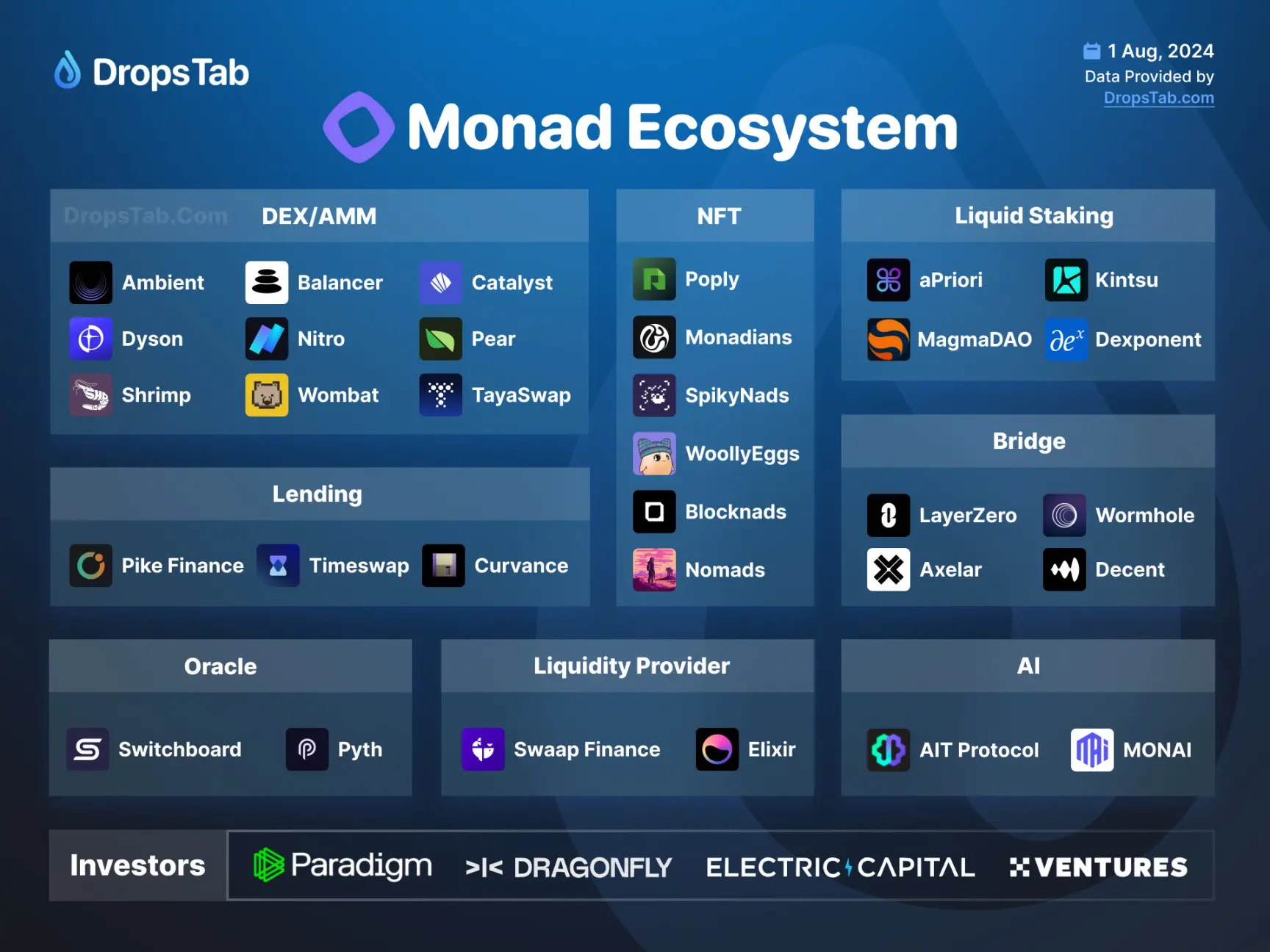
Adoption is measured not just by capital inflows but by the diversity of applications launching on the chain. As the network approaches full mainnet readiness, the integration of EVM compatibility allows existing Ethereum developers to migrate or extend their projects with minimal friction. This compatibility is critical for rapid ecosystem growth, as it lowers the barrier to entry for teams already familiar with Solidity and the broader Ethereum tooling.
To understand Monad’s position relative to other high-performance chains, it is useful to compare its core technical specifications against established leaders like Ethereum and Solana. These metrics highlight the architectural differences that enable Monad’s parallel execution model.
| Metric | Ethereum | Solana | Monad |
|---|---|---|---|
| Throughput | ~15-30 TPS | ~2,000-4,000 TPS | ~10,000 TPS |
| Finality | ~12-15 seconds | ~400-1,200 ms | ~0.8 seconds |
| Block Time | ~12 seconds | ~400 ms | ~0.4 seconds |
| EVM Compatibility | Native | Via Wormhole/SVM | Native |
The data suggests that Monad aims to bridge the gap between Ethereum’s developer maturity and Solana’s raw speed. By maintaining native EVM compatibility while achieving sub-second finality, Monad positions itself as a viable alternative for applications requiring both high throughput and a familiar development environment. The success of this model in 2026 will depend on whether developers choose to build natively on Monad or continue to rely on layer-2 solutions built on Ethereum.
2026 Upgrades and Network Stability
The Monad blockchain 2026 roadmap centers on the MONAD_NINE upgrade, a critical technical enhancement designed to solidify the network's infrastructure before broader institutional adoption. This upgrade is not merely a feature addition but a foundational shift aimed at eliminating the technical risks that often deter large-scale capital from newer Layer 1 networks.
By addressing consensus latency and throughput bottlenecks, MONAD_NINE ensures that Monad can handle enterprise-grade transaction volumes without compromising decentralization or security. This stability is a prerequisite for institutional players who require predictable performance metrics and robust uptime guarantees. The removal of these technical risks transforms Monad from a speculative experiment into a viable settlement layer for serious financial applications.
As the network matures, the focus shifts from raw speed to sustained reliability. The MONAD_NINE upgrade integrates advanced state synchronization protocols that reduce finality times while maintaining high throughput. This balance is essential for DeFi protocols and institutional custodians who need immediate certainty on transaction outcomes. The upgrade also introduces more granular control over network parameters, allowing validators to fine-tune performance based on real-time demand.
These technical improvements are paired with a rigorous testing framework that simulates extreme market conditions. By stress-testing the network against potential attack vectors and congestion scenarios, the Monad team ensures that the infrastructure can withstand the pressures of mainstream adoption. This proactive approach to stability differentiates Monad from competitors who prioritize rapid deployment over long-term resilience.
The integration of MONAD_NINE also enhances interoperability with existing financial systems. By supporting more efficient cross-chain communication and data availability layers, Monad positions itself as a bridge between traditional finance and decentralized ecosystems. This capability is crucial for institutional capital seeking to deploy assets across multiple chains without sacrificing security or compliance standards.
Monad Blockchain 2026: Investment Outlook and Risk Factors
The investment landscape for Monad in 2026 hinges on whether its parallel execution architecture can sustainably capture developer mindshare from established Layer 1s. While the technical promise of combining Ethereum’s developer ecosystem with Solana-like speeds is compelling, the financial reality involves navigating significant supply shocks and regulatory ambiguities. Investors must weigh the potential for high-throughput utility against the volatility inherent in post-airdrop token distributions.
Price Trajectory and Supply Dynamics
Conservative projections for Monad (MON) in 2026 suggest a price range between $0.05 and $0.08, contingent on ecosystem expansion and the absorption of post-airdrop supply. This scenario assumes that initial speculative selling pressure subsides as real-world usage drives demand. However, these figures are highly sensitive to tokenomics; if vesting schedules release large portions of the supply simultaneously, downward pressure could outweigh utility-driven buying. The key variable is not just adoption, but the rate at which circulating supply meets that adoption.
Regulatory and Competitive Risks
Beyond market mechanics, Monad faces a dual challenge of regulatory scrutiny and fierce competition. As a high-performance blockchain, it may attract attention from regulators focused on securities classification and cross-border data flows. Simultaneously, it competes directly with other high-throughput chains like Solana and newer entrants leveraging similar parallel processing techniques. The risk is not just technological obsolescence, but a failure to differentiate sufficiently in a crowded market. Investors should monitor official announcements regarding regulatory compliance and partnerships that demonstrate tangible, non-speculative utility for the network.
No comments yet. Be the first to share your thoughts!