Parallel execution architecture
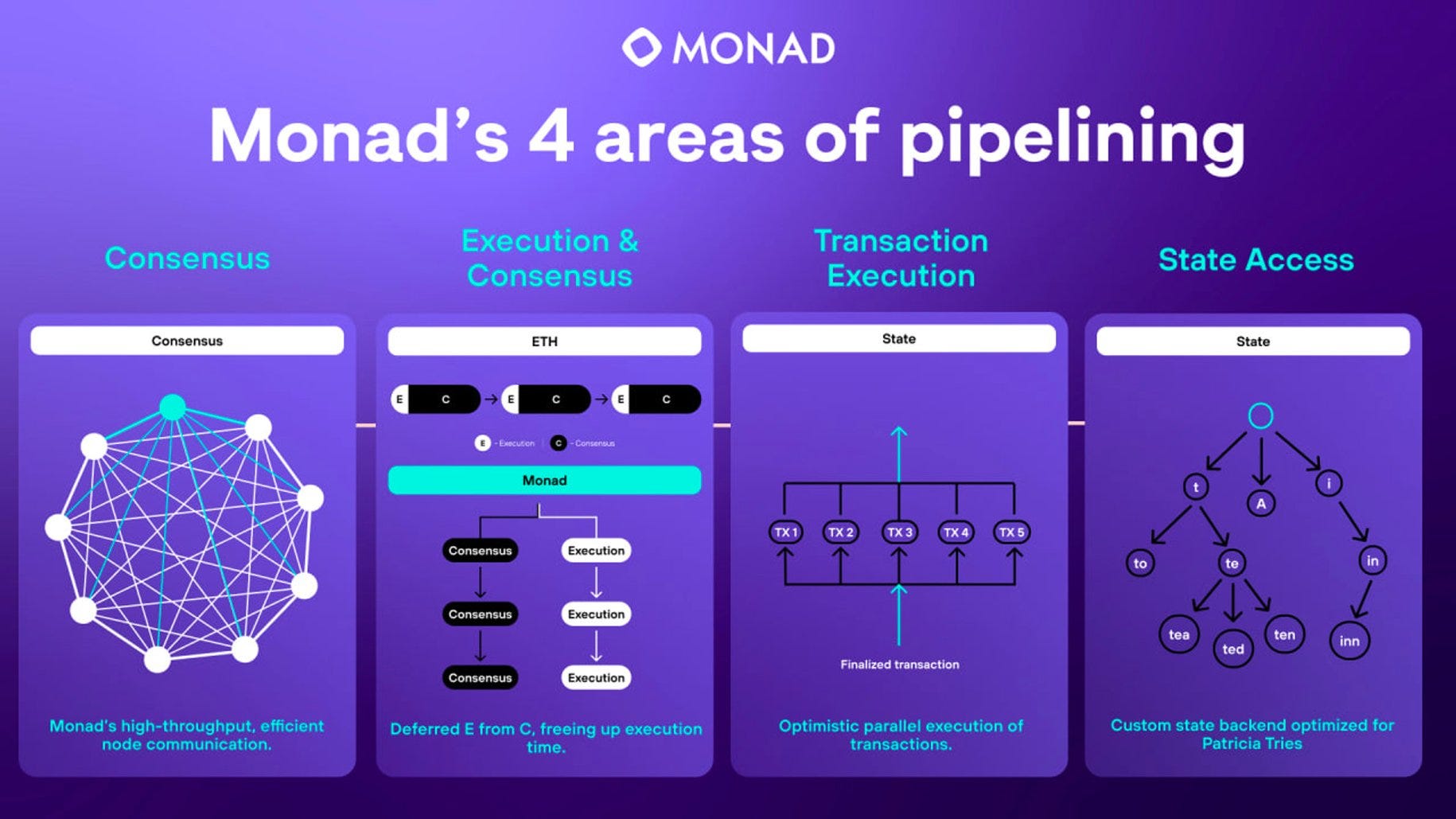
Monad distinguishes itself from existing EVM networks through its parallel execution engine. Standard EVM chains process transactions sequentially, creating a bottleneck where every block must wait for the previous transaction to complete. Monad removes this constraint by executing independent transactions simultaneously, allowing the network to handle significantly higher throughput without sacrificing compatibility.
This architecture enables Monad to claim 10,000 transactions per second (TPS) with 0.8-second finality. To understand the scale, consider that Ethereum processes roughly 15-30 TPS sequentially, while Solana achieves high speeds through a fundamentally different, non-EVM architecture. Monad bridges this gap by retaining full EVM compatibility while unlocking parallel processing power. This means developers can deploy existing Solidity smart contracts without modification, leveraging Monad's speed rather than rewriting code for a new virtual machine.
The technical shift is not merely about speed; it is about economic efficiency. By batching and executing transactions in parallel, Monad reduces the computational waste associated with sequential validation. This efficiency translates to near-zero fees for users, a critical factor for high-frequency trading and consumer applications. However, parallel execution introduces new complexity in state management and conflict resolution, requiring robust consensus mechanisms to ensure data integrity.
While the theoretical performance is compelling, the actual user experience depends on network adoption and validator distribution. High throughput is only valuable if the ecosystem supports high-volume applications. Monad's approach positions it as a potential infrastructure layer for high-frequency financial applications, but its success hinges on developer migration and sustained network security.
Mainnet 2026 Timeline and Developer Readiness
The Monad Foundation is steering the protocol toward its mainnet launch in 2026, a milestone that marks the transition from high-performance theoretical benchmarks to live, institutional-grade financial infrastructure. Unlike testnet environments that prioritize novelty, mainnet demands absolute reliability for a network promising 10,000 transactions per second with 0.8-second finality. The foundation’s role is not merely to deploy code but to cultivate an ecosystem capable of handling this throughput without compromising the EVM compatibility that developers rely on.
Developer tools are being hardened to support this scale. The foundation is establishing the necessary infrastructure to ensure that builders can deploy decentralized applications that leverage Monad’s parallel execution capabilities without the friction typical of early-stage Layer 1s. This preparation is critical; the gap between testnet performance and mainnet stability is where most high-throughput projects fail. By focusing on robust tooling and ecosystem growth, Monad aims to secure its position as the financial layer of the internet.
| Feature | Testnet Status | Mainnet Goal |
|---|---|---|
| Performance | Benchmarked | 10,000 TPS |
| Finality | Stable | 0.8s |
| Ecosystem | Developer Onboarding | Institutional Adoption |
The risk profile for early mainnet participants remains high. While the technical specifications are impressive, the market’s reaction to Monad’s live launch will depend on its ability to maintain uptime and security under real-world load. Investors and developers are watching closely to see if the foundation can deliver on its promise of parallel execution without sacrificing decentralization or security guarantees.
MON price and technical outlook
Monad (MON) is currently trading near $0.022, reflecting a volatile period for the high-performance Layer 1 blockchain. With a 24-hour trading volume hovering around $25 million, the token is navigating a consolidation phase. While recent data points to a slight daily decline, the broader technical structure remains a focal point for traders monitoring the project's institutional-grade execution claims.
The market cap sits at approximately $277 million against a circulating supply of 11.8 billion tokens. This valuation metric is critical for assessing the token's room for growth relative to its stated 10,000 TPS capacity. Traders should note that price movements are often amplified by the binary nature of mainnet launch expectations versus technical delivery.
Technical indicators suggest a balance between support and resistance levels. The 1D chart highlights key volume clusters that often precede significant directional moves. For investors, the primary risk lies in the gap between the projected parallel execution capabilities and the current market sentiment. Monitoring these technical levels provides a clearer picture of short-term momentum than static price snapshots alone.
Comparing Monad to Other High Throughput L1s
Monad’s architecture targets a specific gap in the current market: the performance ceiling of existing EVM-compatible networks. While Solana offers high throughput, it operates on a non-EVM stack, requiring developers to learn new tools and limiting direct compatibility with Ethereum’s vast ecosystem. Monad positions itself as a high-performance Layer 1 that retains full EVM compatibility, allowing Ethereum developers to deploy existing smart contracts and tooling without modification while accessing significantly higher speeds.
The core differentiator lies in Monad’s parallel execution engine. Unlike traditional sequential blockchains, Monad processes transactions concurrently, enabling theoretical throughput of up to 10,000 TPS. This is complemented by 400ms block times and 800ms finality, metrics that aim to rival or exceed the latency of established Layer 1s. For institutional and high-frequency applications, this reduction in finality time is critical for reducing counterparty risk and improving capital efficiency.
The following comparison highlights how Monad’s specifications stack up against Ethereum (as the EVM standard) and Solana (as the high-throughput non-EVM competitor). This data reflects current architectural capabilities and official technical claims.
| Network | Throughput (Theoretical) | Finality Time | EVM Compatible | Consensus Mechanism |
|---|---|---|---|---|
| Monad | 10,000+ | ~800ms | Yes | Proof of Stake |
| Solana | 65,000+ | ~400ms | No (Native) | Proof of History + PoS |
| Ethereum L1 | ~15-30 | ~12-15 mins | Yes | Proof of Stake |
While Solana leads in raw TPS on paper, Monad’s EVM compatibility lowers the barrier to entry for the broader Ethereum developer community. This compatibility is not merely a feature but a strategic advantage, allowing Monad to tap into the existing liquidity, security models, and developer talent pool of Ethereum. As the ecosystem matures, the ability to seamlessly migrate or deploy dApps from Ethereum to Monad without code refactoring could accelerate adoption more rapidly than niche L1s that require new infrastructure.
Frequently asked questions about Monad
Investors and developers frequently query the mechanics and market status of Monad. The following answers address the most common points of confusion regarding its technical architecture and current trading conditions.
Helpful gear
Use these product recommendations as a starting point, then choose the size, material, and price point that fit how you actually use the gear.

As an Amazon Associate, we may earn from qualifying purchases.
No comments yet. Be the first to share your thoughts!