Monad parallel evm architecture explained
Monad addresses the throughput limitations of traditional EVM blockchains by introducing parallel execution capabilities while maintaining 100% EVM compatibility. Unlike sequential processing models that bottleneck transaction throughput, Monad allows independent transactions to be processed simultaneously across multiple cores. This architectural shift enables the network to target approximately 10,000 transactions per second (TPS) with 0.4-second block times and 0.8-second optimistic finality [src-serp-1].
The core mechanism relies on dependency detection. Monad’s runtime analyzes transactions within a block to identify those that do not share state dependencies—such as interactions with different smart contracts or unrelated account balances. These independent transactions are then executed in parallel. Crucially, the network still maintains a linear ordering of transactions and blocks, ensuring deterministic outcomes and preserving the security guarantees that developers expect from the EVM environment [src-serp-5].
This design allows developers to deploy existing Ethereum smart contracts and toolchains without modification. By supporting the standard JSON-RPC protocol, Monad bridges the gap between high-performance layer-1 capabilities and the mature Ethereum developer ecosystem. This compatibility is essential for low-latency trading and complex DeFi interactions, where speed directly impacts capital efficiency and user experience [src-serp-6].
Monad Performance Metrics
Monad targets 10,000 transactions per second (TPS) with 0.8-second finality and 0.4-second block times. These figures position it as a high-throughput Layer-1 blockchain designed for low-latency trading and complex DeFi interactions. The architecture achieves this speed through parallel execution, processing multiple EVM instances simultaneously rather than sequentially.
The speed advantage is critical for traders who rely on low-latency execution. Traditional EVM chains often bottleneck during peak demand, causing delays that low-latency strategies cannot tolerate. Monad’s 0.4-second block time allows for rapid state updates, reducing the window for front-running and other latency-based attacks.
Infura and Monad Labs cite these metrics as benchmarks for scalable DeFi infrastructure. While real-world throughput may vary based on network congestion and transaction complexity, the theoretical capacity sets a new standard for EVM-compatible networks. This performance level supports complex smart contract interactions that would otherwise fail or stall on slower chains.
Monad vs Solana and Ethereum Scaling
Monad positions itself at the intersection of two dominant blockchain paradigms: the raw throughput of Solana and the developer compatibility of Ethereum. By re-engineering the EVM for parallel execution, Monad aims to deliver the speed typically associated with non-EVM chains while retaining the ability to deploy existing Ethereum smart contracts without modification. This approach targets low-latency trading and complex DeFi interactions that require both speed and a mature ecosystem of tools.
Performance and Throughput
The primary differentiator for Monad is its parallel processing architecture. While traditional Ethereum processes transactions sequentially, Monad executes them in parallel, theoretically achieving up to 10,000 transactions per second (TPS) [src-serp-4]. This places it in direct competition with Solana, which also offers high throughput and low fees but operates on a non-EVM virtual machine. Monad’s goal is to provide similar performance metrics to Solana without forcing developers to learn a new programming language or ecosystem.
EVM Compatibility and Developer Experience
For developers, Monad’s 100% EVM compatibility is a significant advantage over Solana. It allows for the seamless porting of Ethereum smart contracts and dApps using familiar toolchains like Hardhat and Foundry [src-serp-3]. This reduces the barrier to entry compared to Solana, which requires learning Rust or C. Monad also supports the standard JSON-RPC protocol, ensuring that existing Ethereum infrastructure can interact with the network [src-serp-8].
Finality and Network Structure
Both Monad and Ethereum are Layer-1 networks, but they differ in consensus and finality mechanisms. Ethereum relies on Proof-of-Stake with probabilistic finality, while Monad aims for faster deterministic finality through its parallel execution engine. Solana also uses Proof-of-History combined with Proof-of-Stake to achieve sub-second finality. Monad’s architecture seeks to balance the robust security model of Ethereum with the speed optimizations typically found in high-performance L1s.
Comparison Table
The following table outlines the key technical differences between Monad, Solana, and Ethereum.
| Feature | Monad | Solana | Ethereum |
|---|---|---|---|
| Architecture | Parallel EVM L1 | Non-EVM L1 | Sequential EVM L1 |
| Virtual Machine | EVM-compatible | Sealevel (Rust/C) | EVM |
| Estimated TPS | ~10,000 | ~65,000 | ~15-30 |
| Smart Contract Language | Solidity/Vyper | Rust/C/C++ | Solidity/Vyper |
| Consensus | Proof-of-Stake (Parallel) | Proof-of-History + PoS | Proof-of-Stake |
Market Positioning
Monad is not trying to replace Ethereum’s settlement layer but rather to compete with it on the execution layer’s performance. By offering a high-throughput L1 that is fully compatible with the Ethereum ecosystem, Monad addresses the scalability trilemma without sacrificing developer familiarity. This makes it a strong candidate for low-latency trading and gaming applications that require both speed and access to Ethereum’s liquidity and tooling.
Ecosystem growth and developer adoption
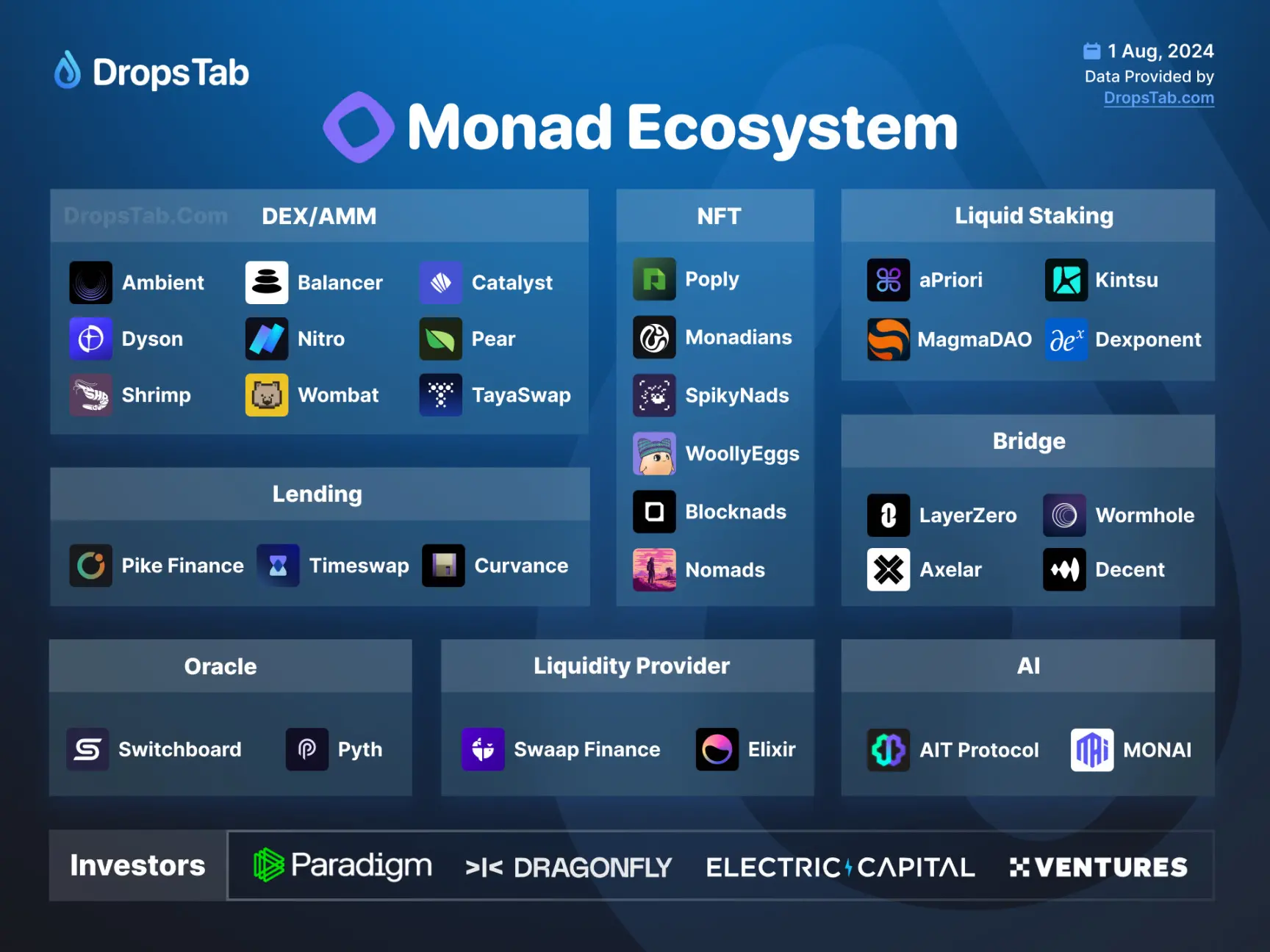
Monad’s ecosystem expansion is defined by its strict adherence to EVM compatibility, a strategy designed to lower barriers for existing Ethereum developers. The network supports the standard JSON-RPC protocol, allowing teams to deploy smart contracts and applications without rewriting code or learning new languages. This approach leverages familiar Ethereum toolchains, ensuring that the migration from existing L1 or L2 environments is frictionless.
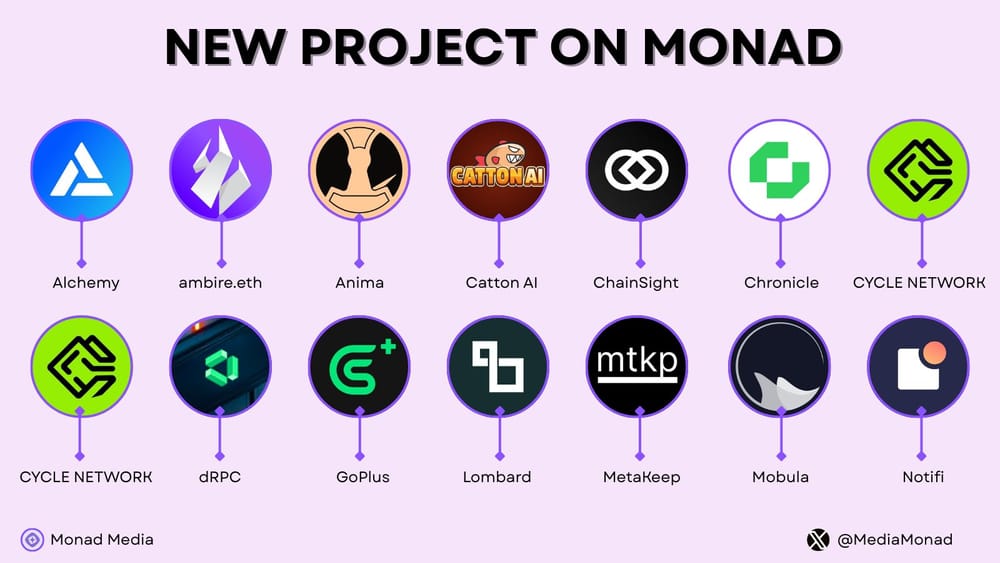
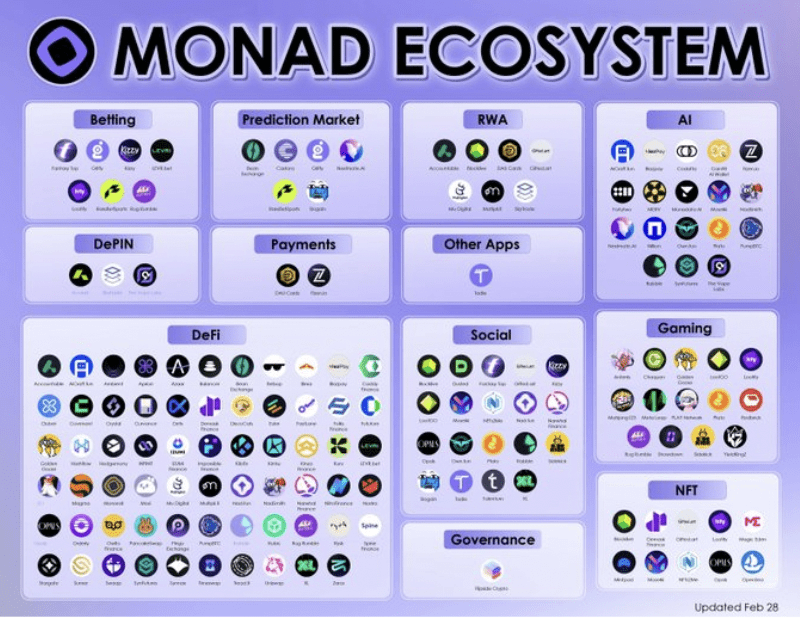
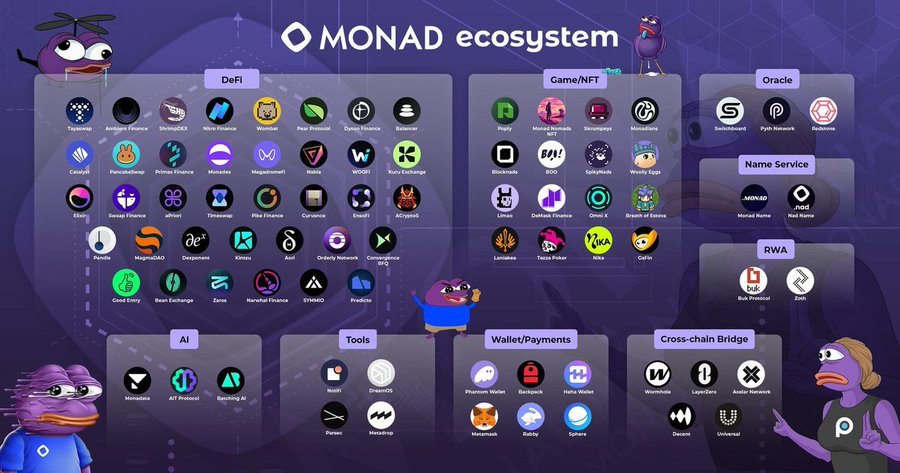
The developer toolkit is further supported by major infrastructure providers. Infura now offers dedicated Monad network endpoints, while Ledger has integrated support for secure key management, signaling institutional readiness. This infrastructure layer reduces the operational risk for developers building low-latency trading systems on the platform.

Notable projects are already positioning themselves within this high-performance environment. The following list highlights key ecosystem participants leveraging Monad’s parallel execution capabilities.
Notable Ecosystem Projects
-
Monad Labs
The core team building the parallel EVM infrastructure and consensus layer. -
Infura
Providing reliable RPC endpoints for developers to connect to the Monad network. -
Ledger
Integrating hardware wallet support to secure user assets on the new chain.
Risks and centralization concerns
Monad’s architecture prioritizes raw throughput, but this efficiency introduces specific trade-offs for network health and decentralization. The primary concern lies in validator concentration. As the network grows, the computational requirements for running a Monad node may favor large-scale operators, potentially reducing the diversity of the validator set. A less distributed validator base increases the risk of coordinated attacks or single points of failure, which undermines the trustless nature of DeFi protocols.
Network stability during peak loads presents another technical hurdle. While MonadBFT consensus is designed to prevent validator gaming, low-latency trading scenarios can still create contention. If the parallel execution engine cannot resolve conflicts quickly enough, latency spikes may occur, leading to failed transactions or front-running vulnerabilities. Developers must account for these potential bottlenecks when designing low-latency systems.
Investors and builders should monitor on-chain metrics closely. A healthy Monad ecosystem requires a balance between performance and accessibility. If running a node becomes prohibitively expensive, the network risks centralizing around a few major providers. This dynamic could shift power away from the community, making the protocol more susceptible to regulatory pressure or internal governance disputes.
No comments yet. Be the first to share your thoughts!