

Imagine a blockchain that blasts through 10,000 transactions per second while running every Ethereum smart contract verbatim. That's Monad in action, fresh off its mainnet launch on November 24,2025. This Layer 1 powerhouse doesn't just promise Monad 10000 TPS; it delivers, all with byte-for-byte EVM compatibility. Developers can port dApps seamlessly, users get sub-second confirmations, and DeFi protocols scale without compromise. Monad's secret sauce? A radical rethink of EVM execution through parallelism.

Traditional EVM chains like Ethereum process transactions sequentially, creating massive bottlenecks as activity ramps up. Monad flips the script with Monad parallel EVM execution. It scans incoming transactions, spots independencies - those not touching the same state - and fires them off in parallel across threads. Suddenly, what took minutes on Ethereum wraps in milliseconds. I've seen high-frequency trading systems choke under load; Monad's approach feels like upgrading from a bicycle to a hypercar.
Cracking the Code on Dependency Detection
At the heart of EVM parallel execution lies sophisticated dependency analysis. Monad's runtime examines read-write patterns before execution. If Transaction A reads from state slot X but doesn't write to it, and B writes elsewhere, they run side-by-side. Conflicts? They're serialized safely. This isn't guesswork; it's precise, deterministic scheduling that preserves Ethereum's sequential semantics. The result: throughput explodes without sacrificing security or correctness.
Monad identifies independent transactions that do not share dependencies and processes them concurrently, significantly increasing throughput.
Parallelism alone isn't enough, though. Monad layers in optimizations that make it a beast for real-world workloads. Check out this deeper dive for the full mechanics: How Monad's Parallel EVM Execution Delivers 10,000 TPS Without Sacrificing Ethereum Compatibility.
Deferred Execution: Untangling Consensus from Compute
Here's where Monad gets clever with its deferred execution model. Most blockchains execute transactions during consensus, tying block proposers to heavy computation. Slow executor? The whole network stalls. Monad decouples them: validators first agree on transaction ordering via MonadBFT consensus, then execute post-consensus. This slashes latency, boosts hardware efficiency, and lets any node keep up. In my trading days, latency was king; Monad's 400ms block times and 800ms finality would have been game-changers.
This model shines in high-contention scenarios. Picture a DeFi flash loan frenzy - transactions order deterministically first, execute in parallel second. No reorgs, no surprises. Developers love it because tools like Foundry and Hardhat work unchanged. For a technical breakdown, see Monad EVM Parallelization: How Developers Can Achieve Ultra-High Throughput on Ethereum-Compatible Chains.
MonadDB: The Storage Engine Supercharging Parallelism
No parallelism story is complete without killer storage. Enter MonadDB, a custom key-value store tuned for async I/O. Ethereum's Merkle Patricia Tries are sequential nightmares; MonadDB enables parallel reads and writes, nuking disk bottlenecks. It batches state updates, pipelines commitments, and uses multi-version concurrency control to let readers fly past writers.
| Metric | Monad | Ethereum (Avg) |
|---|---|---|
| Throughput | and gt;10,000 TPS | 15-30 TPS |
| Block Time | 400 ms | 12 seconds |
| Finality | 800 ms | and gt;12 minutes |
Performance Comparison: Monad vs Ethereum
| Metric | Ethereum (L1) | Monad |
|---|---|---|
| Transactions Per Second (TPS) | 15-30 | 10,000+ ⚡ |
| Block Time | 12 seconds | 400 ms ⚡ |
| Time to Finality | 12-15 minutes | 800 ms ⚡ |
These benchmarks come from real Ethereum mainnet traces, not synthetic fluff. Monad processes historical blocks at 10x speed, proving it's ready for prime time. With 240 and projects already on testnet, the ecosystem is buzzing. Parallel execution isn't a feature; it's the foundation for next-gen dApps in gaming, socialFi, and beyond.
DeFi builders, take note: this storage overhaul means your lending protocols or DEXes can handle Black Swan-level volume without crumbling. I've optimized algos for HFT desks where microseconds mattered; MonadDB turns blockchain I/O from a drag into a turbo boost.
MonadBFT Consensus: Parallelism's Reliable Backbone
Underpinning it all is MonadBFT consensus, a pipelined engine that cranks out 400ms blocks without the drama of cascading failures. Drawing from HotStuff's lineage, it separates state proposals from voting, letting execution hum independently. Validators stream transactions, propose order, and vote in lockstep - all before heavy lifting. The payoff? Single-slot finality in under a second, even under spam attacks. Traditional BFTs buckle at scale; MonadBFT scales linearly, fueling that Monad 10000 TPS reality.
Ethereum Technical Analysis Chart
Analysis by Samantha Greer | Symbol: BINANCE:ETHUSDT | Interval: 1h | Drawings: 6
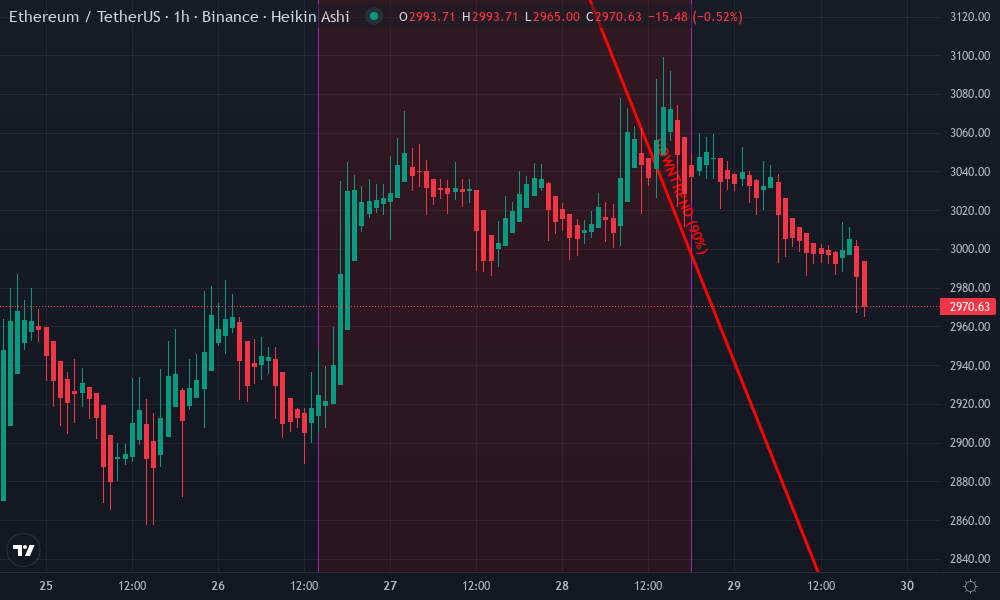
Technical Analysis Summary
Aggressively mark this ETHUSDT dump with a thick red downtrend line from the peak at 2025-11-26T14:00:00Z (price ~3480) connecting to the recent low at 2025-11-30T16:00:00Z (~2570) – extend it forward for the next leg down potential. Layer on horizontal resistance at 3400 and 2800 with dashed lines, solid support at 2550. Rectangle the consolidation zone mid-week around 2800-3000 from 2025-11-27 to 28. Fib retracement from high to low, targeting 38.2% bounce at ~2850. Arrow down on MACD bearish cross, callout exploding volume on breakdown. Long entry arrow at 2570 with high-risk stop below 2550 and PT at 3000 – let's ride the volatility!
Risk Assessment: high
Analysis: Volatile post-news dump, high reward potential on bounce but whipsaw risk from alts rotation
Samantha Greer's Recommendation: Aggressive long now – high tolerance play for 20% swing to 3000, trail stops tight!
Key Support & Resistance Levels
📈 Support Levels:
- $2,550 - Psych + volume cluster low, strong hold strong
- $2,600 - Recent swing low, moderate test moderate
📉 Resistance Levels:
- $2,800 - Breakdown origin, heavy seller zone strong
- $3,400 - Pre-dump high, major overhead strong
Trading Zones (high risk tolerance)
🎯 Entry Zones:
- $2,570 - Aggressive long on oversold dump near support, Monad tailwind high risk
- $2,720 - Pullback entry on bounce confirmation medium risk
🚪 Exit Zones:
- $3,000 - Fib 50% retrace + resistance test 💰 profit target
- $3,000 - Next resistance flip 💰 profit target
- $2,520 - Below key support invalidation 🛡️ stop loss
Technical Indicators Analysis
📊 Volume Analysis:
Pattern: climax selling
Exploding volume on downside candles confirms distribution, no accumulation yet
📈 MACD Analysis:
Signal: bearish crossover
MACD line sliced below signal with histogram flip red – momentum kill
Applied TradingView Drawing Utilities
This chart analysis utilizes the following professional drawing tools:
Disclaimer: This technical analysis by Samantha Greer is for educational purposes only and should not be considered as financial advice. Trading involves risk, and you should always do your own research before making investment decisions. Past performance does not guarantee future results. The analysis reflects the author's personal methodology and risk tolerance (high).
Real-world stress tests on mainnet replay Ethereum's busiest days, clocking over 10,000 TPS consistently. No fairy dust - just smart engineering that respects EVM's quirks like reentrancy and gas metering.
Developer Paradise: Port, Deploy, Scale
For Ethereum devs, Monad feels like home with steroids. Full bytecode compatibility means your Solidity contracts deploy as-is. No forks, no rewrites. Tools like Remix, VS Code plugins, and Etherscan forks work day one. RPC endpoints mimic Ethereum's JSON-RPC spec, so bots and indexers plug right in. I've ported trading bots across chains; Monad's the smoothest yet - deploy a Uniswap clone, flood it with swaps, watch it thrive at scale.
Monad vs Competitors: Performance Comparison
| Blockchain | TPS | EVM Compatibility % | Block Time | Finality |
|---|---|---|---|---|
| Monad | 10,000+ | 100% | 400 ms | 800 ms |
| Solana | 65,000 | 0% | 400 ms | ~1 s |
| Sui | 120,000 | 0% | 400 ms | <1 s |
| Aptos | 30,000 | 0% | 500 ms | ~1 s |
Migration is dead simple: compile, deploy via standard wallets like MetaMask. Over 240 projects hit testnet pre-launch, from DeFi heavyweights to on-chain games craving low latency. Gaming guilds running 1,000-player raids? Monad laughs at lag spikes.
Security stays ironclad. Parallel execution uses optimistic scheduling with conflict resolution, rolling back only on reads-after-writes clashes. MonadBFT's threshold signatures and stake-slashing keep bad actors in check. Audits from top firms validate the stack; mainnet's humming since November 24,2025, with zero exploits.
The ecosystem's exploding. RPC providers like those benchmarked for Monad high performance blockchain needs are racing to support archive nodes and sub-50ms latencies. Wallets from Backpack to Fireblocks integrate natively. DeFi TVL is climbing as protocols chase Ethereum's liquidity with Monad's speed.
Picture socialFi apps tallying millions of micro-interactions per minute or NFT drops without frontrunning hell. That's Monad unlocking use cases Ethereum dreamed of. As a trader who's seen chains crumble under volatility, I bet on Monad reshaping Web3. Its parallel EVM doesn't just hit numbers; it builds the infrastructure for mass adoption. Dive deeper into the architecture here: How Monad's Parallel EVM Achieves 10,000 TPS: Technical Deep Dive for Blockchain Developers.
With mainnet live and momentum building, 2025 marks Monad's era. Grab your dev tools, spin up a node, and join the throughput revolution.




No comments yet. Be the first to share your thoughts!